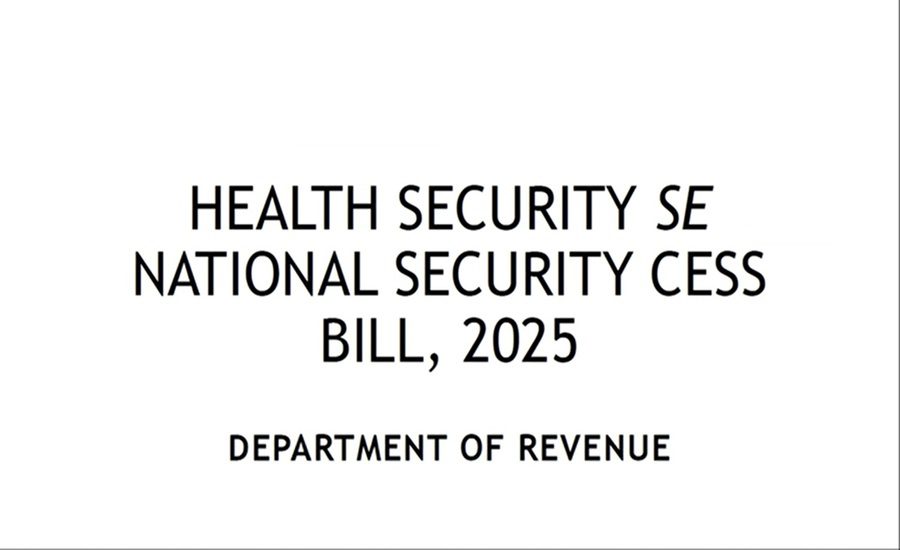
New Delhi: On 5 December 2025, the government of India introduced the Health Security se National Security Cess Bill 2025 — a new legislative measure designed to secure a dedicated stream of revenue for public health initiatives and national security.
The Bill proposes to impose a special excise-style “cess” on the machinery or the processes used to manufacture certain goods — initially targeting pan masala — with proceeds channelled into the Consolidated Fund of India.
By levying this cess, the government aims to ensure stable, predictable funding for critical national priorities, while imposing additional cost on goods associated with health risks.
Background of Health Security SE National Security Cess Bill 2025
Since the rollout of the Goods and Services Tax (GST) in 2017, many “sin goods” — including tobacco products, pan masala, gutkha, etc. — were subject not only to GST but also to a “compensation cess.” This was introduced to compensate states for revenue losses due to the GST transition.
However, with the government nearing full repayment of COVID-era borrowing used for compensating states, the compensation cess regime is set to lapse.
Read also: Public Health for Sale? Ex-IAS P.V. Ramesh Questions Andhra Govt’s PPP Model for Medical Colleges
To avoid a sharp drop in revenues from such goods — and to continue the deterrent pricing on items harmful to public health — the government has proposed two new bills: Central Excise (Amendment) Bill 2025 (to reimpose excise duties on tobacco and related products) and the Health Security se National Security Cess Bill (to levy cess on pan masala manufacturing).
Goals of Health Security SE National Security Cess Bill 2025 : Funding Public Health & National Security
According to the statement of objects and reasons accompanying the Bill, the cess is meant to create a “capacity-based” revenue stream to fund key government expenditures on public health programmes and national security — hence the dual name.
Rather than being a temporary tax or a stop-gap, the Bill is framed as part of a broader, structural shift toward a stable, rule-based revenue mechanism, ensuring products associated with health or social harm bear a fair share of the burden.
Key Provisions of the Health Security SE National Security Cess Bill 2025
The Bill spells out a detailed statutory framework covering levy, calculation, compliance, and enforcement. Some of the important provisions are as follows:
Goods Covered Initially: pan masala. The government may notify other goods later.
Who Must Pay : Any person who owns, operates or controls machines or processes that manufacture the specified goods — regardless of tax status.
Nature of Levy: A “capacity-based monthly levy”, based on the installed machinery’s rated capacity or manual process output. Levy is on the production capacity or process, not on actual sales.
Calculation Basis: For machine-based processes: based on maximum rated speed (e.g. pouches/tins per minute) and weight per pack; for manual processes: a flat monthly rate.
Monthly Cess Amounts: For machine-based process (for an item up to 500 pouches/tins per minute, up to 2.5 g): ₹101 lakh/month. For manual processes: ₹11 lakh/month flat (as prescribed).
Abatement during Non-operation: If the machine/unit remains inoperative for 15 or more continuous days — eligible for abatement.
Use of Proceeds: Funds to be credited to the Consolidated Fund of India; earmarked for public health and national security expenditure.
Compliance Requirements: Mandatory registration of machines/processes, self-declaration of machine/process parameters, monthly return filing & payment by 7th of every month.
Verification & Oversight: Authorities authorized to inspect, audit, verify — including calibration of declared parameters.
Enforcement & Penalties: Offences such as non-declaration, evasion, falsification, obstruction attract graded penalties: fines, confiscation, seizure, arrest.
Appeals Mechanism: Multi-tier: Appellate Authority → Tribunal → High Court → Supreme Court.
Government Powers: Government may — in public interest — double the cess rate, exempt taxable persons, or notify additional goods under Schedule I.
Thus, the Bill establishes not just a tax levy, but a full regulatory regime to ensure compliance, transparency, and accountability.
Key Implications of National Security Cess Bill 2025
- Manufacturers of pan masala — whether large, machine-based units or small-scale/manual producers — will now be liable to register, declare capacity, and pay fixed monthly cess, regardless of actual production volume or sales.
- The shift from a sales-based “consumption cess” to a capacity-based “production cess” changes the tax burden calculus — even if production is low, fixed costs remain due. This may particularly impact small or seasonal producers.
- Non-compliance — or failure to declare machinery/process — could invite strict penalties, including seizure of equipment, legal action, and even arrest.
- The cess offers a predictable, stable revenue stream, potentially unaffected by fluctuations in sales or demand, ensuring steady funding for national security and health-related expenditures.
- By retaining high taxation on “sin goods,” the policy also aims to deter consumption of health-risky products — aligning fiscal policy with public health objectives.
- The capacity-based model reduces the risk of under-reporting or evasion — a common problem when tax is levied on sales or output.
- Higher cost and heavier regulation may discourage production and, in turn, consumption of pan masala — a product associated with health risks such as oral cancer and other diseases.
- The proceeds dedicated to health could strengthen the government’s ability to fund public-health programmes, awareness campaigns, medical treatment, preventive care, especially in areas impacted by tobacco and related products.
- Over time, the structured framework could help India gradually reduce demand for harmful “sin goods,” improving long-term public health outcomes.
- While the cess is levied on producers, higher production cost is likely to be passed on to consumers, making pan masala — and potentially other notified goods — more expensive.
- This could deter casual or habitual consumption, especially among price-sensitive buyers.
- For essential goods, the government has clarified that the cess will not apply — alleviating fears that daily necessities will become costlier.
Wider Context: Tax Restructuring & ‘Sin Goods’ Strategy
The introduction of this Bill comes alongside the Central Excise (Amendment) Bill, 2025, which proposes fresh excise duties on tobacco and related products. Together, both bills aim to plug the fiscal gap created by the phasing out of the GST compensation cess.
Under the new tax regime, many “sin goods” are expected to face a combined levy: the standard GST (now at the highest applicable slab) plus either excise duty or the new cess.
The government frames this as part of a broader shift toward “structured, rule-based framework” for taxing products that have negative health or social externalities — prioritizing both revenue security and public health.
Potential Criticism & Concerns
Some industry stakeholders and smaller producers may argue that a fixed “capacity-based” cess is unfair — especially for small-scale or seasonal manufacturers whose operations may not run at full capacity all year.
A high fixed monthly cess may act as a barrier to entry or sustainability for artisanal or cottage-industry producers of pan masala or similar goods.
There is a risk that illegal or unregistered production may increase if small players try to evade the cess, potentially complicating enforcement.
Critics may also question whether earmarking cess revenues for national security and health will translate into efficiently executed programmes — especially in the absence of a transparent allocation and audit mechanism.
As consumption shifts, there may be unintended consequences — such as consumers switching to unregulated or cheaper illicit substitutes, undermining public health aims.
Read also: J&K High Court Rules Cross-LoC Trade With PoK as Intra-State Under GST, Reaffirm PoK as Part of J&K