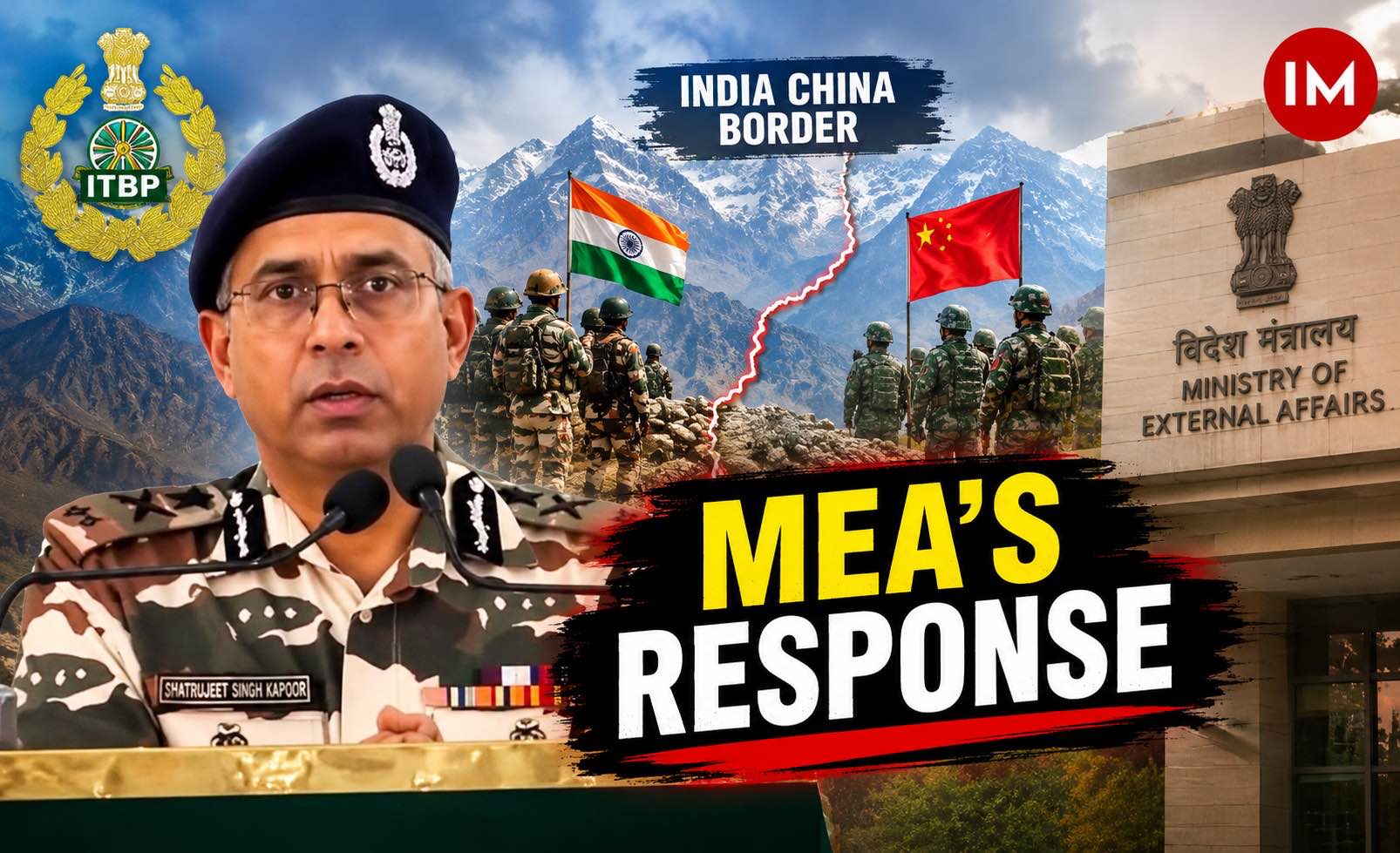
New Delhi: The Ministry of External Affairs (MEA) has responded to remarks by Indo-Tibetan Border Police (ITBP) Director General Shatrujeet Singh Kapoor concerning continuing face-offs between Indian and Chinese personnel along the Line of Actual Control (LAC) in Arunachal Pradesh.
MEA spokesperson Randhir Jaiswal said on Friday that the situation in India-China border areas occasionally deteriorates when Chinese forces deviate from established patrolling protocols. He reiterated that both countries continue to use diplomatic and military mechanisms to address outstanding border issues and prevent misunderstandings.
The clarification followed statements by Mr Kapoor, a 1990-batch Haryana cadre IPS officer, who indicated that Indian and Chinese personnel had encountered each other at several locations in Arunachal Pradesh in recent months and that tensions had not been fully resolved.
His remarks, made during a programme in Rajasthan, have drawn political attention, with the Congress seeking an explanation from the government over the reported border situation.
What Did the MEA Say About Chinese Patrolling Along the LAC?
Responding to questions about the ITBP chief’s observations, MEA spokesperson Randhir Jaiswal, a 1998 batch of the Indian Foreign Service (IFS), said that specific operational details concerning the situation should be sought from the Ministry of Defence.
He nevertheless reiterated India’s position that border conditions can worsen when Chinese forces depart from established patrolling arrangements.
“As we have mentioned previously, the situation in the India-China border areas occasionally deteriorates when Chinese forces deviate from established patrolling protocols,” Mr Jaiswal stated.
The spokesperson stressed that India and China remain engaged through existing diplomatic and military channels to resolve differences along the LAC.
He explained that these mechanisms are intended to address outstanding issues while reducing the possibility of misunderstandings or miscalculations between troops operating in sensitive border areas.
The two countries have also agreed to discuss ways of improving their understanding of the LAC in relevant areas to strengthen border management.
Mr Jaiswal emphasised that maintaining peace and stability in border regions is essential for the overall development of bilateral relations.
The MEA’s response underscores India’s position that border stability remains closely linked to progress in its wider relationship with China.
Read also: India China Border Tensions: ITBP Deploys Shaurya Commandos Along LAC
ITBP Chief Flags Continuing Face-Offs in Arunachal Pradesh
The controversy began after ITBP Director General Shatrujeet Singh Kapoor spoke about the situation along the India-China border during the Himveer Samman ceremony at the ITBP Central Training College in Alwar, Rajasthan, on Thursday.
Mr Kapoor said that Indian and Chinese personnel had come face-to-face at several locations in Arunachal Pradesh during recent months.
According to his remarks, some of these confrontational situations were continuing despite efforts by the two countries to address border-related issues through dialogue.
The comments drew attention because they represented an unusually direct public acknowledgement by a senior border-guarding official of continuing face-offs in the eastern sector of the LAC.
The reported areas of concern include Asaphila and Maja in Arunachal Pradesh’s Upper Subansiri district, where tensions have reportedly persisted since late July.
These accounts have not been accompanied by a detailed public operational assessment from the Ministry of Defence. The precise nature, duration and current status of individual incidents therefore remain matters requiring official clarification.
Mr Kapoor’s comments came just days before his scheduled retirement on October 31, 2026.
Three Rounds of Talks, but Border Concerns Remain
The ITBP chief also referred to discussions between India and China at different diplomatic and military levels since July.
According to the account of his remarks, three rounds of high-level engagement involving established mechanisms, including the Working Mechanism for Consultation and Coordination on India-China Border Affairs (WMCC), Special Representatives and military commanders, had taken place.
Despite these engagements, he indicated that concerns remained in certain locations.
The MEA, meanwhile, maintained that the existing dialogue mechanisms continue to play an important role in managing differences and preventing escalation.
These exchanges reflect the complexity of border management between two countries that have not reached a mutually agreed final demarcation of the LAC.
The Congress party reacted to the ITBP chief’s statements by demanding greater clarity from the government about the reported face-offs and the situation in Arunachal Pradesh.
ITBP Plans ₹1,000 Crore Investment in Drones and Anti-Drone Systems
Alongside his observations on the border situation, Mr Kapoor outlined an extensive modernisation programme aimed at strengthening the ITBP’s operational preparedness along the India-China frontier.
According to the ITBP chief, approximately ₹4,000 crore has been approved for the force’s modernisation, with around ₹1,000 crore earmarked for drones and anti-drone systems.
The investment is intended to improve surveillance, intelligence gathering and the ability to respond to emerging security threats in difficult mountainous terrain.
He also said that 70 per cent of the funding under an existing ₹400 crore project had been allocated towards strengthening drone-related capabilities.
The emphasis on unmanned aerial systems reflects the growing importance of technology in border surveillance and modern military operations.
Mr Kapoor linked the need for improved preparedness to lessons from earlier India-China confrontations, including the deadly Galwan Valley clash of June 2020.
Drone Platoons Established in All ITBP Border Battalions
The ITBP has also established dedicated drone platoons in its border security battalions to strengthen surveillance and operational support.
Mr Kapoor said the force is training personnel as drone pilots and working towards developing its own drone systems.
Such capabilities are particularly important in high-altitude areas where conventional ground surveillance is restricted by mountainous terrain, adverse weather and limited road connectivity.
Drones can help security personnel monitor remote stretches of the frontier, identify unusual activity and improve situational awareness without requiring continuous physical movement through difficult terrain.
Anti-drone systems are also expected to become increasingly important as unmanned aircraft are used more widely for reconnaissance and other military purposes.

Underground Shelters Planned Along the LAC
Another major initiative highlighted by the ITBP chief involves the construction of underground facilities at border outposts.
Mr Kapoor said that modern warfare has increased the vulnerability of personnel and infrastructure located above ground, particularly because of advances in aerial surveillance and precision-strike capabilities.
To address these risks, the ITBP has initiated a pilot project for underground shelters at selected border locations.
The plan is to assess the effectiveness of these facilities before considering their development into permanent security infrastructure.
Underground structures could offer additional protection to personnel and improve the resilience of border outposts during emergencies or hostile situations.
The initiative forms part of a broader effort to adapt the force’s infrastructure and operational methods to changing security requirements.
ITBP Introduces ‘Strike’ Training and Plans ‘Shaurya’ Commando Teams
Mr Kapoor also spoke about changes being introduced in the training of ITBP personnel.
The force has developed a specialised programme called ‘Strike’, designed to equip personnel with modern combat skills and updated operational strategies.
The training is intended to prepare personnel for difficult confrontational situations, including those that could arise along disputed stretches of the LAC.
According to the ITBP chief, the objective is to extend this training across the force by the end of 2027.
The ITBP also plans to establish a dedicated ‘Shaurya’ commando team in every battalion.
These teams are expected to strengthen specialised response capabilities and improve readiness for challenging security situations.
The initiatives reflect the force’s emphasis on combining traditional border-guarding responsibilities with modern surveillance technology, specialised training and stronger protective infrastructure.
What Is the Line of Actual Control Between India and China?
The Line of Actual Control is the line separating areas under Indian and Chinese control in the disputed border regions.
India considers the LAC to be approximately 3,488 kilometres long, although China does not accept this figure. The two countries also differ over the alignment of the boundary in several areas.
The LAC is generally divided into three sectors.
The western sector covers Ladakh, the middle sector extends across Himachal Pradesh and Uttarakhand, while the eastern sector includes Sikkim and Arunachal Pradesh.
The Arunachal Pradesh stretch is commonly described as approximately 1,126 kilometres long.
Because the LAC has not been mutually delineated along its entire length, Indian and Chinese forces sometimes operate according to different perceptions of its alignment.
This can lead to face-offs when patrols from both countries encounter each other in disputed areas.
The lack of a mutually agreed alignment remains one of the central challenges in managing the India-China boundary.
Why the 2020 Galwan Clash Remains Important
Border security arrangements between India and China have remained under close scrutiny since the June 2020 Galwan Valley clash in eastern Ladakh.
The confrontation resulted in the deaths of 20 Indian soldiers and marked one of the most serious episodes of violence along the India-China border in decades.
It led to heightened military deployments, prolonged negotiations and renewed emphasis on border infrastructure and surveillance.
Although India and China subsequently reached disengagement arrangements in several friction areas, the broader boundary dispute remains unresolved.
The latest remarks by the ITBP chief have therefore renewed attention on the eastern sector, particularly Arunachal Pradesh.
The MEA’s response indicates that India continues to regard established patrolling practices, military communication and diplomatic engagement as essential safeguards against further escalation.
Who Is IPS Shatrujeet Singh Kapoor?
Mr Kapoor is a 1990-batch Indian Police Service officer of the Haryana cadre who serves as Director General of the Indo-Tibetan Border Police.
He previously served in senior policing positions in Haryana, including as Director General of Police of the state.
As ITBP chief, Mr Kapoor oversees a central armed police force responsible for guarding the India-China border across difficult high-altitude terrain.
His responsibilities include operational preparedness, personnel management, surveillance capabilities, border infrastructure and coordination with other security agencies.
His latest remarks have drawn particular attention because they were made shortly before his scheduled retirement on October 31, 2026.
Why the MEA’s Response Matters
The latest exchange highlights two important aspects of India’s approach to the China border.
The first is the government’s continued emphasis on diplomatic and military dialogue to manage disagreements along the LAC and prevent localised incidents from developing into larger confrontations.
The second is the growing importance of technology and infrastructure in maintaining security along the frontier.
The ITBP’s plans for drone systems, underground shelters, specialised combat training and battalion-level commando teams indicate an effort to improve preparedness for changing operational challenges.
At the diplomatic level, the MEA has reiterated that peace and stability along the border remain essential for the development of India-China relations.
The precise status of the reported Arunachal Pradesh face-offs, however, awaits further clarification from the Ministry of Defence.

About ITBP
The Indo-Tibetan Border Police (ITBP) is one of India’s elite Central Armed Police Forces, functioning under the administrative control of the Ministry of Home Affairs. Raised on 24 October 1962 in the wake of the Sino-Indian War, this specialized mountain force is primarily tasked with safeguarding the 3,488-kilometer-long India-China border. Affectionately known as the “Himveers,” its personnel operate under extreme conditions, patrolling high-altitude Border Out Posts ranging from 9,000 to 18,800 feet where winter temperatures can plummet to minus 45 degrees Celsius.
Guided by the motto “Shaurya-Dridhata-Karma Nishtha” (Valour – Determination – Devotion to Duty), the ITBP specializes in mountaineering, skiing, and high-altitude warfare. Beyond border surveillance, the force plays a crucial role in internal security operations, counter-insurgency, UN peacekeeping missions, and acts as the vital ‘First Responder’ for natural disasters in the fragile Himalayan region
Read also: After Years Of Tensions, Can This New India-China Military Mechanism Reduce Border Friction?