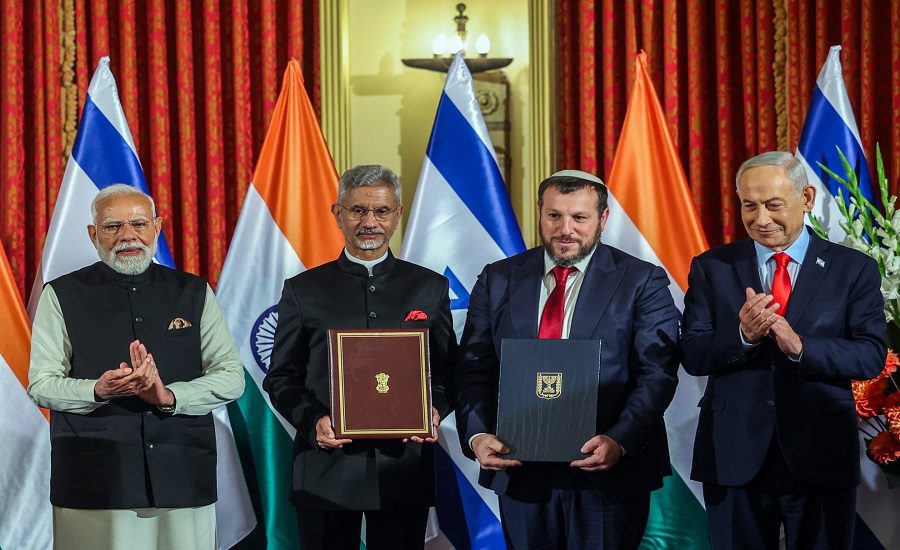
New Delhi: India and Israel on Thursday formally elevated their bilateral relations to a Special Strategic Partnership during the two-day state visit of Prime Minister Narendra Modi to Israel. The leaders signed 16 memoranda of understanding (MoUs) covering a broad range of sectors, signaling a deepening of strategic, technological, and economic cooperation between the two countries.
The agreements were exchanged in the presence of PM Narendra Modi and Israeli Prime Minister Benjamin Netanyahu, underscoring the importance of collaboration in areas such as artificial intelligence, agriculture, cybersecurity, fintech, education, fisheries, labour mobility, and cultural exchanges.
Key Agreements in Technology and Finance
Among the major MoUs was a partnership between NPCI International (NIPL) and Israel’s MASAV, enabling cross-border remittances using India’s Unified Payments Interface (UPI).
Another significant initiative was the establishment of the India-Israel Innovation Centre for Agriculture (IINCA) under the Indian Council of Agricultural Research (ICAR) and Israel’s MASHAV. The centre will focus on precision farming, satellite-based irrigation, advanced machinery, integrated pest management, germplasm exchange, post-harvest solutions, and capacity building.
In fintech and financial services, agreements were signed between the International Financial Services Centres Authority (IFSCA) and the Israel Securities Authority (ISA), while a separate pact promoted commercial arbitration between the Israeli Institute of Commercial Arbitration (IICA) and the Indian Council of Arbitration (ICA).
Collaboration in Fisheries, Education, and Cybersecurity
The two countries strengthened cooperation in fisheries and aquaculture, promoting technology-driven sustainable systems, including advanced aquaculture, disease management, mariculture, seaweed cultivation, R&D, trade, training, and centres of excellence.
Education and academic collaboration were enhanced through agreements for AI in education, teacher development, and equitable access, as well as academic exchanges between Nalanda University and the Hebrew University of Jerusalem, covering subjects like Buddhist studies, archaeology, mathematics, and international relations.
A letter of intent was also issued to establish an Indo-Israel Cyber Centre of Excellence in India, focusing on cybersecurity best practices, emerging technologies, and digital resilience.
Labour Mobility and Employment Initiatives
Three implementation protocols were signed to facilitate regulated recruitment of Indian workers in Israel across:
- Commerce and services sectors, including retail, cleaning, logistics, warehousing, food processing, hospitality, and recycling
- Manufacturing industries such as textiles, metals, electronics, chemicals, food processing, wood, paper, plastics, and rubber
- Restaurant and food preparation businesses
Additionally, a quota of up to 50,000 Indian workers over the next five years was agreed upon, promoting labour mobility and strengthening bilateral cooperation in workforce development.
Focus on Geophysical Exploration and Mineral Resources
India and Israel also signed a dedicated MoU on geophysical exploration, leveraging AI-driven technologies and modern survey techniques for mineral resource development. The partnership aims to:
- Enhance mineral exploration efficiency and accuracy
- Facilitate knowledge exchange and technical expertise sharing
- Encourage bilateral investment and sustainable resource development
- Promote long-term strategic cooperation in the mining and resources sector
This agreement highlights India’s commitment to securing critical minerals and modernizing its exploration ecosystem through international collaboration.
Cultural and Strategic Cooperation
The two nations announced several additional initiatives, including:
- Elevation of the Joint Committee on Science and Technology to ministerial level
- Establishment of India-Israel Academic Cooperation Forum and Parliamentary Friendship Group
- 20 joint fellowships in agricultural research and increased contributions to joint research calls
- Cultural Exchange Programme 2026-2029 covering music, theatre, dance, visual arts, and festivals
The fourth India-Israel CEO Forum report, presented in November 2025, provided recommendations to align policies with industry trends and enhance public-private collaboration.
Significance of the Visit
The state visit, which included PM Modi’s address to the Knesset on February 25 and a visit to Yad Vashem, was described as highly productive by both leaders. The agreements are expected to boost bilateral trade, promote innovation, strengthen strategic ties, and enhance people-to-people and technological collaboration between India and Israel.