New Delhi/Tokyo: India and Japan have taken a significant step towards expanding their defence partnership, with Japan’s Self-Defense Forces set to use Indian firing ranges for live-fire training for the first time. The agreement opens the possibility of Japanese surface-to-ship missile training at Indian facilities and marks a new phase in military cooperation between the two countries.
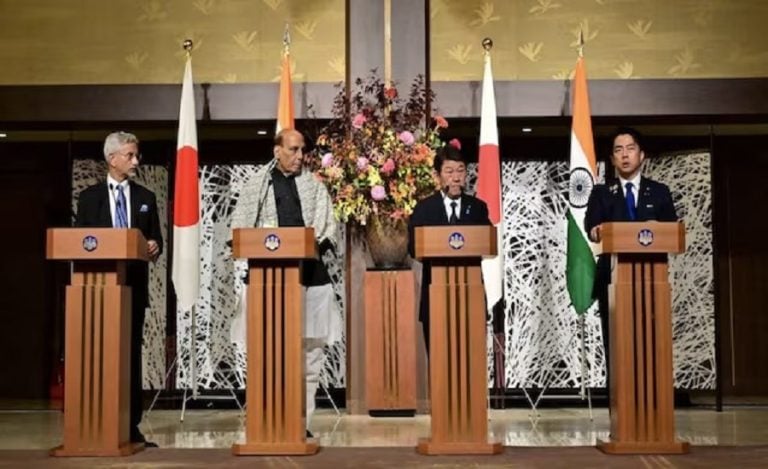
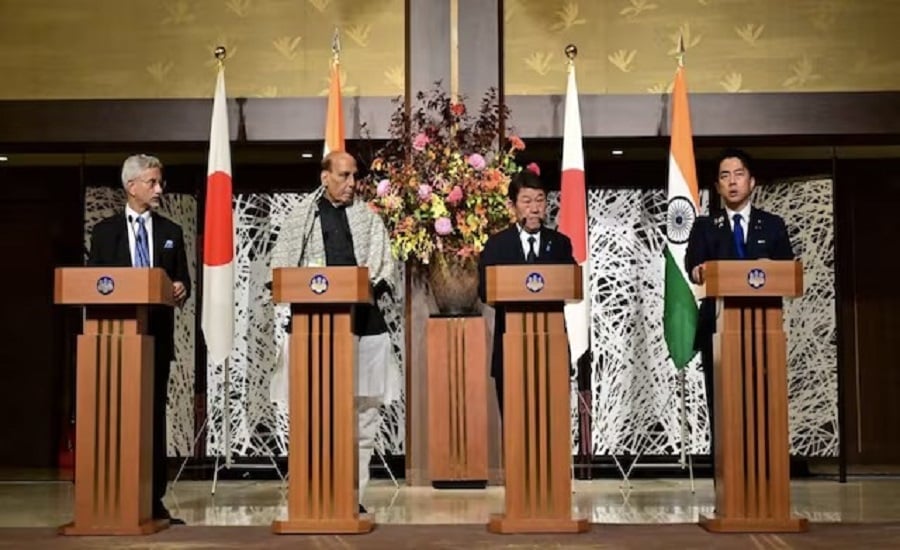
The development was confirmed in the joint statement issued after the fourth India-Japan Foreign and Defence Ministers’ 2+2 Dialogue in Tokyo on November 19, 2026. Defence Minister Rajnath Singh and External Affairs Minister Dr S. Jaishankar represented India, while Japan was represented by Foreign Minister Toshimitsu Motegi and Defence Minister Shinjiro Koizumi.
The ministers welcomed the signing of a Letter of Intent (LOI) for the use of Indian firing ranges by the Japan Self-Defense Forces. The arrangement will enable Japanese forces to conduct live-fire training, including exercises involving surface-to-ship missiles. Both sides agreed to accelerate coordination for its early implementation.
The development is particularly significant because Japan has been exploring the possibility of using Indian facilities to train with its newly deployed Type-25 surface-to-ship guided missile, which has a reported range of approximately 1,000 kilometres, as well as smaller attack drones.
Why Is Japan Interested in Indian Missile Test Ranges?
Japan has been looking for suitable training environments to make full use of the range and capabilities of its newly developed long-range weapons. Its domestic training areas pose limitations when it comes to conducting exercises involving missiles with ranges extending to around 1,000 kilometres.
In October 2026, Japan’s Ground Self-Defense Force Chief of Staff, General Masayoshi Arai, confirmed that Japanese officials had visited India to examine the possibility of using Indian facilities for training with long-range weapons, including the Type-25 missile and smaller attack drones.
The Japanese military was assessing how overseas training environments could help it conduct exercises that fully utilise the missile’s range. The possibility of using Indian firing ranges was also discussed during earlier defence-level interactions.
India’s eastern coastline, facing the Bay of Bengal, has emerged as a potential area of interest because of its extensive maritime space and established missile-testing infrastructure. However, the official November 19 joint statement does not identify a specific Indian range or confirm that the Type-25 missile will be tested in the Bay of Bengal.
Read also: Rajnath Singh Visits Japan Naval Base, Highlights Growing India-Japan Maritime Cooperation
What Is Japan’s Type-25 Missile?
The Type-25 Surface-to-Ship Guided Missile is a long-range weapon developed by Japan as part of its efforts to strengthen its stand-off defence capabilities. It is derived from the earlier Type-12 surface-to-ship missile and has a reported range of around 1,000 kilometres.
Japan’s Ministry of Defense announced the deployment of the upgraded Type-25 missile system in March 2026. Its extended range allows Japanese forces to engage maritime targets from considerable distances, keeping launch platforms farther away from potential threats.
The missile is part of Japan’s broader effort to strengthen its ability to respond to evolving security challenges in the Indo-Pacific. Its long range, however, also creates a requirement for suitable training areas where the weapon can be tested and its operational procedures practised safely.
The proposed use of Indian firing ranges could provide Japan with an additional training environment. The precise weapons, locations and schedule for the exercises will depend on further coordination between the defence authorities of the two countries.
Small Attack Drones Also Part of Japan’s Training Plans
Apart from the Type-25 missile, Japan has also explored the possibility of using Indian facilities for training with smaller attack drones.
Japanese military officials reportedly examined potential training locations in India as part of the broader assessment of overseas ranges. The proposed cooperation could provide opportunities to expand training involving unmanned systems.
The November 19 joint statement also highlighted the importance of deepening bilateral exercises through greater complexity and the integration of unmanned systems. However, it did not announce a specific drone-testing programme or confirm the types of drones that may be used at Indian facilities.
India-Japan Defence Partnership: From Joint Exercises to Technology Cooperation
The agreement on firing ranges is part of a wider effort to deepen military cooperation between India and Japan.
During the 2+2 Dialogue, the ministers reviewed progress in bilateral defence cooperation and stressed the importance of expanding joint exercises involving the armed forces of both countries.
One significant development has been the participation of fighter aircraft from Japan’s Air Self-Defense Force in the India-Japan air exercise ‘Veer Guardian 26’. It marked the first-ever visit of Japanese Air Self-Defense Force fighter aircraft to India for the exercise.
The two countries also agreed to deepen cooperation through more complex bilateral and multilateral exercises, including the integration of unmanned systems and the possibility of conducting exercises at short notice.
‘Design with Japan, Make in India’: Expanding Defence Production
Defence industrial cooperation also featured prominently in the discussions. India and Japan are looking to expand collaboration in defence equipment, technology and manufacturing under the framework of ‘Design with Japan, Make in India’.
The ministers welcomed progress towards the early realisation of arrangements related to the Unified Complex Radio Antenna (UNICORN), a naval communication system, and discussed the next steps for its transfer to India.
They also agreed to strengthen cooperation between their respective navies in areas such as mine countermeasures, naval shipbuilding and design. Japan’s technological expertise and India’s manufacturing capabilities are expected to support these efforts.
The two countries are also working towards enhancing mutual repair and maintenance arrangements at shipyards in India and Japan, which could improve operational support for naval vessels and contribute to maritime security in the region.
Cooperation in Maritime Security and Underwater Technology
Beyond missile and drone training, India and Japan are expanding cooperation in maritime security, information sharing and domain awareness.
The ministers welcomed the Memorandum of Arrangement on Maritime Security Cooperation signed by the two countries in August 2026. They agreed to pursue practical cooperation between the Indian Navy and Japan Maritime Self-Defense Force in maritime and air domain awareness, search and rescue, information sharing, and humanitarian assistance and disaster relief.
The discussions also covered the need to strengthen mine-countermeasure capabilities and explore joint development in naval shipbuilding and design.
Both countries reaffirmed their commitment to maintaining secure sea lanes and a stable maritime order in the Indo-Pacific.
75 Years of India-Japan Diplomatic Relations in 2027
The defence agreements come ahead of the 75th anniversary of the establishment of diplomatic relations between India and Japan in 2027.
The two governments have agreed to mark the milestone through commemorative programmes throughout the year under the theme ‘Japan-India Year of Shared Horizons’.
The November 19 joint statement described the anniversary as an opportunity to strengthen friendship, mutual understanding and people-to-people exchanges.
For India and Japan, the expanding defence partnership reflects their shared interest in a free, open and rules-based Indo-Pacific. The proposed use of Indian firing ranges by Japanese forces, alongside cooperation in maritime security, defence technology and industrial production, adds a new operational dimension to that relationship.