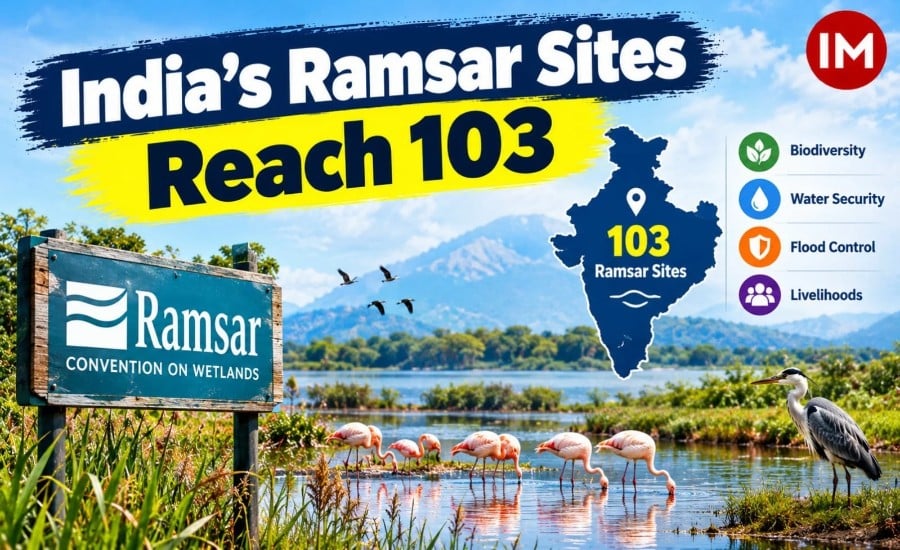
New Delhi: India’s network of internationally recognised wetlands has expanded nearly fourfold since 2014, reaching 103 Ramsar Sites covering more than 13.87 lakh hectares across 28 States and Union Territories.
India ranks first in Asia and third globally in the number of Ramsar Sites. The wetlands include lakes, floodplains, mangroves, estuaries, reservoirs and urban marshes that support biodiversity, recharge groundwater, reduce flood impacts and sustain local livelihoods.
The government’s conservation efforts are supported by the Wetlands (Conservation and Management) Rules, 2017, and initiatives such as the National Plan for Conservation of Aquatic Ecosystems (NPCA), Amrit Dharohar and Mission Sahbhagita.
India Adds New Wetlands to Its Ramsar Network
India became a party to the Ramsar Convention on February 1, 1982. The convention, adopted in Ramsar, Iran, in 1971, provides an international framework for the conservation and wise use of wetlands.
According to reports, the country’s Ramsar network has grown from 26 sites in 2014 to 103 in October 2026.
Key developments include:
- 2025: Eleven wetlands were added, taking the total to 96.
- June 2026: Surha Tal in Uttar Pradesh became India’s 100th Ramsar Site.
- August 2026: Glaw Lake in Arunachal Pradesh became the 101st site.
- October 2026: Sukhna Wetland in Chandigarh and Sauj Jheel in Uttar Pradesh were added, taking the total to 103.
Tamil Nadu has the highest number of Ramsar Sites, with 20, followed by Uttar Pradesh with 14.
What Makes a Wetland Eligible for Ramsar Status?
A Ramsar Site is a wetland designated as being of international importance under the Ramsar Convention. To qualify, a wetland must meet at least one of the convention’s nine criteria relating to wetland types, biodiversity and ecological significance.
These criteria include:
- Supporting threatened species or threatened ecological communities.
- Sustaining important populations of plants and animals.
- Providing breeding grounds, nurseries or migration routes for fish.
- Regularly supporting at least 20,000 waterbirds.
- Supporting at least 1% of the population of a particular waterbird or wetland-dependent non-avian animal species.
In India, the process begins with the State Government or Union Territory Administration identifying a suitable wetland. The Ministry of Environment, Forest and Climate Change then coordinates the proposal and forwards it to the Ramsar Secretariat.
Two Latest Additions Highlight Wetland Diversity
The latest additions illustrate the range of ecosystems protected under the Ramsar framework.
Sukhna Wetland, Chandigarh: Created in 1958 at the foothills of the Shivalik hills, this human-made reservoir supports resident and migratory birds. There are species such as Pallas’s fish eagle, the common pochard and the black pond turtle among its conservation interests.
Sauj Jheel, Uttar Pradesh: Located in Mainpuri district, this shallow floodplain lake regularly hosts more than 30,000 waterbirds. It provides feeding and nesting habitat for species including the sarus crane and greater spotted eagle.
How Ramsar Sites Support Biodiversity and Livelihoods
Wetlands provide ecological services that extend beyond wildlife conservation. They store freshwater, recharge groundwater, absorb excess water during floods and support fisheries, agriculture and other livelihoods.
The highlighted examples:
- Chilika Lake, Odisha: Supports 118 fish species and serves as a breeding, wintering and staging ground for waterbirds. It was removed from the Montreux Record in 2002 following ecological restoration.
- East Kolkata Wetlands, West Bengal: Its wastewater-fed fisheries and agricultural systems support livelihoods and produce approximately 10,500 tonnes of fish annually, according to the backgrounder.
- Sundarban Wetland, West Bengal: Covering 4.23 lakh hectares, it is India’s largest Ramsar Site. Its mangroves help protect coastal areas against storms, tidal surges and saltwater intrusion.
- Beas Conservation Reserve, Punjab: Supports the endangered Indus River dolphin, along with a diverse range of birds and fish. A gharial reintroduction programme was launched in 2017.
- Khichan Wetland, Rajasthan: Community conservation efforts help protect wintering demoiselle cranes from threats such as power-line collisions and stray dogs.
These examples illustrate how wetland conservation can support ecological resilience while benefiting communities that depend on these ecosystems.
Government Initiatives Strengthen Wetland Conservation
India’s wetland conservation framework combines regulation, scientific management and community participation.
Major initiatives include:
Wetlands (Conservation and Management) Rules, 2017
Notified under the Environment (Protection) Act, 1986, these rules provide the regulatory framework for wetland conservation. They establish State and UT Wetlands Authorities and restrict activities such as encroachment, waste dumping and the discharge of untreated effluents.
National Plan for Conservation of Aquatic Ecosystems (NPCA)
The NPCA integrates conservation efforts for lakes and wetlands. Updated guidelines issued in 2024 provide States with a scientific framework for wetland management.
Amrit Dharohar
The initiative focuses on the conservation of species and habitats, nature tourism, wetland-based livelihoods and carbon assessment. According to reports, studies to inventory flora and fauna have been conducted across 75 Ramsar Sites by the Botanical Survey of India and Zoological Survey of India.
Mission Sahbhagita and Save Wetlands Campaign
These initiatives promote public participation in wetland conservation. The campaign, launched in Goa on February 4, 2023, has involved more than two million citizen volunteers in mapping over 1.7 lakh wetlands.
Mangrove Initiative for Shoreline Habitats and Tangible Incomes (MISHTI)
MISHTI targets mangrove restoration across 540 square kilometres in nine States and four Union Territories. Reports suggest that ₹88.44 crore has been released for restoring 9,949.5 hectares of degraded mangroves.
Indore and Udaipur Receive Wetland City Recognition
India’s conservation efforts also extend to urban wetlands. Indore and Udaipur became the country’s first Ramsar-accredited Wetland Cities in January 2025.
The accreditation recognises cities that demonstrate efforts to conserve wetlands through urban planning, management and public participation.
Conservation Must Continue Beyond Designation
Ramsar designation provides international recognition and access to scientific guidance, but it also requires continued efforts to protect a wetland’s ecological character.
The designated sites must be monitored regularly, while their Ramsar Information Sheets are to be updated every six years. Effective management plans, coordination between governments and community participation remain important to long-term conservation.
With 103 Ramsar Sites, India’s expanding network provides a framework for protecting biodiversity, strengthening water security and supporting livelihoods. The long-term benefits will depend on maintaining the ecological health of these wetlands alongside development needs.
Read Also: 300+ Painted Storks Begin Nesting at Delhi Zoo, Highlighting Its Wetland’s Ecological Value