11 November 2026
ADVERTISEMENT
ADVERTISEMENT

IAF Engages 100 Drone Industry Representatives to Advance Indigenous Unmanned Systems

The Indian Air Force has outlined its long-term requirements for unmanned and autonomous systems, highlighting indigenous propulsion, autonomous software and resilient navigation as key priorities for strengthening India's defence capabilities
Indian Masterminds Stories

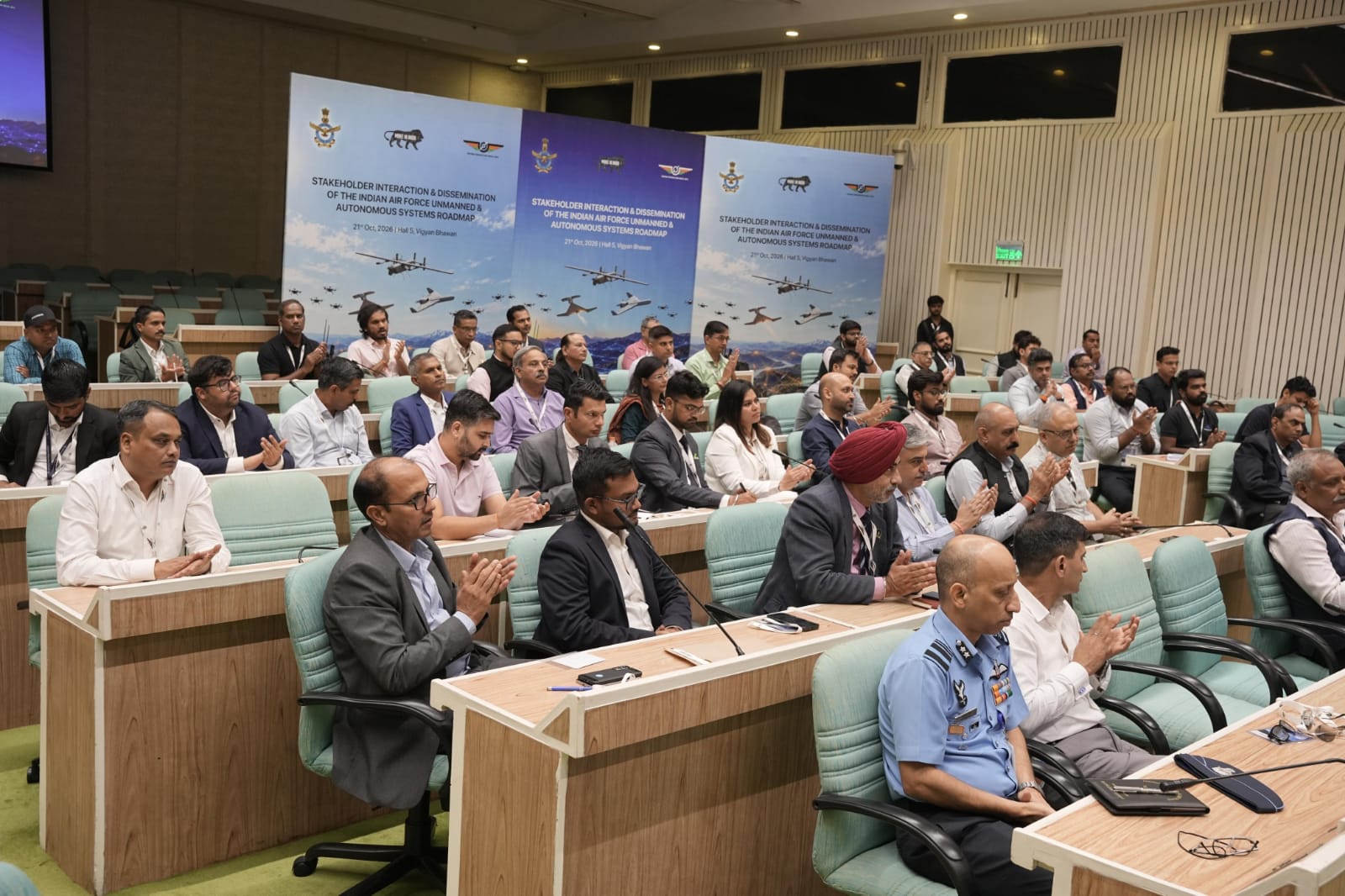
New Delhi: The Indian Air Force (IAF) has engaged around 100 representatives from drone companies, startups, Micro, Small and Medium Enterprises (MSMEs) and other industry partners to discuss its long-term requirements for unmanned and autonomous systems, with a focus on developing indigenous defence technologies.

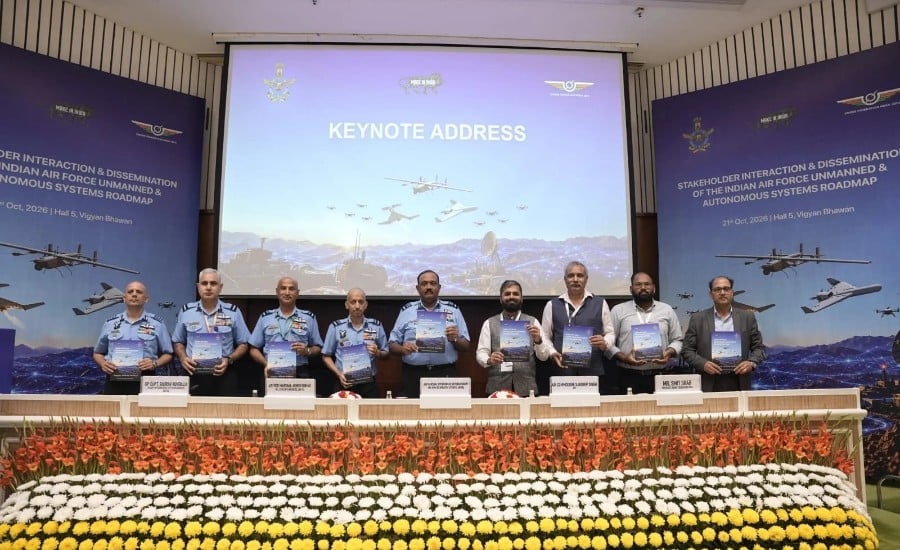
The Industry Outreach Programme was held at Vigyan Bhawan, New Delhi, on October 21, 2026. It was chaired by Air Marshal Premkumar K, VM, VSM, Director General (Weapon Systems), Air Headquarters.

The programme provided a platform for the IAF to communicate its operational requirements and technological priorities to industry stakeholders, building on the IAF Unmanned and Autonomous Systems Roadmap released during IAF Dronathon 2026 at Pokhran on September 14, 2026.

IAF Shares Long-Term Unmanned Systems Roadmap

During the programme, the IAF explained its future requirements in unmanned and autonomous systems and distributed copies of its roadmap booklet to participating industry partners.

Read Also: IAF GSAT-7C Satellite Deal: 5 Ways It Could Strengthen the Indian Air Force

The roadmap envisages a layered and networked family of unmanned systems designed to complement existing and future manned platforms.

It emphasises the development of indigenous capabilities that are operationally relevant, reliable and resilient, reflecting the evolving requirements of air power.

The engagement was intended to help industry stakeholders better understand the IAF’s future needs and align technological development with operational requirements.
Indigenous Defence Technology Identified as a Priority

The IAF emphasised that Aatmanirbharta in unmanned systems is an operational necessity rather than merely an aspiration.

Reducing dependence on external sources for critical technologies is a key consideration in strengthening India’s domestic defence ecosystem.

The programme highlighted several technology areas requiring focused attention:

  • Indigenous propulsion: Developing domestic propulsion technologies for unmanned platforms.
  • Autonomous software: Advancing software capabilities that enable unmanned systems to perform tasks with greater autonomy.
  • Resilient navigation: Strengthening navigation capabilities to support reliable operations.
  • Standardised interfaces: Developing common interfaces to improve integration and coordination among different systems.

These areas form part of the broader effort to build reliable, indigenous unmanned capabilities for the Indian Air Force.

Startups, MSMEs and Industry Partners in Focus

Around 100 representatives from drone companies and affiliated industry partners participated in the programme, reflecting engagement between the IAF and India’s unmanned systems industry.

The IAF aims to sustain collaboration with industry, MSMEs, startups and academia to accelerate innovation and support the development of technologies suited to its operational requirements.

The approach seeks to strengthen cooperation between the armed forces and domestic technology developers, helping translate emerging technologies into credible operational capabilities.

Building India’s Domestic Unmanned Systems Ecosystem

The outreach programme forms part of the IAF’s broader engagement with industry to advance the development of unmanned and autonomous systems.

Through sustained interaction with technology developers and academic institutions, the IAF aims to encourage collaborative development and strengthen domestic capabilities in critical defence technologies.

The initiative also supports the wider objective of Aatmanirbharta in defence by encouraging the development of indigenous technologies and reducing reliance on external sources for essential components and capabilities.

Read Also: IAF Day 2026: Indian Air Force Celebrates 94 Years Of Courage, Precision And Excellence



Indian Masterminds Stories
Join our WhatsApp Channel
ADVERTISEMENT
ADVERTISEMENT
Related Stories
ADVERTISEMENT
ADVERTISEMENT
NEWS
government-of-haryana
Haryana Transfers 14 IAS, HCS Officers: PC Meena Gets Human Resources Role, D.K. Behera Named GMDA CEO
Punjab Government
Punjab Transfers 29 IAS Officers: Himanshu Aggarwal Appointed Ludhiana DC, 5 Other Districts Get New Chiefs
PMGSY Bihar rural road connectivity
34 Bihar IAS Officers of 2014 Batch Promoted; Nalanda DM Udita Singh, Patna Municipal Commissioner Yashpal Meena Among Them
Pranjal Patil IAS
Who Is Pranjal Patil? CAT Quashes Transfer of First Visually Impaired Woman IAS Officer to Arunachal Pradesh, Citing Disability Rights Act
cm dhami
Uttarakhand CM Dhami Writes to PM Modi, Highlights Development and Public Welfare Initiatives
Idashisha Nongrang Meghalaya DGP
Who Is Idashisha Nongrang? Meghalaya’s First Woman DGP Nears End of Tenure Amid Succession Delay
Gaurav Yadav IPS
Punjab DGP Flags Online Recruitment of Youth by Pakistan-Based Operatives; Highlights Yuva Sanjh Initiative
Godda Homeopathic Medical College
Godda Homeopathic Medical College to Get ₹2.70 Crore Infrastructure Upgrade; E-Tendering Underway
ADVERTISEMENT
ADVERTISEMENT
Videos
Five years after Kargil, India sent its cricketing heroes to Pakistan where terrorism posed a deadly threat. The man guarding them, former Special Director of Intelligence Bureau, Mr. Yashovardhan Azad, reveals what all went behind the scenes during that crucial tour. 
Trust No One, Said His Instinct in Pakistan
Gajendra Singh Shekhawat
How India Plans to Boost Tourism, Create Jobs and Ease Overcrowding : Gajendra Singh Shekhawat on the Road to 2047
Dr Saket Badola IFS
Beyond Tigers and Safaris: How Corbett Literature Festival Wants to Change the Conservation Conversation
ADVERTISEMENT
UPSC Stories
Aniket Sagar ICoAS
No Coaching, Full-Time Job and Two Attempts: How Aniket Sagar Cleared ICoAS
Aniket Sagar, a chartered accountant from Bundelkhand, cleared UPSC ICoAS 2025 after working at PwC,...
IDAS Himanshu Tembhekar
Should UPSC Aspirants Give Up Their Hobbies? IDAS Officer Himanshu Tembhekar Explains
Should UPSC aspirants give up their hobbies? IDAS officer Himanshu Tembhekar explains how hobbies help...
UPSC Story
He Taught Students to Meet Expenses. Today, Sachin Bhadouria is a Scientist ‘B’ at CWPRS
Sachin Bhadouria overcame financial challenges and a Hindi-medium background to secure AIR 2 in a UPSC...
CSR NEWS
NCL CSR Blood Bank Project
NCL Signs ₹1.16 Crore CSR MoU to Establish Blood Bank at District Hospital in Singrauli
The project will fund essential medical equipment, furniture and renovation of the existing building...
REC Foundation Solar Street Light
REC Foundation to Install 350 Solar Street Lights Across Six Districts of West Bengal to Improve Rural Safety 
The CSR initiative, undertaken in partnership with Y4D Foundation, aims to improve night-time safety...
nalco
NALCO Signs MoU with SDI Bhubaneswar to Provide Skill Training to 60 Youths in Odisha
The three-month CSR programme will benefit youths from villages near NALCO's Angul and Koraput complexes,...
ADVERTISEMENT
ADVERTISEMENT
ADVERTISEMENT
Latest
government-of-haryana
Haryana Transfers 14 IAS, HCS Officers: PC Meena Gets Human Resources Role, D.K. Behera Named GMDA CEO
Punjab Government
Punjab Transfers 29 IAS Officers: Himanshu Aggarwal Appointed Ludhiana DC, 5 Other Districts Get New Chiefs
ADVERTISEMENT
ADVERTISEMENT
ADVERTISEMENT
ADVERTISEMENT
ADVERTISEMENT
ADVERTISEMENT
ADVERTISEMENT
Videos
Five years after Kargil, India sent its cricketing heroes to Pakistan where terrorism posed a deadly threat. The man guarding them, former Special Director of Intelligence Bureau, Mr. Yashovardhan Azad, reveals what all went behind the scenes during that crucial tour. 
Gajendra Singh Shekhawat
Dr Saket Badola IFS
ADVERTISEMENT
ADVERTISEMENT