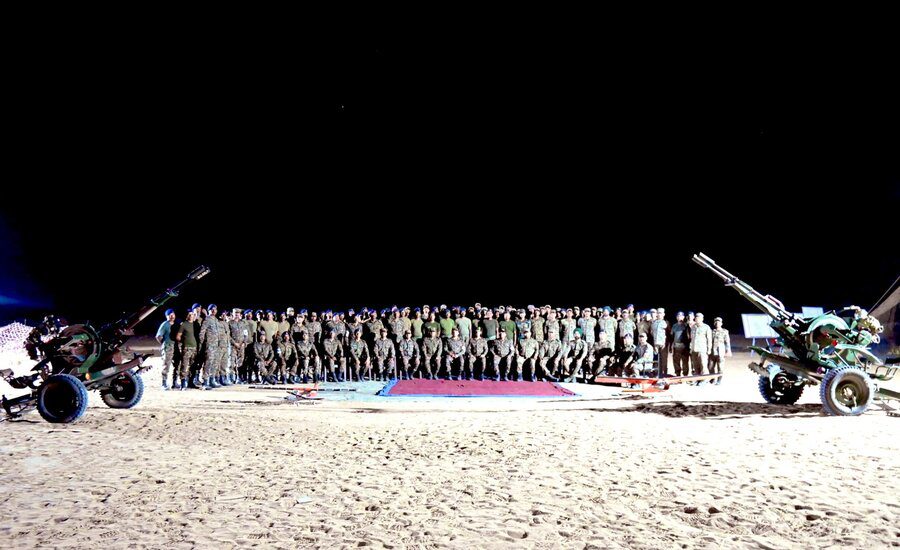
Indian Army Air Defence Exercise has once again highlighted India’s growing military preparedness as Air Defence Gunners under the Southern Command carried out a high-intensity live firing drill in desert terrain.
The exercise focused on precision targeting and modern aerial threats, especially drone warfare. Conducted under official supervision, the drill validated India’s ability to detect, track, and neutralize evolving aerial challenges in real combat-like conditions.
This development reflects the Army’s continuous push toward advanced, technology-driven warfare capabilities in line with future battlefield requirements.
Details of Indian Army Air Defence Exercise
According to official communication from the Indian Army’s Southern Command, Air Defence Gunners conducted a field firing exercise in desert terrain, likely in Rajasthan’s operational zones.
Read also: Indian Army Plans Drone-Dominated Warfare: Key Highlights from New UAS Technology Roadmap
The key highlights of the exercise include:
- Live firing against simulated aerial threats
- Precision engagement systems tested
- Real-time coordination between radar, sensors, and weapon systems
- Focus on drone warfare scenarios
Such desert-based drills are important because these regions represent strategically sensitive border areas where real conflict situations may arise.
Focus on Drone Warfare and Modern Threats
The exercise emphasized countering unmanned aerial systems (UAS), which are becoming a major threat in modern warfare.
- Drones are low-cost but highly effective weapons
- They can be used for surveillance, attacks, and swarm operations
- Modern armies must detect and destroy them quickly
India is actively developing counter-drone systems and integrated defence networks to tackle such threats.
This drill tested the Army’s ability to respond to:
- Swarm drone attacks
- Low-altitude aerial threats
- Fast-moving targets with high precision
Link to Sudarshan Chakra Mission
The exercise is also aligned with India’s larger defence modernization plan under Mission Sudarshan Chakra.
- Aims to build a multi-layered air defence shield
- Focuses on missiles, drones, and future aerial threats
- Integrates sensors, command systems, and weapons
This mission reflects India’s shift toward network-centric and technology-driven warfare.
Role of Army Air Defence Units
The Corps of Army Air Defence plays a key role in protecting India’s airspace from enemy aircraft, missiles, and drones.
- Responsible for low-altitude air defence
- Uses radar, missiles, and advanced tracking systems
- Works in coordination with other military branches
These units ensure that any aerial threat is neutralized before it can cause damage.
What is the Importance Indian Army Air Defence Exercise
This exercise is important for several reasons:
1. Real Combat Preparedness
It simulates real battlefield conditions, ensuring troops are ready for actual conflict.
2. Technology Validation
Tests new systems like:
- Radar tracking
- Drone detection
- Precision firing systems
3. Future Warfare Readiness
Modern conflicts are increasingly:
- Drone-based
- Technology-driven
- Multi-domain (land, air, cyber)
The drill confirms that the Indian Army is adapting quickly to these changes.
Growing Importance of Desert Warfare
Desert regions like Rajasthan are key military zones because:
- They border sensitive areas
- Large-scale troop movement is possible
- Ideal for testing heavy weapons and air defence systems
Previous exercises in these areas have also validated joint operations and advanced combat capabilities.
Read also: Explained: How Pantsir-S1M Can Protect S-400 from Modern Drone Warfare Threats