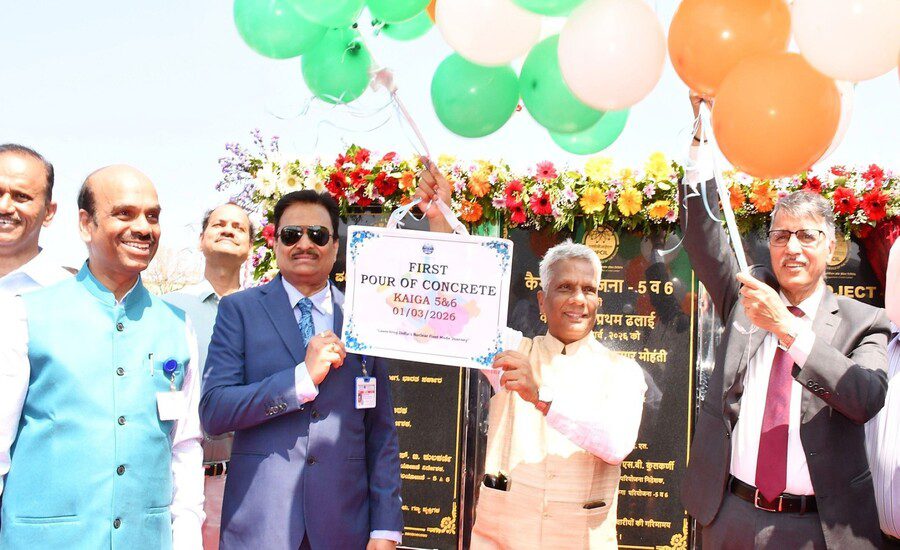
New Delhi: India has marked a major milestone in its clean energy expansion by beginning full-scale construction of nuclear power units 5 and 6 at the Kaiga Nuclear Power Plant in Karnataka.
On 1st March 2026, the First Pour of Concrete (FPC) was successfully completed — a formal step that transitions the project from planning into construction. This step also officially recognizes the site as an under-construction nuclear power facility under regulatory standards.
Kaiga Nuclear Power Plant: What the First Pour of Concrete Means
The First Pour of Concrete is a globally recognized watershed moment in building a nuclear power plant. It means that the nuclear power station site has cleared all safety and regulatory checks and has begun structural construction work. This milestone was approved by India’s Atomic Energy Regulatory Board (AERB) after extensive safety reviews of the design and quality assurance plans.
In nuclear construction, this step is analogous to breaking ground in other major infrastructure projects — but with much higher safety and regulatory rigor.
About the New Reactors – 700 MWe PHWRs
The reactors being built at Kaiga Units 5 & 6 are indigenous 700 MWe Pressurized Heavy Water Reactors (PHWRs). These are part of India’s advanced nuclear fleet developed by Nuclear Power Corporation of India Ltd (NPCIL). Such reactors are designed to:
- Generate 700 MW of electricity each
- Use heavy water as coolant and moderator for stable and efficient operation
- Incorporate advanced safety systems aligning with international nuclear safety standards
These designs are classified under the Indian PHWR-700 series, a Generation III+ technology developed by NPCIL and built with significant domestic participation.
India’s Nuclear Power Goals and Strategy
The Kaiga expansion fits into India’s broader long-term energy vision under the Atmanirbhar Bharat (Self-Reliant India) mission and the national target to achieve cleaner electricity generation. India continues to pursue a diversified energy mix combining renewables, hydro, and nuclear power.
NPCIL’s plan includes constructing multiple indigenous PHWR-700 reactors across the country in a “fleet mode,” which can reduce construction times and improve efficiency. The first unit of Kaiga 5 & 6 is expected to reach nuclear criticality within about 60 months of the FPC milestone.
Kaiga Nuclear Power Plant: Location and Capacity Expansion
The Kaiga Nuclear Power Plant is located in Uttara Kannada district, Karnataka, and is operated by NPCIL. Before the new units, the site hosted four operational 220 MWe PHWR reactors. With Units 5 & 6 becoming operational, Kaiga’s total installed nuclear capacity will increase significantly, helping to strengthen southern India’s power grid.