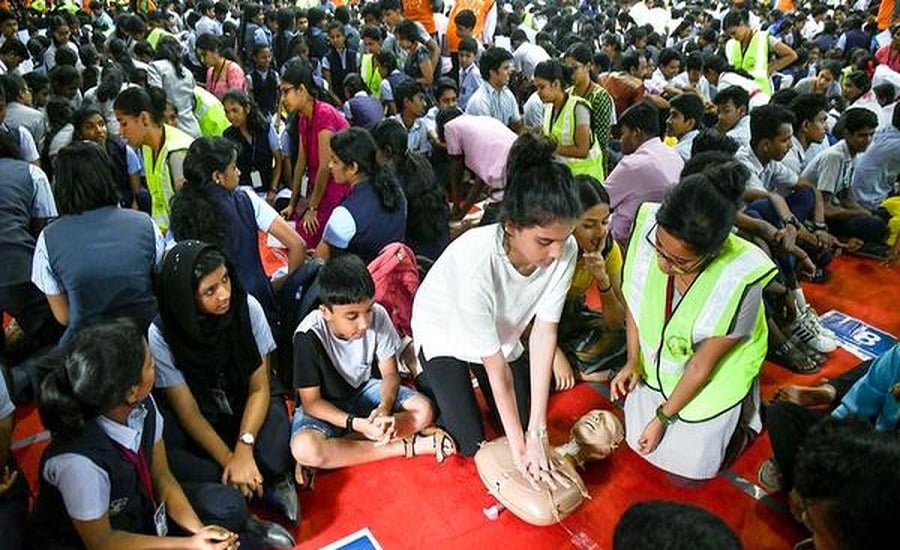
Ernakulam: An accident, sudden cardiac arrest or a medical emergency can turn fatal within minutes if the victim does not receive timely assistance. In many situations, the time between an emergency and the arrival of professional medical help becomes critical. Recognising the importance of immediate intervention, Kerala‘s Ernakulam district is preparing to turn its entire population into a community of trained first responders.
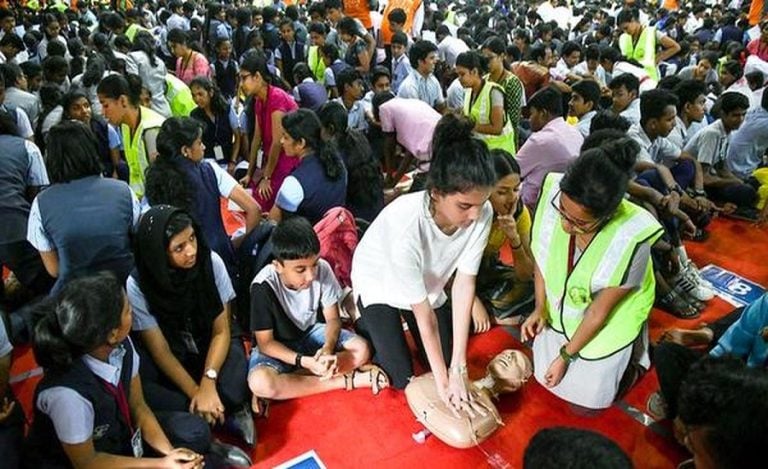
In a unique public safety initiative, the Ernakulam District Panchayat has set an ambitious target of training approximately 2.8 million people in essential life-saving skills, including Cardiopulmonary Resuscitation (CPR), bleeding control and basic first aid.
The initiative aims to make Ernakulam the country’s first Basic Life Support (BLS)-trained district, where every individual above the age of 14 has the knowledge and confidence to provide immediate assistance during an emergency.
The programme will cover people from different walks of life, including school students, college students, teachers, police personnel, firefighters, auto-rickshaw drivers, factory workers, labourers, shopkeepers and members of resident associations.
The underlying idea is simple but significant: instead of remaining helpless or panicking when an accident or medical emergency occurs, ordinary citizens should know how to provide the right assistance until the victim reaches a hospital.
2.8 Million People to Be Trained in Life-Saving Skills
The Ernakulam District Panchayat is spearheading the initiative in collaboration with the Indian Institute of Emergency Medical Services (IIEMS) and the organisation Mitrikulam.
The programme will focus on people aged above 14, bringing students from Class 8 onwards within its ambit. By including educational institutions, workplaces, government departments and local communities, the initiative seeks to ensure that emergency response skills become a part of everyday public awareness.
The District Panchayat has proposed training at least 30 individuals in every panchayat. The programme will also involve municipal bodies and different government departments, including the Police, Forest Department and Excise Department.
A dedicated task force for the initiative is scheduled to be established on November 21 at the District Panchayat Hall in Kochi. It will help coordinate the training programme and facilitate its implementation across the district.
The scale of the initiative is considerable, with a target of approximately 2.8 million trained individuals. Rather than limiting emergency response training to healthcare professionals, the programme aims to make essential life-saving knowledge accessible to the general public.
Read also: Who Is IPS Merin Joseph? Meet the Kerala Cop Who Inspired Sai Pallavi’s Police Officer Look
How the Initiative Will Be Implemented Across Ernakulam
The District Panchayat is leading the programme, with training activities already underway across 80 Gram Panchayats, 12 Municipal Councils and the Municipal Corporation.
KG Radhakrishnan, President of the Ernakulam District Panchayat, said the local self-government institutions would play an important role in taking the programme to people across the district.
The involvement of panchayats and municipalities is expected to help reach communities at the grassroots level, ensuring that training is not restricted to urban centres or major institutions.
The district administration also plans to develop a network of trained and certified individuals in every panchayat and municipality. These individuals will be equipped to provide immediate assistance when accidents or medical emergencies occur in their neighbourhoods.
District Collector G. Priyanka said, “We will build a team of trained and certified individuals in every Panchayat and municipality across the district. This team will be equipped to provide immediate assistance.”
The emphasis is therefore not merely on conducting training sessions but on creating a local network of people who can respond when an emergency occurs.
Four Types of Training to Equip Citizens for Medical Emergencies
The initiative will provide training in four essential areas of emergency response. Together, these modules are designed to help participants recognise emergencies, provide immediate care, prevent further injury and improve the victim’s chances of survival before reaching a hospital.
1. Basic Trauma Care (BTC)
Basic Trauma Care will focus on providing initial assistance to people injured in road accidents and other incidents.
Participants will learn how to handle injured individuals, provide immediate support and stabilise them before they are transported to a hospital. The training will also cover the precautions required while assisting accident victims to avoid aggravating their injuries.
2. Stop the Bleed (STB)
The Stop the Bleed module will teach participants how to control severe bleeding immediately after an injury.
Uncontrolled blood loss can become life-threatening within a short period. Through this training, participants will learn techniques to manage serious bleeding and provide timely assistance until professional medical help becomes available.
3. Basic First Aid (BFA)
Basic First Aid training will cover the scientific application of first aid in common medical emergencies and injuries.
Participants will be trained to provide initial assistance in cases involving wounds, burns, cuts, fractures, animal bites, and bee or wasp stings.
The objective is to ensure that people understand how to respond appropriately to different types of injuries rather than relying on panic or unscientific methods.
4. Basic Life Support (BLS)
Basic Life Support will focus on essential life-saving techniques, particularly Cardiopulmonary Resuscitation (CPR).
Participants will learn how to respond to emergencies such as cardiac arrest and airway obstruction. CPR and other basic life-support measures can be critical in maintaining a person’s chances of survival until advanced medical assistance arrives.
Together, these four modules will equip participants with practical skills to respond to different emergencies, from road accidents and serious injuries to sudden cardiac events.
Corporate Support Through CSR Funds
The initiative is also expected to receive financial support from private companies through their Corporate Social Responsibility (CSR) funds.
This will help mobilise resources for conducting training programmes on such a large scale and involve corporate organisations in a public health and safety initiative.
Anil Jose, founder of Mitrikulam, said the larger objective was to create a community capable of responding effectively during emergencies rather than panicking.
“Our goal is to build a community in Ernakulam that, instead of panicking during an accident or any other emergency, is capable of providing the right kind of assistance,” he said.
The participation of corporate organisations, along with local self-government institutions and government departments, is expected to support the district-wide implementation of the programme.
Why Training Ordinary Citizens in First Aid Matters
In an emergency, the first few minutes can make a significant difference to a victim’s survival. While ambulances and hospitals provide professional medical care, assistance given by people present at the scene can be crucial during the intervening period.
Dr. Johnson George, Lead Instructor at Aster Medicity (BLS), highlighted the importance of providing appropriate first aid immediately after an accident.
“If a victim receives proper first aid following an accident, the chances of survival increase significantly. It can also reduce the duration of hospital treatment required,” he said.
This is the central principle behind the Ernakulam initiative: emergency response should not depend entirely on the availability of doctors or paramedics at the scene. Ordinary citizens, if properly trained, can also play an important role in helping victims.
Building a District-Wide Network of First Responders
The Ernakulam initiative goes beyond conventional first-aid awareness campaigns. Its central objective is to create a decentralised network of trained individuals who can provide immediate assistance in their own communities.
By involving schools, colleges, workplaces, government departments, local bodies and residential communities, the District Panchayat aims to make emergency response knowledge widely accessible.
The proposed training of 2.8 million people could significantly strengthen the district’s ability to respond to accidents, injuries and sudden medical emergencies.
If successfully implemented, Ernakulam could establish a model for other districts in India, demonstrating how community participation and basic emergency medical training can become an important part of public safety.
Read also: Kerala Govt to Purchase 24 New Hybrid Vehicles for Ministers and Chief Secretary at ₹9.60 Crore