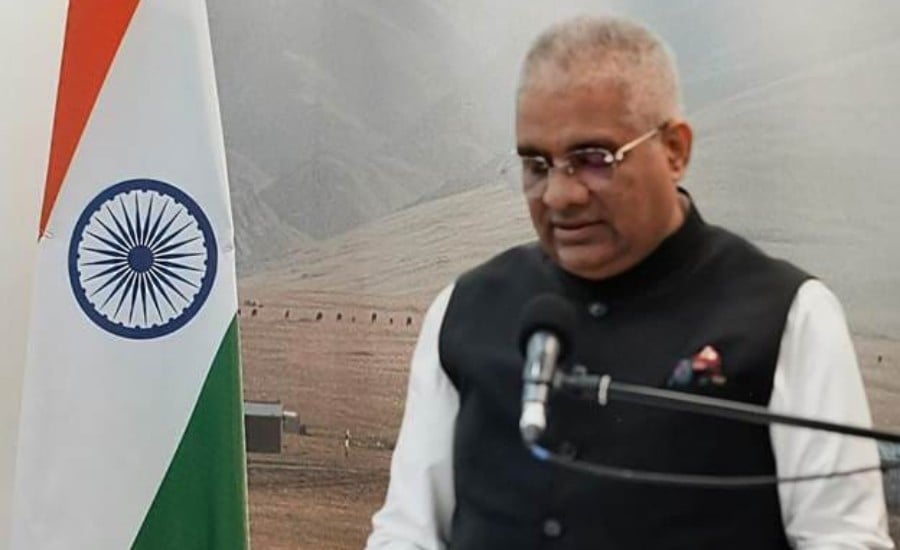
Ulaanbaatar: India restored 21.76 million hectares of land between 2011 and 2020, generating approximately 1.22 billion person-days of employment, Union Environment, Forest and Climate Change Minister Bhupender Yadav said at the 17th Conference of the Parties (COP17) to the United Nations Convention to Combat Desertification (UNCCD) in Ulaanbaatar, Mongolia.
Speaking at an International Union for Conservation of Nature (IUCN)-organised side event, Yadav said land restoration is an established national priority and is being pursued as part of India’s efforts on sustainable land management, biodiversity conservation, climate action and rural development.
India’s Restoration Commitment
India is among the major countries that have made commitments under the Bonn Challenge, a global effort to bring degraded and deforested landscapes under restoration.
Read Also: India Launches First-Ever Guide to Grasslands and Open Natural Ecosystems at UNCCD COP17
India initially made its restoration commitment in 2015 and subsequently enhanced its target to 26 million hectares by 2030.
The country’s latest progress report covers restoration activities undertaken between 2011 and 2020.
Key figures from India’s restoration efforts
- 21.76 million hectares: Land brought under restoration between 2011 and 2020
- 1.22 billion person-days: Employment generated during the period
- 26 million hectares: India’s enhanced restoration commitment for 2030
- 2021–2025: Period covered by India’s ongoing next reporting cycle
Yadav said the figures demonstrate that restoration can generate both environmental and socio-economic outcomes by reviving degraded landscapes while supporting rural livelihoods.
Restoration Goes Beyond Forests
The Environment Minister said India’s assessment does not measure restoration only through the number of hectares covered.
The reporting also considers restoration across different land-use systems, including:
- Forest landscapes
- Agricultural areas
- Soil and water conservation areas
- Other land-use systems
According to Yadav, this landscape-based approach recognises that restoration measures need to reflect the ecological and socio-economic conditions of individual regions.
India Strengthens Monitoring of Restoration Outcomes
India is now undertaking the next reporting cycle covering 2021–2025 in collaboration with the ICFRE Centre of Excellence on Sustainable Land Management and IUCN.
The assessment will focus on three key indicators:
- Area restored
- Financial flows
- Employment generated
The government is also seeking to strengthen the systems used to track restoration outcomes, financing and livelihood impacts.
Multiple Schemes Supporting Land Restoration
Yadav highlighted that restoration in India is being pursued through multiple programmes rather than a single intervention.
Key initiatives include:
Green India Mission:
Focuses on increasing forest and tree cover, improving ecosystem services and strengthening climate resilience.
Compensatory Afforestation Fund Management and Planning Authority (CAMPA):
Provides resources for compensatory afforestation and related restoration activities.
Nagar Van Yojana:
Extends the restoration agenda to urban and peri-urban areas through urban forestry and green spaces.
Watershed development and soil conservation:
Supports restoration and improved management of land and water resources.
Agroforestry:
Integrates trees with agricultural systems while contributing to land restoration and livelihood opportunities.
From Restoring More Land to Restoring Better
Yadav said India’s experience shows that restoration cannot be achieved through one programme or sector alone. It requires coordination across landscapes, sectors and different levels of governance, involving local communities, states and the Union Government.
Looking beyond 2030, he said India’s objective should extend beyond restoring larger areas to achieving measurable and lasting restoration outcomes.
This would require:
- Innovative financing to mobilise greater public and private investment
- Stronger regional and international partnerships
- Greater sharing of restoration technologies and knowledge
- Sustained participation of local communities
- Robust monitoring and evidence-based assessment
Linking Land Restoration With Rural Livelihoods
The employment figure of 1.22 billion person-days highlighted by the Minister places livelihoods alongside ecological restoration in India’s approach.
Yadav said restoration is ultimately sustained by the communities that depend on and manage these landscapes. India’s restoration efforts therefore seek to connect environmental recovery with rural development and employment generation.
He reaffirmed India’s commitment to working with international partners to advance land restoration at scale, saying that strong institutions, sustained financing, scientific approaches, monitoring systems and partnerships are essential to translating restoration commitments into measurable outcomes.