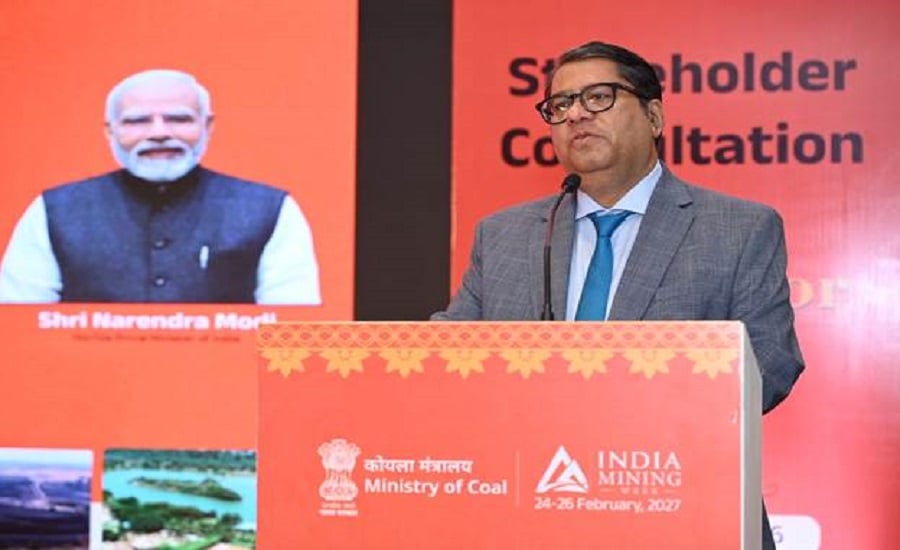
New Delhi: The Ministry of Coal has called on coal block allottees to accelerate the operationalisation of allocated mines and bring them into production within revised timelines. The Ministry held a stakeholder consultation on ‘Mining for Future’ in Panjim, Goa, to discuss ways to increase domestic coal production, introduce policy reforms and promote responsible mining.
Of the 137 commercial coal mines allocated since 2020, only 25 have started production, highlighting the gap between allocation and operationalisation. The Ministry urged industry stakeholders to focus on bringing already allocated coal blocks into production to strengthen India’s energy security and meet rising domestic demand.
The day-long consultation brought together allottees of captive and commercial coal blocks, representatives of State Governments, the Central Ground Water Authority (CGWA), the Directorate General of Hydrocarbons (DGH), the Ministry of Environment, Forest and Climate Change (MoEFCC), and senior officials of the Ministry of Coal.
Vikram Dev Dutt, Secretary, Ministry of Coal, attended the consultation as the Chief Guest. Rupinder Brar, Additional Secretary and Nominated Authority, along with other senior officials of the Ministry, was also present.
Ministry of Coal Highlights Need to Accelerate Coal Block Production
Addressing coal block allottees, Secretary Vikram Dev Dutt emphasised that India’s future coal production growth would depend not only on allocating new mines but also on operationalising blocks that have already been allotted.
He pointed out that coal blocks that remain allocated but do not produce coal represent resources that the country cannot utilise for its energy requirements.
The Secretary also acknowledged the contribution of the coal industry during the past eight months, when disruptions in global LNG and LPG supplies following the West Asia conflict from late February put pressure on energy markets.
He noted that coal stocks at mines and power plants helped the government assure uninterrupted power availability during the period. However, he cautioned that global energy market pressures remain significant.
According to the International Energy Agency, gas markets are expected to remain tight through 2027. Asian spot LNG prices averaged US$17.5 per million British thermal units (MBtu) in the second quarter, representing a 45% increase over the corresponding period last year.
Global coal demand is also forecast to reach a record 8.94 billion tonnes in 2026. The Secretary highlighted the importance of domestic coal production in protecting the Indian economy from fluctuations in international energy markets.
India’s Coal Demand Expected to Increase by 2050
Highlighting the country’s long-term energy requirements, Dutt referred to NITI Aayog projections indicating that India’s coal demand could rise from approximately 1.25 billion tonnes in 2025 to more than 2.6 billion tonnes by 2050 under current policy scenarios.
Even under a net-zero pathway, coal demand is projected to exceed 1.8 billion tonnes by 2050.
The demand outlook is supported by the expected expansion of major coal-consuming sectors, including:
- Power: Continued electricity requirements to support economic and industrial growth.
- Steel: Increasing demand for coal to support steel production and infrastructure development.
- Cement: Higher consumption requirements as construction and infrastructure activities expand.
India produced 1,041 million tonnes of coal during FY 2025-26. Coal continues to account for more than 70% of the country’s electricity generation, underlining its importance in India’s energy mix.
Ministry Emphasises Sustainable and Responsible Mining
The Secretary highlighted that the Ministry’s approach to coal sector development extends beyond production targets and includes sustainability, community welfare and technological advancement.
He stressed the importance of scientific mine closure and the restoration of mined-out areas into productive and environmentally sustainable spaces. He called for the development of vibrant habitats through collaboration with local communities, ensuring ecological restoration alongside social and economic well-being.
Dutt also highlighted the role of Corporate Social Responsibility (CSR) initiatives in bringing positive changes to coal-bearing regions. He said these initiatives should be strengthened to ensure that local communities are included in the development process and benefit from mining-related activities.
On land acquisition and rehabilitation, he emphasised that companies must provide clarity to affected families from the beginning regarding compensation, relocation and restoration of their livelihoods.
He called on mining companies to fulfil their commitments towards communities and ensure that responsible mining remains an integral part of sectoral growth.
Coal Sector Reforms and Faster Operationalisation of Mines
During the consultation, Additional Secretary and Nominated Authority Rupinder Brar outlined the major reforms introduced by the Ministry to improve transparency, attract investment and accelerate coal block operationalisation.
The 2020 commercial coal mining framework introduced several changes to make the sector more competitive and accessible to investors.
Key reforms include:
- Removal of End-Use Restrictions: The framework removed restrictions on the end use of coal produced from commercial mines.
- Revenue-Sharing Mechanism: Bidding was shifted to a revenue-share model linked to the National Coal Index.
- Relaxed Eligibility Conditions: Technical and financial eligibility requirements were removed to encourage wider participation.
- Foreign Investment: 100% Foreign Direct Investment (FDI) was permitted through the automatic route.
- Incentives for Underground Mining: Underground coal mines received a waiver of the upfront amount, a lower floor price and reduced performance security requirements.
The Ministry has also reduced the scheduled operationalisation timelines for coal blocks.
- Fully Explored Blocks: The timeline has been reduced from 51 months to 40 months.
- Partially Explored Blocks: The timeline has been reduced from 66 months to 52 months.
Other measures have also been introduced to simplify regulatory processes and accelerate mine development.
- Mining plan approvals now take an average of 4.5 months, compared with nine months earlier.
- Mine Opening Permission is now granted by the company’s Board.
- A total of 44 accredited exploration agencies no longer require a prospecting licence.
Brar acknowledged the contributions of different ministries in implementing reforms to accelerate coal block operationalisation. She also called for increased production while maintaining a balance between economic growth, environmental protection and community welfare.
She highlighted transparency, policy stability and ease of doing business as important factors in attracting investment, promoting competition and creating new economic opportunities in the coal sector.
Ministry Seeks Industry Suggestions to Speed Up Coal Production
The Ministry urged coal block allottees to take concrete steps to accelerate mine development and increase production.
The key priorities discussed during the consultation included:
- Opening mines ahead of the revised operationalisation timelines.
- Increasing production to reach peak rated capacity as quickly as possible.
- Raising land acquisition, forest clearance and State-level issues at an early stage.
- Ensuring compliance with responsible mining practices.
- Strengthening coordination with relevant government departments to resolve operational bottlenecks.
The Ministry also invited suggestions from industry stakeholders on policy changes that could accelerate mine operationalisation.
Participants were encouraged to identify provisions in coal mine agreements that require revision and recommend amendments to relevant Acts and Rules to improve the regulatory framework.
Technology, AI and Innovation in Future Mining
The stakeholder consultation featured discussions on technology adoption, innovation and modern mining practices to improve operational efficiency and add value across the coal sector.
Industry representatives presented developments in several emerging areas, including:
- Artificial Intelligence (AI), robotics and digital transformation.
- Advanced exploration techniques.
- Technologies for reducing ash content in coal at the mine.
- Underground Coal Gasification (UCG).
- Paste filling technology.
- Global best practices in mining operations.
The discussions highlighted the potential of modern technologies to improve productivity, strengthen safety standards, reduce environmental impact and support more efficient resource utilisation.
Officials from the Directorate General of Hydrocarbons (DGH), Directorate General of Mines Safety (DGMS), MoEFCC and CGWA also shared their perspectives on the Coal Bed Methane (CBM) framework, mine safety, environmental policy reforms and groundwater clearances.
An open-house discussion followed, providing stakeholders with an opportunity to raise regulatory and operational issues and suggest measures for the next generation of coal sector reforms.
Rehabilitation, Resettlement and Community Welfare in Focus
The consultation also examined the social and environmental dimensions of coal mining, with discussions focusing on inclusive growth and the welfare of communities in coal-bearing regions.
Key areas covered during the sessions included:
- Rehabilitation and resettlement of project-affected families.
- Land repurposing and restoration of mined-out areas.
- Worker welfare and community development.
- Corporate Social Responsibility initiatives.
- Just transition and inclusive growth.
- Afforestation and environmental stewardship.
- Scientific mine closure and ecological restoration.
Participants also shared experiences regarding the impact of policy reforms, first-mile connectivity and measures to increase domestic coking coal production.
The discussions reinforced the need to place communities and other stakeholders at the centre of coal sector development while ensuring that production growth goes hand in hand with environmental responsibility.
Ministry to Consolidate Stakeholder Suggestions for Future Reforms
The consultation concluded with an interactive question-and-answer session, providing a platform for direct engagement between industry representatives and government officials.
The Ministry of Coal said it would consolidate the suggestions received during the consultation and take them up with the relevant stakeholders for further consideration.
The Goa consultation is part of the Ministry’s continuing engagement with industry and other stakeholders to identify operational challenges, encourage innovation and strengthen sustainable mining practices.
Through these consultations and ongoing policy reforms, the Ministry aims to develop a future-ready, resilient and globally competitive coal ecosystem that supports India’s energy security and national development priorities.
Read also: Coal India Signs MoU with Ministry of Coal to Set Performance Targets for FY 2026-27