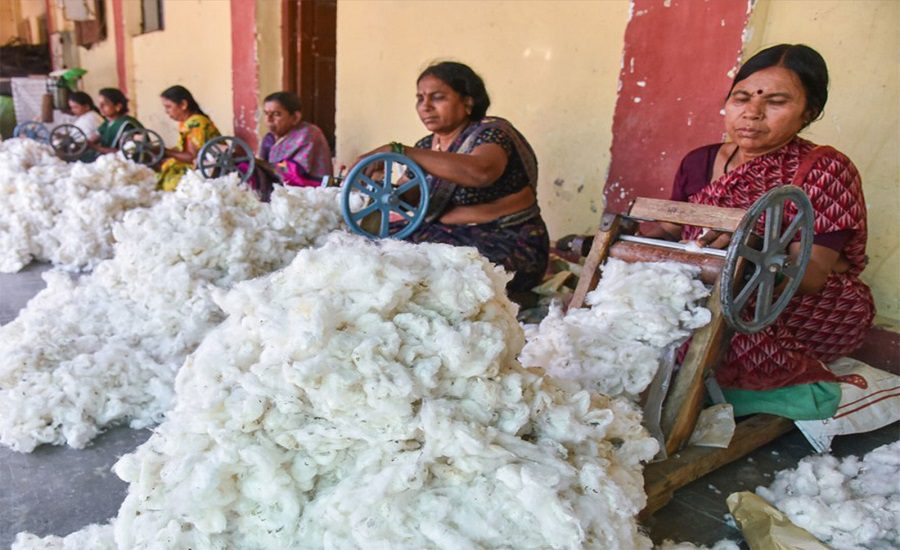
New Delhi: The Centre has launched the Mission for Cotton Productivity (KAPAS KANTI) with an outlay of ₹5,659.22 crore for five years to improve cotton production, productivity and quality across India. Under the mission, Karnataka has received significant financial support and set an ambitious target of producing 40 lakh bales of cotton by 2030-31.
The mission focuses on modern farming technologies, scientific research, better-quality cotton, farmer demonstrations and improved marketing systems. It is expected to strengthen the cotton value chain while increasing farmers’ income and making Indian cotton more competitive.
A Five-Year Mission
Approved on May 5, 2026, the Mission for Cotton Productivity will run from 2026-27 to 2030-31.
The scheme includes four major components:
- ₹555.05 crore for Component I(A), implemented by the Department of Agricultural Research and Education (DARE).
- ₹3,804.17 crore for Component I(B), implemented by the Department of Agriculture and Farmers Welfare (DA&FW).
- ₹1,000 crore for Component II, implemented by the Cotton Corporation of India (CCI) under the Ministry of Textiles.
- ₹300 crore for Component III, implemented by the National Jute Board (NJB) under the Ministry of Textiles.
Together, these components aim to improve cotton production from farm to market.
Read Also: National Handloom Day 2026: President Murmu to Honour India’s Finest Handloom Weavers
Karnataka Gets Major Support
Karnataka has been identified as one of the major beneficiaries under the mission.
For 2026-27, the state has been allocated ₹48.50 crore, including Central and State shares. Out of this, Raichur district has been earmarked ₹11 crore for cotton productivity activities.
In addition, around ₹11.50 crore has been approved for cotton research under the All India Coordinated Research Project (AICRP) at Raichur, Dharwad and Chamarajanagar.
Focus on Technology and Demonstrations
The mission covers 140 cotton-growing districts across 14 states. Karnataka has prepared district-wise demonstration targets to help farmers adopt modern cultivation practices.
The programme will promote:
- High Density Planting System (HDPS)
- Closer Spacing (CS)
- Extra Long Staple (ELS) cotton
- Integrated Crop Management (ICM)
Among Karnataka’s districts, Raichur has received the highest demonstration targets, reflecting its importance as a major cotton-producing region.
Production Target of 40 Lakh Bales
The Karnataka government aims to increase cotton production steadily over the next five years.
The targets include:
- 2026-27: 26 lakh bales
- 2027-28: 31 lakh bales
- 2028-29: 34.1 lakh bales
- 2029-30: 36.8 lakh bales
- 2030-31: 40 lakh bales
During the same period, productivity is expected to rise from 559 kg lint per hectare to 860 kg lint per hectare.
Raichur is also expected to record significant growth in both production and productivity under the mission.
Quality Testing and Kasturi Cotton
The mission also focuses on improving cotton quality.
It proposes setting up 50 Cotton Testing Laboratories across cotton-producing clusters through the Public-Private Partnership (PPP) model. Their locations will be decided through a competitive selection process.
Eligible ginning and processing units will receive incentives for producing Kasturi Cotton Bharat-certified cotton bales, helping improve traceability and quality standards.
Monitoring and Implementation
Implementation of the farmer-focused component will be monitored through State-Level and District-Level Committees.
The committees will review annual targets, monitor progress and ensure that farmers benefit from demonstrations and modern farming practices.
Why the Mission Matters
Cotton is one of India’s most important commercial crops and supports millions of farmers and workers. The Mission for Cotton Productivity aims to improve yields through research, better technology and scientific farming while strengthening quality testing and value addition.
If implemented effectively, the scheme could increase farmer incomes, improve India’s cotton competitiveness in global markets and create new opportunities across the textile value chain.