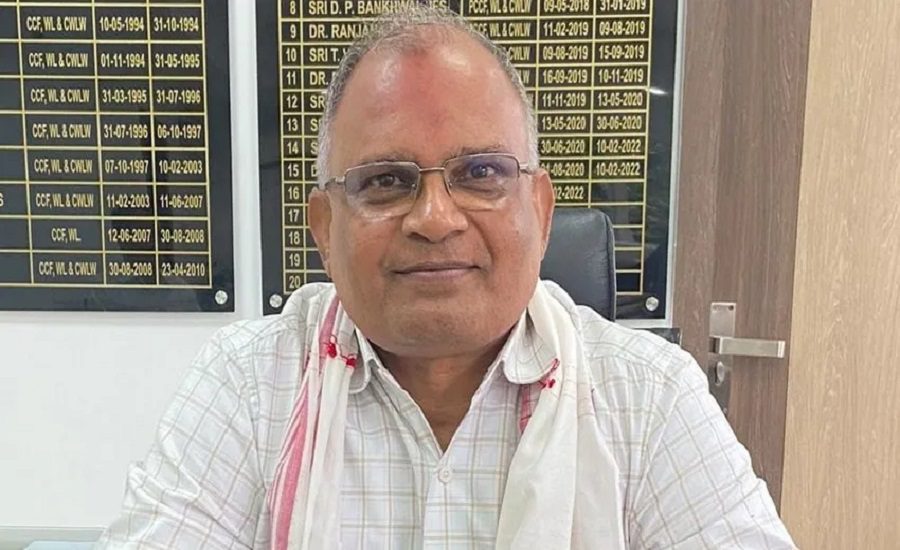
A fresh legal and political controversy has emerged in Assam over the continued functioning of retired Indian Forest Service officer MK Yadava as Special Chief Secretary (Forest), after the Model Code of Conduct (MCC) came into force on March 15 ahead of the Assembly elections scheduled for April 9.
Opposition parties, led by Indian National Congress in Assam, have questioned the legality of allowing a retired All India Service officer to continue in a senior administrative post with full administrative and financial powers during an election period. Critics have described the arrangement as politically motivated and inconsistent with central service rules governing re-employment of retired officers.
Re-Engaged Immediately After Retirement
MK Yadava, who earlier served as Principal Chief Conservator of Forests and Head of Forest Force in Assam, retired on February 29, 2024.
The very next day, on March 1, 2024, the Assam government re-engaged him as Special Chief Secretary (Forest) for one year, an unusual move because the assignment effectively placed a retired officer at the helm of a major department with powers comparable to a serving senior cadre officer.
The arrangement was further extended after the Assam Cabinet approved continuation of his tenure during its February 21–22, 2025 meeting, allowing him to remain in office from March 1, 2025 onward.
Extension Includes Full Administrative and Financial Powers
According to the extension order, Yadava continues to exercise full departmental authority, including:
• Approval of budgets
• Financial sanctions
• Policy decisions
• Departmental administrative supervision
This has intensified criticism because the post carries responsibilities usually associated with serving cadre officers.
Opposition leaders argue that a contractual re-engagement should not effectively replicate full cadre authority, particularly in a politically sensitive department such as forests.
Questions Raised Under All India Services Rules
The controversy has revived debate around the interpretation of All India Services (Death-cum-Retirement Benefits) Rules, 1958 and guidelines issued by Department of Personnel and Training.
Under these rules, retired All India Service officers—including IAS, IPS and IFS officers—may be re-employed in public interest up to age 65 or for a maximum of five years.
However, such appointments are generally expected to be:
• Contractual in nature
• Justified on public interest grounds
• Approved by Cabinet
• Supported by reasons showing absence of suitable serving officers
• Salary adjusted after deducting pension benefits
Critics argue that while re-employment itself is permissible, granting a retired officer full cadre-equivalent powers raises a separate legal issue.
Cadre Post Rules Also Under Scrutiny
The issue has also drawn attention to Rule 9 of the Indian Administrative Service (Cadre) Rules, 1954, which regulates occupation of cadre-equivalent senior administrative posts.
Though Yadava belongs to the Indian Forest Service, activists argue that retired officers treated as non-cadre personnel should not occupy positions equivalent to senior cadre authority in state administration.
In a representation to Election Commission of India, activist Dilip Nath argued that such appointments should not continue during the election period, especially where full administrative powers remain intact.
Election Commission Asked to Examine Legality During MCC
In his letter to the Election Commission, Dilip Nath contended that the post should be treated as vacant during the election period because the original re-engagement was linked to the previous Cabinet decision.
He argued that once the Model Code of Conduct comes into force, a politically approved contractual continuation in such a key administrative role deserves independent scrutiny.
The petition also questions whether a retired officer should continue exercising full powers in a department during elections when neutrality of administration becomes especially important.
Opposition Earlier Demanded High Court-Monitored Probe
The issue is not new in Assam politics.
In 2025, Leader of Opposition Debabrata Saikia had demanded a High Court-monitored probe into Yadava’s appointment.
He had alleged that the arrangement sends what he described as a negative signal to serving officers by bypassing normal service hierarchy and weakening institutional norms.
According to him, prolonged continuation of a retired officer in a top department creates uncertainty within the cadre.
Previous Allegations Add to Current Scrutiny
The debate has become sharper because Yadava’s tenure has also faced scrutiny over alleged forest-related irregularities.
According to reports, in July 2025, Ministry of Environment, Forest and Climate Change directed legal action in connection with alleged violations of forest conservation laws linked to decisions taken during his tenure.
Critics say these allegations further strengthen the case for reviewing his continuation.
Social Media Debate Intensifies
The controversy has also spilled onto social media platforms.
Activist Rohit Choudhury publicly questioned how a retired officer could continue heading a key department during the Model Code of Conduct.
His remarks focused on whether contractual appointees with political approval should exercise administrative control when election neutrality norms are in force.
Issue Earlier Raised During 2024 Lok Sabha Elections
This is not the first time the matter has reached the Election Commission.
During the 2024 Lok Sabha elections, Asom Jatiya Parishad had approached the poll panel seeking intervention on Yadava’s appointment.
However, the party later stated that no formal response was received.
Assam Government Defends Continuation
The Assam government has defended the continuation of MK Yadava.
A senior official said that the Model Code of Conduct primarily bars:
• Fresh appointments
• Transfers
• Promotions
• New administrative decisions requiring political approval
The official maintained that incumbents already in position before MCC are not automatically affected.
Since Yadava’s extension was approved in February 2025, before the poll code came into force, the government argues that he can continue handling routine governance responsibilities.
Government Says MCC Does Not Affect Prior Extension
According to the state’s position, the February extension remains valid because it predates MCC.
Officials also argue that governance cannot be paralysed during elections, and therefore ongoing administrative and financial approvals required for departmental functioning must continue.
This includes policy execution and budget-related approvals already underway.
Legal Questions May Continue Until Poll Panel Responds
With the Election Commission yet to publicly respond, the controversy may continue through the election period.
The case has reopened broader questions about:
• Limits of post-retirement re-employment
• Powers of contractual AIS officers
• Cadre post sanctity
• Administrative neutrality during elections
Read also: EC Appoints Retired IAS Officer Manjeet Singh as Special Observer for Assam Assembly Elections