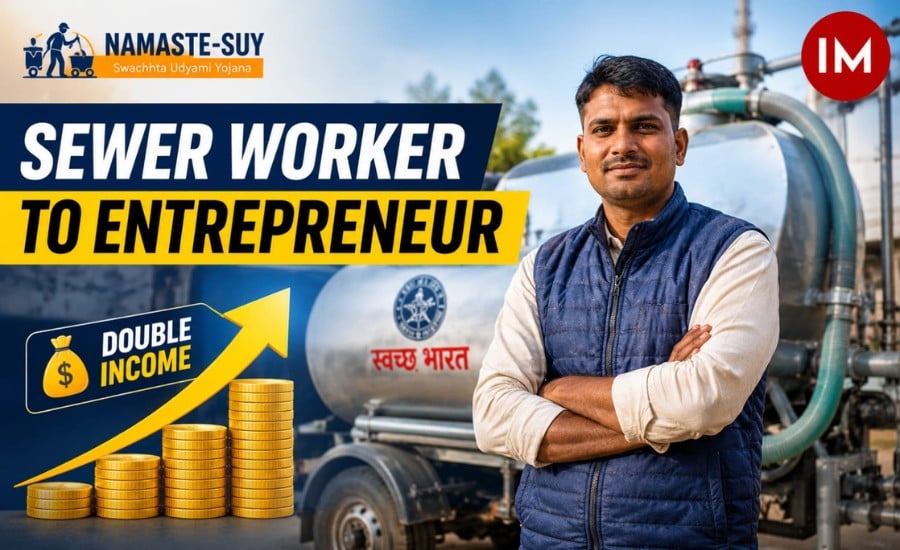
New Delhi: For Sushil Kumar Sharma, a 32-year-old sanitation worker from Pilani in Rajasthan’s Jhunjhunu district, access to financial assistance and mechanised equipment has helped turn a physically demanding occupation into a self-employment opportunity.
Sushil, who previously worked as an outsourced sewer-cleaning worker with Nagar Palika Vidya Vihar, Pilani, earned around ₹15,000 per month. Under the Swachhta Udyami Yojana (SUY) within the NAMASTE initiative of the Ministry of Social Justice and Empowerment, he received financial support to establish a mechanised sanitation enterprise.
From Financial Struggles to Entrepreneurship
A Bachelor of Arts graduate, Sushil lives with his elderly parents and is the principal earning member of his family. Financial difficulties and his father’s health problems had earlier forced him to discontinue his studies and start working.
He subsequently joined the municipal body as an outsourced sewer-cleaning worker.
His work involved physical hardship and came with limited financial stability. He also faced challenges related to access to capital and the social stigma associated with sanitation work.
Despite these difficulties, Sushil wanted to move towards a more stable and dignified livelihood in the sanitation sector.
₹10.70 Lakh Project Backed by Loan and Subsidy
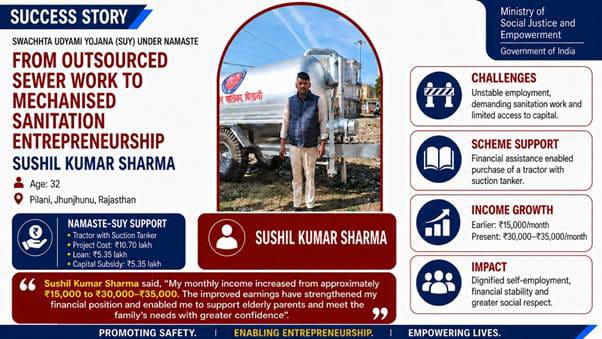
Support under NAMASTE-SUY enabled Sushil to purchase a tractor with a suction tanker, allowing him to undertake mechanised sewer and septic-tank cleaning services.
The project was supported on January 15, 2026, with the following financial structure:
- Total project cost: ₹10.70 lakh
- Loan: ₹5.35 lakh
- Capital subsidy: ₹5.35 lakh
- Equipment acquired: Tractor with suction tanker
The mechanised equipment enabled Sushil to transition from outsourced employment to operating his own sanitation service.
Income Rises to ₹30,000–₹35,000
According to Sushil, the shift to mechanised sanitation services has significantly improved his earnings.
“My monthly income increased from approximately ₹15,000 to ₹30,000–₹35,000. The improved earnings have strengthened my financial position and enabled me to support elderly parents and meet the family’s needs with greater confidence.”
His reported monthly income has therefore increased to roughly double his earlier earnings.
Mechanisation Brings Greater Control and Stability
The use of mechanised equipment has allowed Sushil to carry out sanitation operations more efficiently while reducing dependence on physically strenuous cleaning practices.
His transition has also given him greater control over his work and enabled him to operate as an independent sanitation entrepreneur.
Key changes in Sushil’s livelihood
- Earlier: Outsourced sewer-cleaning worker
- Earlier monthly income: Approximately ₹15,000
- Now: Owner and operator of a mechanised sanitation enterprise
- Current reported income: ₹30,000–₹35,000 per month
- Equipment: Tractor with suction tanker
- Support: ₹5.35 lakh capital subsidy and ₹5.35 lakh loan
NAMASTE-SUY and Dignified Sanitation Work
Sushil’s case highlights the role of financial assistance and mechanisation in creating alternative livelihood opportunities for sanitation workers.
Under the NAMASTE framework, the Swachhta Udyami Yojana seeks to support sanitation workers in moving towards mechanised sanitation services and entrepreneurship.
For Sushil, the assistance has helped convert his experience in sanitation work into an independently operated business, while improving his reported income and financial ability to support his family.
His journey from outsourced sewer-cleaning work to mechanised sanitation entrepreneurship illustrates how access to equipment, credit and capital subsidy can contribute to safer and more sustainable livelihoods in the sanitation sector.
Background: NAMASTE–SUY
NAMASTE (National Action for Mechanised Sanitation Ecosystem) is a government initiative aimed at eliminating hazardous sanitation practices and improving the safety, dignity and livelihoods of sanitation workers. It promotes the shift towards mechanised sanitation, while supporting the rehabilitation and socio-economic development of workers engaged in sanitation-related occupations.
Swachhta Udyami Yojana (SUY) is an entrepreneurship-focused component associated with the sanitation ecosystem, designed to help eligible sanitation workers and their families access financial assistance for acquiring sanitation equipment and establishing related enterprises.
Together, the initiatives seek to encourage safe sanitation practices, mechanisation, entrepreneurship and economic empowerment, while reducing workers’ exposure to hazardous cleaning conditions.