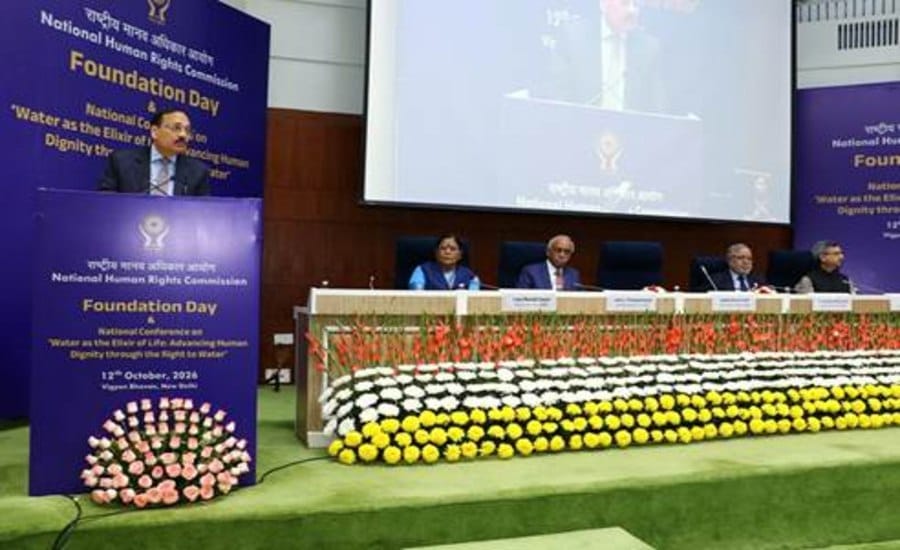
New Delhi: Chief Justice of India Justice Surya Kant has called for stronger human rights protection at the grassroots, highlighting the role of State Human Rights Commissions, access to safe drinking water and the need to ensure that vulnerable people can make their grievances heard.
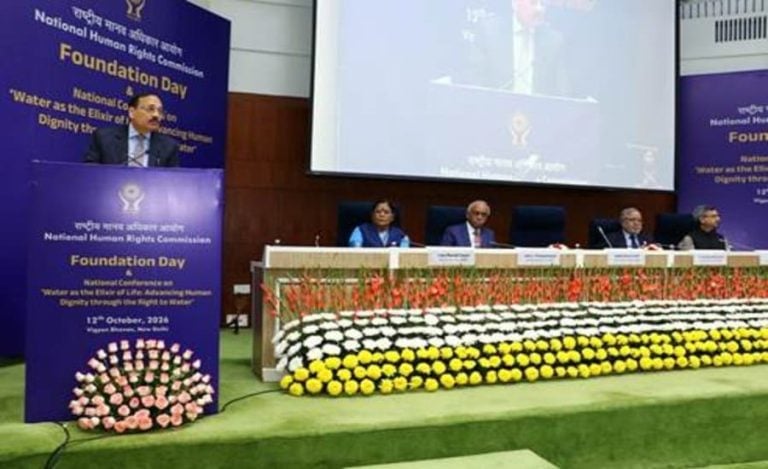
He was speaking as the chief guest at the 33rd Foundation Day celebration of the National Human Rights Commission (NHRC), India, held at Vigyan Bhawan in New Delhi on October 12, 2026. The event also featured a national conference titled “Water as the Elixir of Life: Advancing Human Dignity through the Right to Water.”
Established on October 12, 1993, the NHRC has a mandate to promote and protect human rights. The Foundation Day programme examined how human rights institutions can respond to longstanding concerns as well as newer challenges linked to climate change, water security and digital technologies.
CJI Surya Kant Highlights NHRC’s Role in Protecting Human Dignity
Justice Surya Kant said that the Constitution promises every citizen dignity, equality, liberty and justice. He stressed that these principles must be reflected in everyday life, including in police lockups, hospital wards, villages and other places where people may face difficulties in accessing their rights.
Addressing criticism that human rights commissions can make recommendations but cannot directly command action, the CJI described the NHRC as a guiding light for people facing injustice.
He said the effectiveness of a human rights institution should not be judged only by the number of cases it decides. Its impact should also be measured by whether people who struggle to make their voices heard can access its support.
Justice Kant said commissions must investigate complaints, identify systemic failures and bring overlooked concerns to the attention of the relevant institutions. He also highlighted the role of civil society in presenting ground realities and the contribution of international institutions through scientific knowledge, experience and cooperation.
Why State Human Rights Commissions Matter
The CJI emphasised the importance of State Human Rights Commissions (SHRCs), noting that they are often closer to the places where human rights violations occur.
In a country as large and diverse as India, access to justice can depend on local circumstances. A complaint may arise in a remote village, a neighbourhood or a household far from the national capital.
State commissions can often reach affected communities more directly, understand local conditions and hear complaints in the language in which people express them. According to Justice Kant, this proximity gives them a significant responsibility in protecting human rights.
The observation highlights the need for human rights institutions to remain accessible to people who may face practical, financial or social barriers when approaching formal systems.
NHRC Puts the Right to Water in Focus
The Foundation Day programme also placed the right to water at the centre of the discussion on human dignity.
Commending the NHRC for organising the national conference on water, Justice Surya Kant said access to water should be understood not only as a right of the present generation but also as a responsibility towards the future.
He acknowledged India’s efforts to expand access to drinking water, including through household tap connections in rural areas. However, he stressed that expanding access is only one part of the challenge. Water must also be safe, reliable and available when families need it.
Justice Kant said the government must build and maintain the systems that deliver water to people, while courts must intervene when constitutional rights are violated.
The conference included two technical sessions: “Protection and Restoration of Water Bodies: Safeguarding the Foundation of the Right to Water” and “Protecting Drinking Water Sources: Ensuring Safe and Sustainable Access to Water for All.” The discussions were expected to generate recommendations on protecting water resources and ensuring sustainable access.
NHRC Launches Mobile App to Improve Accessibility
Justice Surya Kant also welcomed the launch of the NHRC’s mobile application and the Commission’s efforts to digitise its records.
The application is intended to make the Commission more accessible, particularly for people who may find it difficult to approach formal institutions through traditional channels.
Digital access can help reduce some practical barriers to seeking assistance. Its effectiveness will depend on how easily people can use the application, access information and navigate the complaint process.
The launch reflects the growing importance of technology in improving public access to institutions and strengthening the delivery of services.
NHRC Chairperson Calls for Reinvention Amid New Challenges
NHRC Chairperson Justice V. Ramasubramanian said human rights institutions must reinvent themselves to remain relevant as the challenges facing the world become more complex.
He observed that human rights concerns can no longer be understood only as disputes between citizens and the state. Non-state actors have gained influence, particularly following the digital revolution.
Justice Ramasubramanian warned that digital platforms can influence opinions, shape thought processes and enable the monitoring of people’s physical and mental activities. He called for renewed institutional commitment to the promotion and protection of human rights, along with improvements in how institutions deliver their responsibilities.
He also drew attention to the relationship between climate change and economic inequality. Citing figures in his address, he said the poorest half of the world’s population accounts for 14% of global carbon dioxide emissions, while the richest 10% account for half.
His remarks linked environmental concerns with questions of fairness, accountability and the protection of vulnerable communities.
NHRC Reaffirms Commitment to Vulnerable Groups
NHRC Member Justice (Dr.) Bidyut Ranjan Sarangi said the Commission remained committed to protecting human rights, including dignity and equality, in accordance with the law and the Constitution.
He noted that the NHRC had expanded its outreach through open hearings and camp sittings to reach people affected by human rights violations.
NHRC Member Vijaya Bharathi Sayani highlighted the relevance of values from ancient Indian texts, including the Rigveda and Upanishads, in promoting mutual respect and human dignity. She called for collective efforts to protect the rights of girls, children, women and other vulnerable groups.
In his opening remarks, NHRC Secretary General Piyush Goyal noted that human rights concerns continue to evolve, with climate change and the digital world presenting new challenges. He outlined the Commission’s work and expressed hope that the national conference would produce meaningful recommendations.
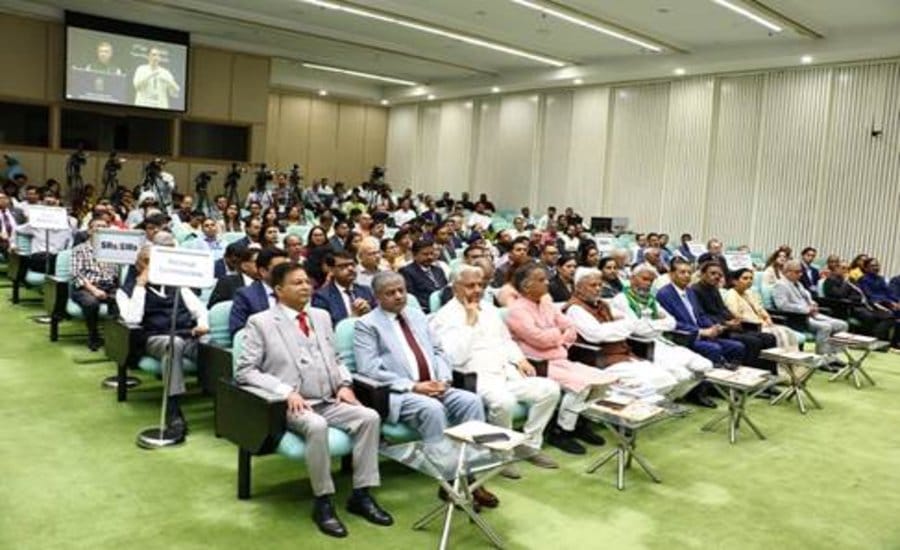
The event brought together representatives from the judiciary, State Human Rights Commissions, international organisations, civil society, academia and other institutions.
Strengthening Human Rights Beyond Institutions
The NHRC’s 33rd Foundation Day highlighted the need to connect constitutional principles with people’s everyday experiences. Access to safe water, protection from rights violations, accessible complaint mechanisms and safeguards in the digital world are all part of this responsibility.
The discussions also underlined that human rights protection requires cooperation among government institutions, courts, civil society and communities. Stronger grassroots outreach and more responsive institutions can help ensure that vulnerable people receive attention when their rights are threatened.
As the NHRC enters its fourth decade, its ability to respond to emerging challenges while remaining accessible to those most in need will remain central to its role in protecting human dignity.