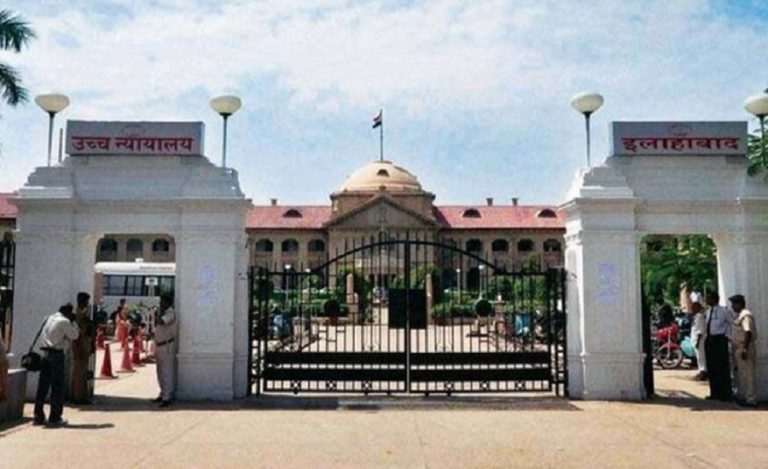
Lucknow: In a significant judgment concerning corruption investigations and the powers of disciplinary authorities, the Allahabad High Court has held that a competent authority cannot independently take a final decision refusing prosecution sanction when the Central Vigilance Commission (CVC) has recommended granting it.
The court clarified that if the competent authority disagrees with the CVC’s recommendation, the matter must be referred to the Department of Personnel and Training (DoPT) for a final decision, rather than being decided unilaterally by the authority concerned.
Justice Subhash Vidyarthi delivered the ruling while hearing a petition filed by an employee of the National Highways Authority of India (NHAI), challenging the sanction granted for his prosecution in a corruption case.
The High Court upheld the prosecution sanction and dismissed the petition challenging the chargesheet, the sanction order and the subsequent judicial proceedings initiated against the employee.
The judgment provides an important clarification on the procedure to be followed when the Central Bureau of Investigation (CBI) seeks permission to prosecute a public servant and the CVC recommends granting such permission.
Competent Authority Cannot Override CVC Recommendation Independently
The central legal question before the High Court was whether a competent authority could refuse prosecution sanction despite a recommendation from the Central Vigilance Commission.
The court held that a competent authority, other than the President, cannot independently take a final decision contrary to the CVC’s advice.
Where the CBI has requested prosecution sanction and the CVC has recommended granting it, any proposal by the competent authority to refuse sanction must be referred to the DoPT for a final decision.
Justice Vidyarthi clarified that the disciplinary authority does not possess the power to conclusively decline prosecution sanction in such circumstances without following the prescribed procedure.
The ruling establishes that disagreement with the CVC’s recommendation must be handled through the designated administrative mechanism rather than through an independent final refusal by the competent authority.
Importantly, the judgment does not mean that the CVC itself grants prosecution sanction. Rather, it clarifies the procedure that must be followed when the competent authority proposes to disagree with the Commission’s advice.
Corruption Case Originated From Alleged Bribe Demand for Fuel Station NOC
The dispute arose from a corruption investigation involving officials of the National Highways Authority of India.
According to the prosecution, a complaint was received alleging that an NHAI official had demanded a bribe in connection with the processing of a no-objection certificate (NOC) required for a fuel station.
Following the complaint, the Central Bureau of Investigation organised a trap operation to investigate the alleged demand.
During the operation, the official allegedly accepted a portion of the bribe amount. According to the CBI, the official subsequently stated that the money had been received on behalf of the petitioner.
Based on the investigation and the material collected, the CBI included the petitioner among the accused in the corruption case.
The investigating agency thereafter approached the competent authority seeking sanction to prosecute the petitioner for offences under the Prevention of Corruption Act.
The allegations formed the basis of the criminal proceedings, but the High Court’s consideration of the sanction issue did not amount to a determination of the petitioner’s guilt.
NHAI Initially Opposed Prosecution Sanction
A significant aspect of the case was the NHAI’s initial position on the CBI’s request for prosecution sanction.
The competent authority had initially declined to grant sanction for prosecuting the petitioner. According to the petitioner’s submissions, sanction had been refused on two occasions.
However, the matter was subsequently examined in light of the advice issued by the Central Vigilance Commission.
The CVC advised the NHAI to grant prosecution sanction in accordance with the procedure prescribed under the relevant Office Memoranda issued by the Department of Personnel and Training.
Following this advice, the competent authority reconsidered its earlier position and granted sanction for prosecution.
The sanction enabled the criminal proceedings against the petitioner to move forward, including the filing of the chargesheet and the subsequent proceedings before the Special Judge.
Petitioner Challenged Reconsideration of Earlier Sanction Refusals
The petitioner approached the Allahabad High Court challenging the legality of the prosecution sanction and the resulting criminal proceedings.
His principal argument was that the competent authority had already refused sanction twice and could not subsequently review or reverse those decisions in the absence of fresh material.
The petitioner questioned the validity of the sanction order on the ground that the earlier decisions declining prosecution had already been taken by the competent authority.
He also challenged the chargesheet filed for offences under the Prevention of Corruption Act and the Special Judge’s order taking cognizance of the alleged offences and summoning him to face trial.
The challenge therefore involved both the administrative decision granting prosecution sanction and the judicial proceedings that followed it.
NHAI Defended Sanction Granted After CVC Advice
In response, the National Highways Authority of India defended the decision to grant prosecution sanction.
The NHAI submitted that the Central Vigilance Commission had advised it to grant sanction in accordance with the procedure laid down in the DoPT’s Office Memoranda.
It stated that the competent authority reconsidered the matter following the CVC’s advice and thereafter issued the prosecution-sanction order.
The NHAI’s position was that the reconsideration had taken place within the prescribed administrative framework governing prosecution sanction and vigilance matters.
This explanation became important in the High Court’s examination of whether the subsequent sanction was legally sustainable despite the earlier refusals.
What the Allahabad High Court Said About DoPT’s Role
Justice Subhash Vidyarthi examined the relationship between the CBI’s request for prosecution sanction, the CVC’s recommendation and the decision-making powers of the competent authority.
The court clarified that where the CBI seeks prosecution sanction and the CVC recommends it, a competent authority proposing to refuse sanction cannot independently make that refusal final.
Instead, the disagreement must be referred to the Department of Personnel and Training for a final decision under the applicable procedure.
The court distinguished between the authority’s power to consider a prosecution-sanction proposal and its power to finally reject such a proposal when the CVC has advised otherwise.
It held that the disciplinary authority does not have the power to take a final decision declining prosecution sanction in these circumstances.
The ruling also specifically recognises an exception concerning the President, making the procedural limitation applicable to competent authorities other than the President.
The judgment thus places emphasis on compliance with the established consultation and referral mechanism in cases involving disagreement with the CVC’s advice.
High Court Upholds Prosecution Sanction Against NHAI Employee
Applying this legal position to the case before it, the Allahabad High Court upheld the prosecution sanction granted against the NHAI employee.
The court rejected the challenge based on the earlier refusals of sanction and accepted the legality of the subsequent sanction issued following reconsideration in light of the CVC’s advice.
It consequently dismissed the petition challenging the prosecution-sanction order, the chargesheet, and the Special Judge’s order taking cognizance and summoning the petitioner.
The decision allows the criminal proceedings arising from the alleged bribery case to continue before the appropriate court.
However, the High Court’s ruling concerns the legality of the sanction process and the challenged proceedings. The question of whether the accused committed the alleged offences remains a matter for determination during the criminal trial.
Why the Judgment Matters for Government Departments and Public Sector Bodies
The Allahabad High Court’s ruling has significance for government departments, public sector organisations and disciplinary authorities dealing with corruption investigations.
Prosecution sanction is an important legal requirement in cases involving certain categories of public servants under the Prevention of Corruption Act. It serves as a statutory safeguard while also forming part of the process through which corruption allegations may proceed to trial.
The judgment clarifies that where the CVC has recommended sanction following a request from the CBI, a competent authority cannot bypass the prescribed procedure by independently issuing a final refusal.
The ruling reinforces the role of the DoPT in resolving disagreements between the competent authority and the CVC in the circumstances covered by the applicable instructions.
It also highlights the importance of procedural compliance in prosecution-sanction decisions, particularly when an authority has previously taken a different view of the material presented by an investigating agency.
For departments and public sector organisations handling vigilance matters, the judgment underscores the need to follow the prescribed decision-making framework when dealing with recommendations from the CVC.
By upholding the sanction against the NHAI employee, the High Court has reaffirmed that prosecution-sanction decisions must conform to the applicable legal and administrative procedure, while leaving the merits of the corruption allegations to be examined during trial.