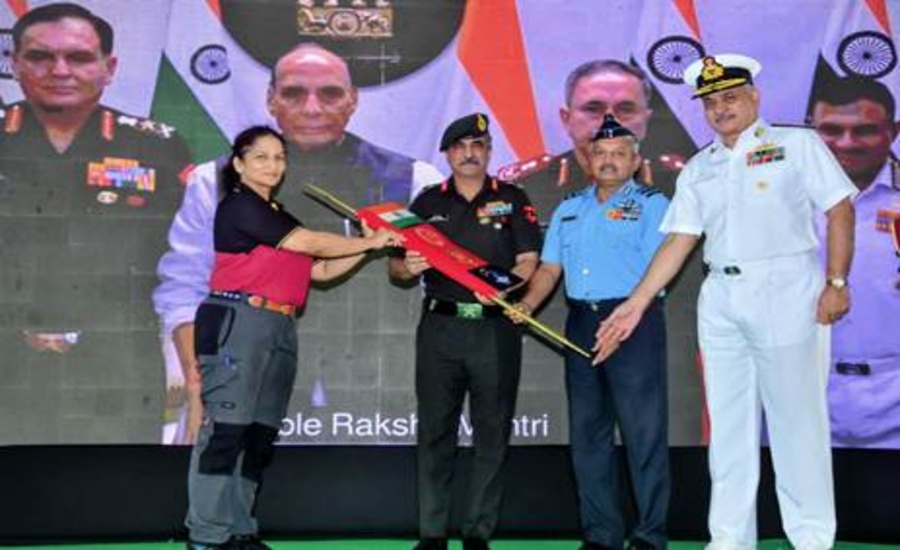
New Delhi: Samudra Pradakshina, India’s first Tri-Service all-women sailing expedition, has successfully completed a 314-day journey around the world. Defence Minister Rajnath Singh virtually flagged in the expedition and praised the nine women officers for their courage, teamwork, and determination. The historic mission covered nearly 25,500 nautical miles across four oceans, making it one of India’s biggest maritime achievements.
Key Highlights of Samudra Pradakshina
- India’s first Tri-Service all-women circumnavigation sailing expedition.
- Nine women officers from the Army, Navy and Air Force completed the mission.
- Journey lasted 314 days.
- Covered nearly 25,500 nautical miles.
- Sailed across four oceans.
- Crossed the Equator twice and the International Date Line.
- Rounded Cape Leeuwin, Cape Horn and the Cape of Good Hope.
- Successfully crossed the dangerous Drake Passage.
- Mission carried out on the indigenously built IASV Triveni.
Read also: Rajnath Singh Highlights the Hidden Weapon Behind India’s Military Strength
What Is Samudra Pradakshina
Samudra Pradakshina is India’s first-ever Tri-Service all-women global sailing expedition. The mission was carried out on IASV Triveni, an Indian Army sailing vessel, by nine women officers from the Army, Navy and Air Force.
The expedition began after Rajnath Singh virtually flagged it off from Mumbai on September 11, 2025, and successfully concluded on July 22, 2026, after sailing around the world.
Samudra Pradakshina: How Long Was the Voyage
The crew sailed continuously for 314 days. During this period, they travelled nearly 25,500 nautical miles, making the expedition one of India’s longest and most challenging sailing missions.
Which Oceans and Major Maritime Routes Did the Team Cross
The expedition successfully completed all internationally accepted conditions for a world circumnavigation. The team:
- Crossed four oceans
- Crossed the Equator twice
- Crossed the International Date Line
- Rounded the Three Great Capes
- Cape Leeuwin
- Cape Horn
- Cape of Good Hope
- Successfully crossed the Drake Passage
Rajnath Singh Calls the Samudra Pradakshina a Symbol of Nari Shakti
Defence Minister Rajnath Singh said the expedition reflects the strength of Nari Shakti, Tri-Service cooperation, and New India’s confidence. He said the courage shown by the women officers proves that determination is stronger than any challenge.
According to him, the mission is an inspiration for every young Indian, especially women who dream of serving the nation.
How Did the Samudra Pradakshina Strengthen India’s Defence Forces
The mission brought together officers from the Army, Navy and Air Force under one team. The officers lived, trained and sailed together for more than ten months.
According to the Defence Minister, the expedition showed how joint planning, teamwork and coordination improve India’s operational strength.
IASV Triveni Showcased Aatmanirbhar Bharat
The expedition was completed on IASV Triveni, an indigenously built 50-foot sailing vessel. Rajnath Singh said the vessel represents Aatmanirbhar Bharat and demonstrates India’s engineering excellence, innovation and indigenous capability.
Samudra Pradakshina Boosted India’s Global Image
The expedition also served as an important mission of military diplomacy. During port visits in different countries, the crew showcased India’s culture, maritime heritage, military professionalism and values.
The government said the voyage strengthened India’s friendship with many nations and enhanced the country’s soft power.
Senior Defence Leaders Attended the Samudra Pradakshina Ceremony
Several senior military leaders attended the flag-in ceremony. These included:
- Chief of Defence Staff General NS Raja Subramani
- Chief of the Naval Staff Admiral Krishna Swaminathan
- Chief of the Army Staff General Dhiraj Seth
- Vice Chief of the Air Staff Air Marshal Ashutosh Dixit
Military delegates from Australia, New Zealand, Argentina and South Africa also attended the event.
Why Is Samudra Pradakshina Important
The expedition is important because it:
- Showcases the growing role of women in India’s Armed Forces.
- Demonstrates successful Tri-Service cooperation.
- Highlights India’s indigenous defence capability.
- Strengthens India’s maritime presence.
- Promotes India’s soft power globally.
- Inspires young women to join the Armed Forces.
Read also: What Makes INS Arnala Special? Inside India’s First Home-Built Anti-Submarine Shallow Water Craft