New Delhi: On the occasion of Hindi Diwas, the Supreme Court announced the imminent launch of its ‘Jan Soochna Seva’ (Public Information Service), aimed at making important judicial decisions more accessible to the general public.
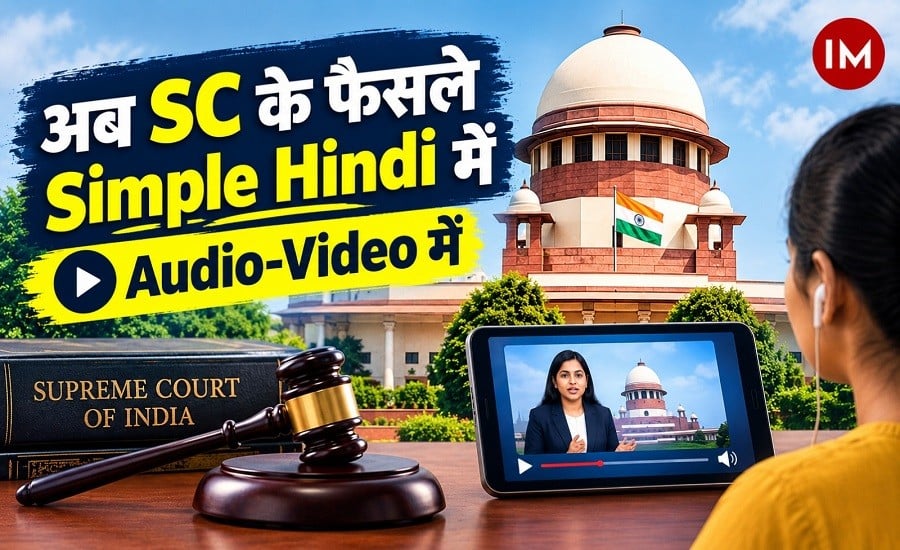
Under the initiative, selected major Supreme Court judgments and orders will be accompanied by simple Hindi summaries. The Court will also release daily audio and video bulletins of around 15 to 30 minutes explaining important rulings, their implications and the possible course of action arising from them.
The service is intended particularly for people who may find lengthy judgments and complex legal terminology difficult to read or understand.
The Supreme Court said the initiative would also make judicial information more accessible to persons with disabilities.
The Hindi service will be launched shortly after the necessary arrangements are completed. Each summary will also carry a link to the corresponding official judgment or order, enabling users to access the original court document whenever they want to examine the complete ruling.
The service will initially be available in Hindi and is proposed to be expanded subsequently to other Indian languages.
Were Supreme Court Verdicts Not Available in Hindi Until Now?
No. Hindi versions of several Supreme Court judgments have already been made available, and Hindi content is also available on the Court’s website.
Therefore, the ‘Jan Soochna Seva’ is not the first initiative through which the Supreme Court has made judicial information available in Hindi.
The significant difference is the format and manner of communication.
Instead of simply translating a judgment, the new service will explain important rulings in simple, conversational Hindi through audio and video. This is intended to help people understand the essence of a decision without having to read lengthy legal documents or navigate complicated legal terminology.
Read also: Why This Supreme Court Judgment Could Change Human Rights Litigation In India
What Will the ‘Jan Soochna Seva’ Offer?
The service will provide summaries of important Supreme Court judgments and orders in simple Hindi.
These will be converted into short audio and video bulletins explaining the key aspects of significant rulings. The objective is to allow citizens to quickly understand what the Court has decided, why the decision matters and what its implications may be.
The summaries will not replace the original judgments. Instead, they will serve as an accessible means of understanding them, with users being able to follow the link provided with each summary to read the official court document.
What Is the Official Language of the Supreme Court?
Under Article 348 of the Constitution, English is the language prescribed for proceedings in the Supreme Court and High Courts.
English is also the mandated language for official judgments and orders of the higher judiciary.
However, translations and other facilities in Indian languages have long been used to disseminate judicial information to a wider section of the public.
The new initiative builds on these efforts by focusing not merely on translation but on explaining important rulings in simple language and through formats that can be heard and watched.
Why Is the Initiative Necessary?
Supreme Court judgments frequently contain specialised legal terminology and can run into hundreds of pages. For a person without legal training, understanding the reasoning, implications and practical consequences of a judgment can therefore be difficult.
The new audio-video format is designed to bridge this gap.
By presenting the key points of important rulings in simple Hindi, the service is expected to make judicial information quicker and easier to understand for people who may otherwise struggle with conventional legal documents.
It is particularly aimed at making important decisions understandable to the common person rather than limiting access to those familiar with legal language.
Who Will Benefit From the Service?
Ordinary citizens and litigants are expected to be among the principal beneficiaries of the initiative.
Lawyers and others who want a quick understanding of significant judgments may also find the short audio-video explanations useful.
The Court has specifically highlighted the potential benefits for persons with disabilities. Audio and video-based dissemination can provide an additional and more accessible means of receiving judicial information for people who face difficulties with conventional text-based documents.
The initiative therefore seeks to improve not only language accessibility but also accessibility of judicial information more broadly.
Will the Service Be Available Only in Hindi?
No. Hindi will be the starting language for the ‘Jan Soochna Seva’, but the Supreme Court has said that the service will subsequently be expanded to other Indian languages.
The proposed expansion could make important Supreme Court decisions easier to understand for citizens across different linguistic regions of the country.
The initiative thus seeks to take judicial information beyond English and conventional written translations and communicate it in formats and languages that are more accessible to the public.
Is This the First Time the Supreme Court Has Emphasised Indian Languages?
No. The Supreme Court website already provides Hindi content and Hindi versions of judgments. Judicial information has also been made available through translation and other language-access facilities.
What distinguishes the ‘Jan Soochna Seva’ is its focus on explaining selected important judgments in simple, conversational language through audio and video bulletins.
The initiative therefore represents an effort to make judicial communication more accessible rather than merely increasing the availability of translated legal documents.
Aims to Bridge the Gap Between Courts and Citizens
The ‘Jan Soochna Seva’ is intended to bridge the gap between the language of higher judicial proceedings and the public’s need to understand important court decisions.
By combining simple Hindi explanations with audio and video formats, the Supreme Court is seeking to make significant judgments easier to comprehend while retaining access to the original official documents.
With the service beginning in Hindi and expected to expand to other Indian languages, the initiative could provide a wider section of citizens with easier access to information about the decisions of the country’s highest court.
Read also: Why Did The Supreme Court Order An Inquiry Against A Judicial Officer? Full Story Here