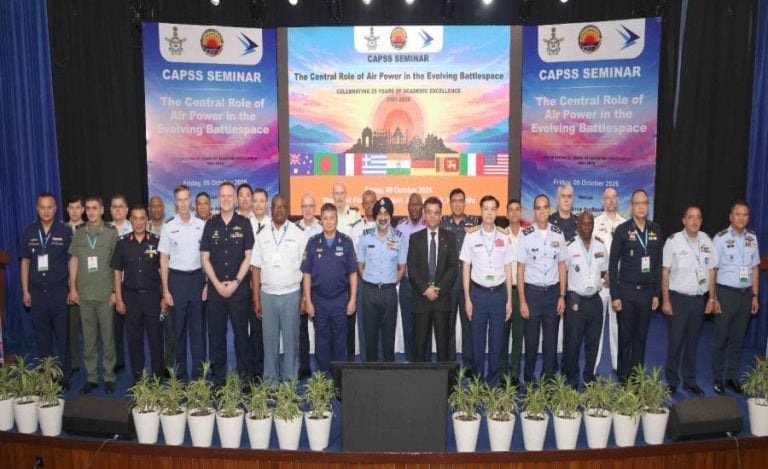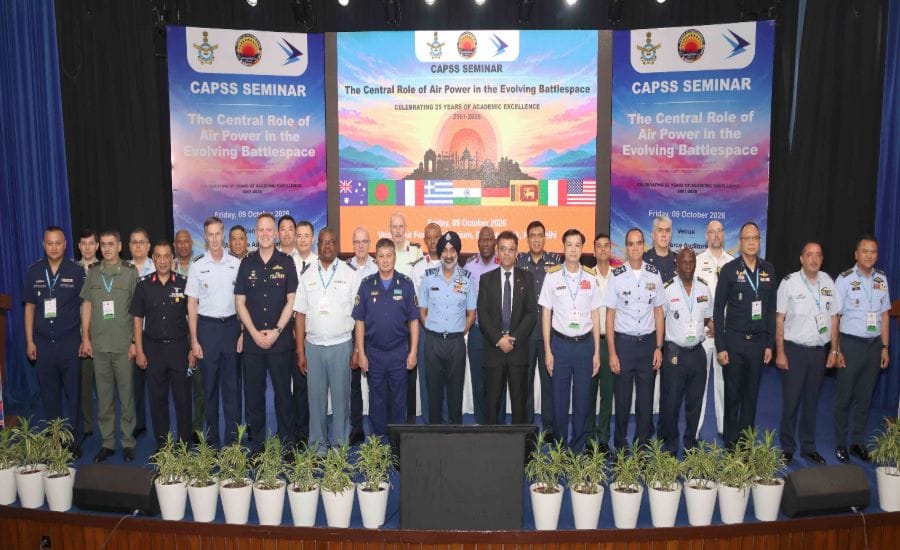
New Delhi: The Indian Air Force (IAF) and the Centre for Aerospace Power and Strategic Studies (CAPSS) organised a seminar in New Delhi on October 9 as part of Exercise Tarang Shakti 2026. The event examined how air power is evolving amid changing battlefield conditions, technological advances and new security challenges.
Held at the Air Force Auditorium in Subroto Park, the seminar carried the theme “The Central Role of Air Power in the Evolving Battlespace.” It brought together representatives of partner air forces from across the continents, senior military leaders, academics, industry representatives and media professionals.
The discussions focused on future air warfare, operational cooperation, integrated military capabilities and the growing importance of information warfare in modern conflicts.
Air Chief Marshal AP Singh Highlights Future Priorities
Chief of the Air Staff Air Chief Marshal AP Singh delivered the inaugural address, emphasising the need for integrated capabilities, operational resilience and stronger interoperability among air forces.
He highlighted the importance of developing manned and unmanned operations together, supported by clear operational doctrines. He also stressed that sensors, weapon systems and unmanned platforms must connect with communication and data networks from the beginning.
The Air Chief also underlined the need to strengthen supply chains, adopt innovative training methods and build the capacity to sustain prolonged military operations.
Beyond combat, he highlighted the role of air power in humanitarian assistance, supporting partner countries and strengthening India’s international standing. He called for focused discussions on information warfare and perception management, alongside greater exchanges of operational experience and closer cooperation among partner air forces.
Exercise Tarang Shakti Takes Discussions Beyond Flying Operations
The seminar followed the operational engagement during Exercise Tarang Shakti-26, allowing participants to examine air power at a strategic and conceptual level.
While flying exercises offer opportunities to practise operational coordination, the seminar provided a platform to discuss the doctrines and cooperation needed to address future challenges.
The organisers aimed to identify key doctrinal priorities, explore areas for future collaboration and encourage informed dialogue among participating air forces.
By bringing together military leaders, researchers, industry representatives and media professionals, the event also connected operational experience with broader discussions about strategy, technology and the changing nature of warfare.
First Session Examines the Transformation of Air Warfare
The first working session focused on the transformation of air warfare in the 21st century. Former Chief of the Air Staff Air Chief Marshal VR Chaudhari chaired the session.
Discussions examined how air forces are moving beyond the traditional objective of achieving air superiority towards broader concepts such as battlespace control and decision dominance.
Participants also explored the role of media as a strategic tool in modern conflicts. The discussions highlighted that air power increasingly depends on an interconnected operational ecosystem rather than control of the skies alone.
The session brought together traditional military concepts and emerging themes, reflecting the need for air forces to adapt their strategies to rapidly changing battlefield conditions.
Second Session Explores Air Power as an Instrument of National Strategy
The second working session was chaired by Air Marshal Stephen Chappell, Chief of the Air Staff of the Royal Australian Air Force.
The session examined air power as an instrument of national power, with discussions covering deterrence, coercion, escalation control and human capital development.
Participants considered the reforms needed to prepare air forces for emerging and future battlefield requirements. The discussion also examined how air power can contribute to deterrence and help manage escalation during conflicts.
The session highlighted the importance of combining military capabilities with strategic planning, trained personnel and appropriate operational frameworks to address complex security challenges.
CAPSS Marks Its Silver Jubilee Year
The seminar also highlighted the role of the Centre for Aerospace Power and Strategic Studies in India’s security and strategic research landscape.
Air Marshal Nagesh Kapoor (Retd.), Director General of CAPSS, delivered the welcome address. He discussed the role of air power in contemporary conflicts and outlined the contribution of the organisation to research and analysis in this field.
Established in 2001, CAPSS is an autonomous research and analysis body focused on national security, nuclear issues and aerospace studies. The year 2026 marks its Silver Jubilee.
Its work provides a platform for examining strategic developments and the changing role of aerospace capabilities in national security.
Stronger Cooperation for Emerging Security Challenges
The seminar concluded with discussions offering participants and online viewers a range of perspectives on the future of air power.
The deliberations reflected the growing need for cooperation among air forces as military operations become increasingly connected to advanced technology, information systems and wider strategic objectives.
The event also highlighted the importance of exchanging operational experience and developing common approaches to shared security challenges.
As Exercise Tarang Shakti 2026 brings international air force participants together, the seminar added a strategic dimension to the engagement by focusing on the doctrines, capabilities and partnerships that could shape future air warfare.
Read also: Tarang Shakti 2026: Rajnath Singh Highlights Defence Self-Reliance and Global Cooperation in Jodhpur