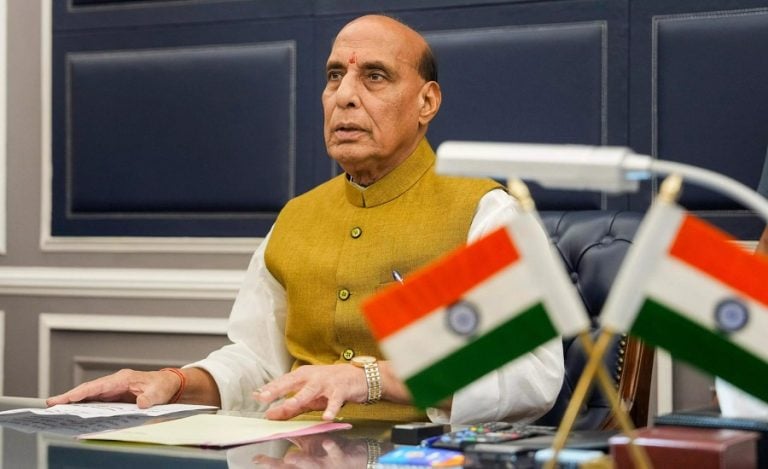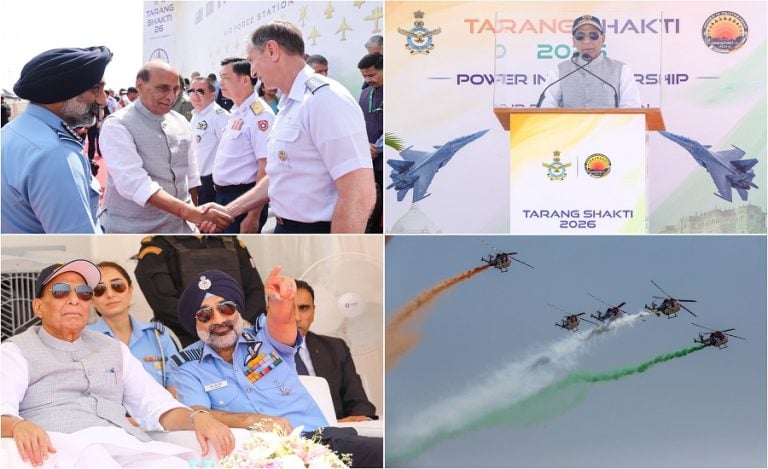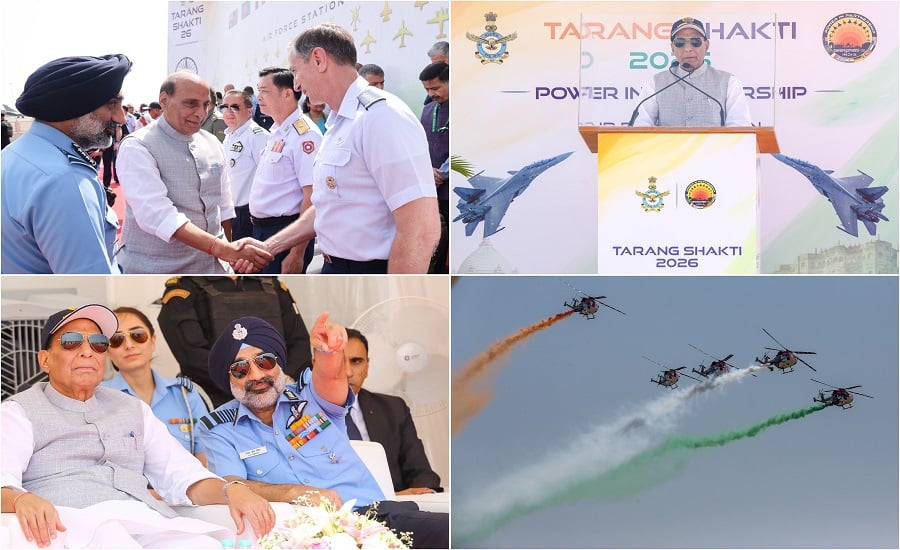
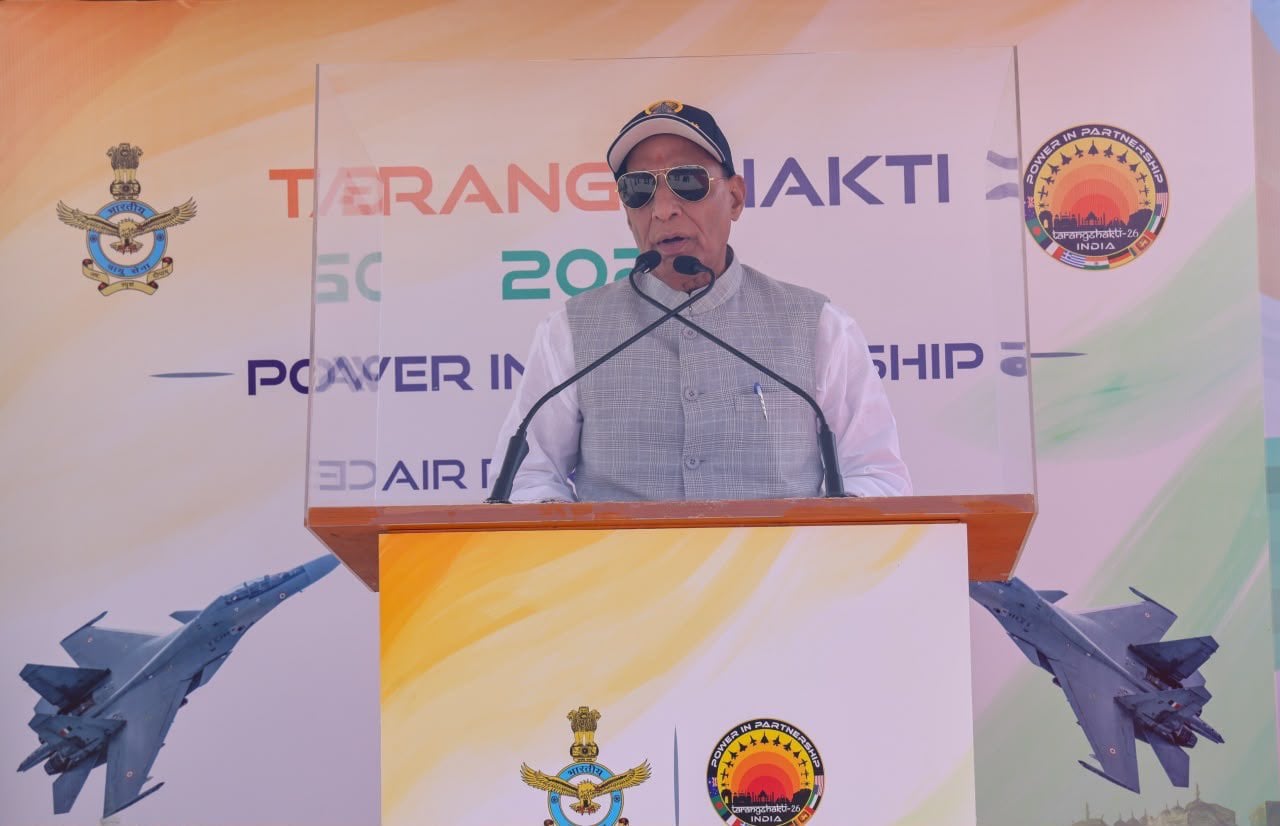
New Delhi: Defence Minister Rajnath Singh has emphasised the importance of self-reliance in defence manufacturing, technological innovation and international cooperation while addressing participants of Exercise Tarang Shakti 2026 at Air Force Station Jodhpur on October 10. The second edition of the multinational air exercise has brought together air forces from seven friendly foreign countries and representatives from 32 observer nations to strengthen operational cooperation and interoperability.
Hosted by the Indian Air Force (IAF) from September 26 to October 12, 2026, Exercise Tarang Shakti 2026 involves participating countries Australia, Bangladesh, France, Germany, Sri Lanka, the United Arab Emirates and the United States. The exercise provides a platform for air forces to exchange operational knowledge, improve coordination and understand different aircraft, technologies and military doctrines.
Addressing the gathering, Rajnath Singh highlighted the changing nature of modern warfare and India’s commitment to developing indigenous defence capabilities while strengthening partnerships with trusted nations.
“Different nations, different aircraft, different experiences, but one sky. That is the message of Tarang Shakti,” the Defence Minister said, emphasising the importance of mutual understanding and cooperation among participating air forces.
Rajnath Singh Emphasises Changing Nature of Modern Warfare
Rajnath Singh said modern warfare is expanding beyond the traditional domains of land, sea and air to include space, cyberspace, the electromagnetic spectrum and the information domain. He highlighted the increasing role of unmanned systems, drones, artificial intelligence, electronic warfare and long-range precision weapons in contemporary military operations.
According to the Defence Minister, future military effectiveness will depend increasingly on how quickly armed forces can gather information, understand situations, make decisions and act.
“Future military power will be defined by the speed of sensing, understanding, deciding and acting,” he said.
He stressed that speed, precision, information and integration have become critical elements of military capability. He also underlined the need for continuous vigilance amid changing geopolitical conditions and rapid technological advancements in the defence sector.
Read also: Tarang Shakti 2026: Why France’s Top Air Commander Sees Mirage 2000 In India’s Tejas Fighter Jet
Atmanirbharta in Defence Remains a National Priority
The Defence Minister said India, under the leadership of Prime Minister Narendra Modi, has adopted self-reliance in defence as a national policy to strengthen its resilience against emerging security challenges.
He emphasised that a country must have the ability to manufacture its own weapons and critical technologies to sustain its defence preparedness during prolonged conflicts and periods of uncertainty.
Rajnath Singh also highlighted the transformation of the Indian Air Force since Independence, noting its evolution from a force operating with limited resources into a modern aerospace power equipped with advanced aircraft, precision weapons, sophisticated sensors and integrated networks.
He clarified that Atmanirbhar Bharat does not mean isolation from the world. Instead, it involves developing domestic capabilities to design, develop, manufacture, maintain and upgrade critical defence technologies while continuing to cooperate with other countries.
Tejas, Prachand, Akash and AMCA Highlight India’s Defence Capabilities
Rajnath Singh highlighted India’s growing aerospace and defence manufacturing ecosystem, pointing to several indigenous platforms and systems that demonstrate the country’s progress in defence technology.
Key programmes and systems highlighted by the Defence Minister included:
- Tejas fighter aircraft: India’s indigenous Light Combat Aircraft programme.
- Dhruv and Rudra helicopters: Indigenous helicopter platforms supporting different operational requirements.
- Prachand: India’s indigenously developed Light Combat Helicopter.
- Light Utility Helicopter (LUH): An indigenous programme aimed at meeting light helicopter requirements.
- Akash air defence system: An indigenous surface-to-air missile system.
- AESA radars and electronic systems: Technologies that strengthen surveillance, detection and combat capabilities.
- Advanced Medium Combat Aircraft (AMCA): India’s programme aimed at developing a fifth-generation stealth fighter aircraft.
The Defence Minister also stressed the importance of advanced aero-engine development and co-production in strengthening India’s aerospace capabilities.
He said India was keen to explore cooperation with like-minded countries in research, co-development, co-production, maintenance, training and innovation.
Emphasising the importance of reliable international partnerships, Rajnath Singh stated, “The defence relationships of the future will be about technology and trust, not just about platforms.”
Exercise Tarang Shakti 2026 Strengthens International Defence Cooperation
Rajnath Singh described Exercise Tarang Shakti as an important platform for translating defence capabilities, technological cooperation, interoperability and trust into operational experience.
The multinational exercise allows participating air forces to operate alongside one another, exchange professional knowledge, evaluate procedures and understand different platforms, doctrines and approaches to mission planning.
Its key objectives include:
- Improving operational coordination among participating air forces.
- Sharing knowledge, experience and best practices.
- Enhancing interoperability between different aircraft and military systems.
- Strengthening professional relationships among aircrews and commanders.
- Identifying opportunities to improve training, tactics, technology and operational procedures.
The Defence Minister called upon the Indian Air Force to incorporate the lessons learned during the exercise into its training, tactics, technology, doctrine and future capability development.
He also expressed confidence that participating nations would build on the relationships developed during the exercise to explore further opportunities for aerospace and defence cooperation.
Seven Foreign Air Forces Participate Alongside 32 Observer Nations
The second edition of Exercise Tarang Shakti builds on the inaugural edition held in 2024 and reinforces India’s commitment to constructive defence engagement and international cooperation.
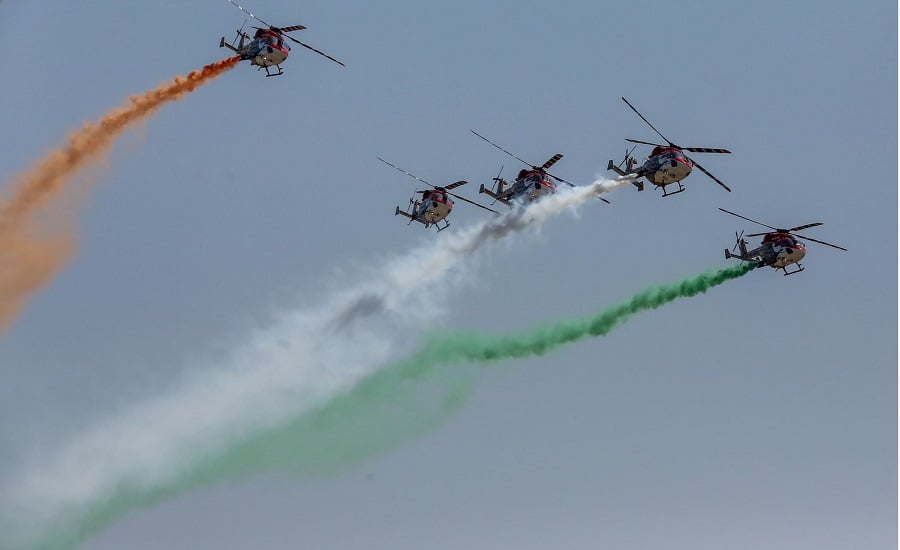
The exercise features a range of combat, transport, surveillance and air-to-air refuelling capabilities, providing opportunities for joint mission planning and operational learning.
The participating countries are:
- Australia
- Bangladesh
- France
- Germany
- Sri Lanka
- United Arab Emirates
- United States of America
In addition to these seven participating countries, 32 observer nations are involved in the exercise.
The participation of indigenous Indian platforms, including the Light Combat Aircraft Tejas and the Light Combat Helicopter Prachand, also showcases India’s progress in aerospace design, engineering and manufacturing.
Operation Sindoor Highlights Importance of Air Power and Preparedness
The contemporary relevance of Exercise Tarang Shakti is also reflected in the role of air power during Operation Sindoor, which demonstrated the Indian Air Force’s ability to conduct precise, calibrated and effective operations in support of national security objectives.
The operation highlighted the importance of operational preparedness, integrated planning, credible deterrence and the effective use of air power in a complex security environment.
Experience gained through operational deployments reinforces the importance of exercises such as Tarang Shakti, which provide opportunities to strengthen professional understanding, evaluate operational approaches and prepare for emerging challenges in modern warfare.
Cultural Programmes and Professional Engagements Form Part of Exercise
Beyond flying operations, Exercise Tarang Shakti 2026 has included professional engagements, industrial visits and cultural interactions designed to strengthen relationships among participating nations.
The programme featured several activities, including:
- Yoga sessions.
- Visits to heritage sites.
- Industrial visits and professional exchanges.
- An International Night celebrating the traditions and cultures of participating countries.
These engagements complement the operational aspects of the exercise by promoting cultural understanding, professional interaction and stronger relationships among military personnel from different countries.
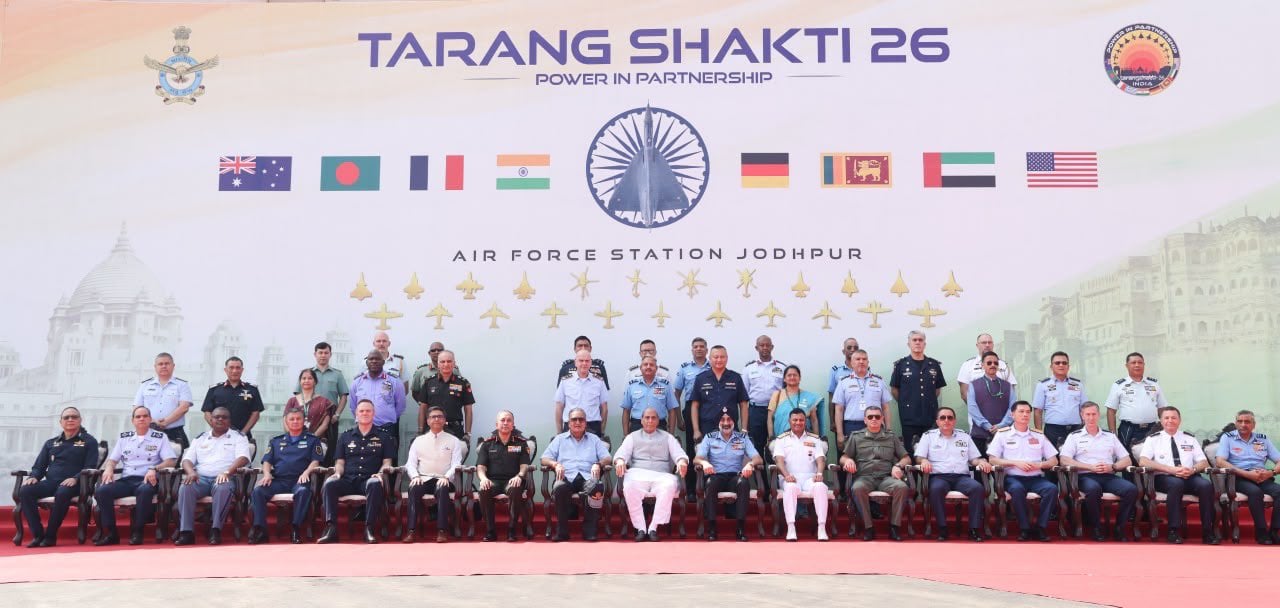
Senior Defence Leadership Attends Exercise Tarang Shakti 2026
Several senior defence officials and dignitaries attended the event at Air Force Station Jodhpur.
Those present included:
- Rajnath Singh, Defence Minister.
- General N. S. Raja Subramani, Chief of Defence Staff.
- Air Chief Marshal A. P. Singh, Chief of the Air Staff.
- Admiral Krishna Swaminathan, Chief of the Naval Staff.
- Officials from the Ministry of Defence.
- Representatives and officials from participating countries.
Congratulating the Indian Air Force and all organisations and personnel involved, Rajnath Singh appreciated the contributions of the participating nations in strengthening professional understanding and operational cooperation.
He expressed hope that the participating contingents would return with valuable professional insights and a deeper understanding of India’s capabilities and perspectives.
Exercise Tarang Shakti Reinforces India’s Defence Partnerships
Exercise Tarang Shakti 2026 underscores India’s approach of combining indigenous defence capabilities with cooperation among trusted international partners. Rajnath Singh emphasised that India must be capable of acting independently when required while also working effectively with other nations when their interests and responsibilities converge.
The exercise, scheduled to conclude on October 12, aims to strengthen operational interoperability, encourage technological collaboration and deepen professional relationships among participating air forces.
Through the combination of multinational training, indigenous aerospace platforms and international engagement, Exercise Tarang Shakti reinforces India’s commitment to defence self-reliance and cooperation in addressing the evolving challenges of modern warfare.
Read also: India’s Defence Exports Hit ₹38,424 Crore as Rajnath Singh Pushes for Greater Private Sector Role