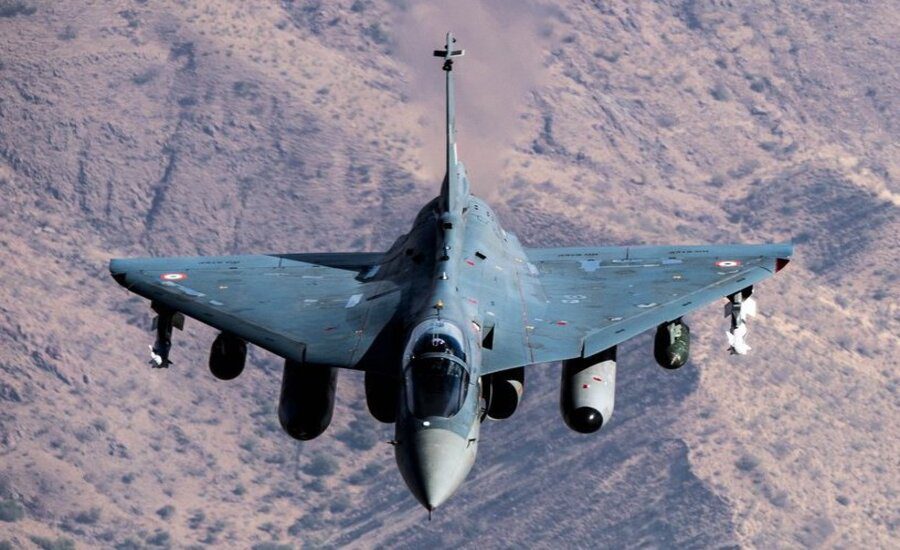
New Delhi: The Tejas fighter jet software glitch has been identified as the main cause behind the February 7 runway incident involving an Indian Air Force (IAF) Light Combat Aircraft. After a detailed investigation and fleet-wide inspection, the IAF confirmed that the issue was linked to the aircraft’s onboard computer software rather than any mechanical or structural failure. The discovery has prompted a major software upgrade across the entire Tejas fleet, developed jointly by the IAF and Hindustan Aeronautics Limited (HAL). The move aims to strengthen operational safety and ensure reliability for India’s indigenous fighter aircraft program.
Details of Tejas Fighter Jet Crash
On 7 February 2026, an Indian Air Force Tejas light combat aircraft was involved in a runway excursion while attempting to take off from a forward airbase along India’s western front.
Read also: The Future of Indian Air Power: How Tejas Mk2 and AMCA Are Transforming India’s Long-Range Air Power
The aircraft veered off the runway and slid into a nearby mud ditch during the takeoff phase. The pilot survived the incident but suffered injuries. Initial reports suggested a possible technical malfunction, which led the IAF to immediately launch a detailed investigation.
As a precautionary measure, the Air Force also conducted exhaustive checks on the entire Tejas fleet to identify any potential safety risk.
Tejas Fighter Jet Crash: Investigation Reveals Critical Software Glitch
The investigation found that the root cause of the mishap was a glitch in the onboard computer software of the aircraft.
Defence sources confirmed that the incident was not caused by mechanical or metallurgical failure. Instead, a software issue affected the aircraft’s internal digital systems during the takeoff process.
During the inspection process, engineers examined multiple critical components, including:
- Undercarriage metallurgy
- Electromagnetic braking systems
- Digital flight control software
- Avionics and onboard computer systems
After extensive testing, the investigation concluded that the software architecture inside the aircraft’s onboard computer triggered the malfunction.
Tejas Fighter Jet Crash: Fleet-Wide Software Upgrade Underway
Following the discovery, the Indian Air Force and Hindustan Aeronautics Limited (HAL) jointly developed a software fix for the Tejas platform.
The updated software is currently undergoing rigorous flight testing before it is rolled out across the entire fleet. Once validated, the upgrade will be installed in all operational Tejas aircraft to prevent similar incidents in the future.
According to defence sources, such software updates are common in modern fighter aircraft because their systems rely heavily on advanced avionics and digital flight controls.
Tejas Fleet Status in the Indian Air Force
The Tejas is India’s indigenously developed Light Combat Aircraft (LCA) designed and manufactured by HAL as part of the country’s push for defence self-reliance.
Key fleet details include:
- Around 38 Tejas aircraft currently operated by the IAF
- 40 jets originally ordered in the initial batch
- Two aircraft lost in previous crashes
- 180 Tejas Mk1A fighters ordered for future induction
The February 7 event marks the third major safety incident involving Tejas since its induction in 2016.
Previous Tejas Fighter Jet Crash
The Tejas fighter program has faced a few operational incidents in recent years:
1. March 2024 – Jaisalmer crash: A Tejas jet crashed after a firepower demonstration. The pilot successfully ejected.
2. November 2025 – Dubai Airshow crash: A Tejas aircraft crashed during an aerobatic display, resulting in the death of Wing Commander Namansh Syal.
Despite these incidents, officials maintain that the Tejas aircraft maintains a strong safety record among modern fighter jets.
Court of Inquiry Still Ongoing
The Indian Air Force has also initiated a formal Court of Inquiry to examine the sequence of events leading to the February 7 incident.
The findings of this inquiry may lead to:
- Additional safety protocols
- Improved software validation processes
- Stronger maintenance and inspection standards
The results could also help guide future upgrades for upcoming variants such as the Tejas Mk1A.
Importance for India’s Indigenous Fighter Program
The Tejas program plays a crucial role in India’s Atmanirbhar Bharat (self-reliant India) defence strategy.
Ensuring the reliability of the aircraft is essential because:
- The IAF needs new fighters to replace ageing fleets like MiG-21.
- The Tejas Mk1A is expected to significantly boost squadron strength.
- Indigenous aircraft reduce dependence on foreign defence imports.
The fleet-wide software upgrade shows how the Indian defence ecosystem is quickly identifying and correcting technical issues to maintain operational readiness.