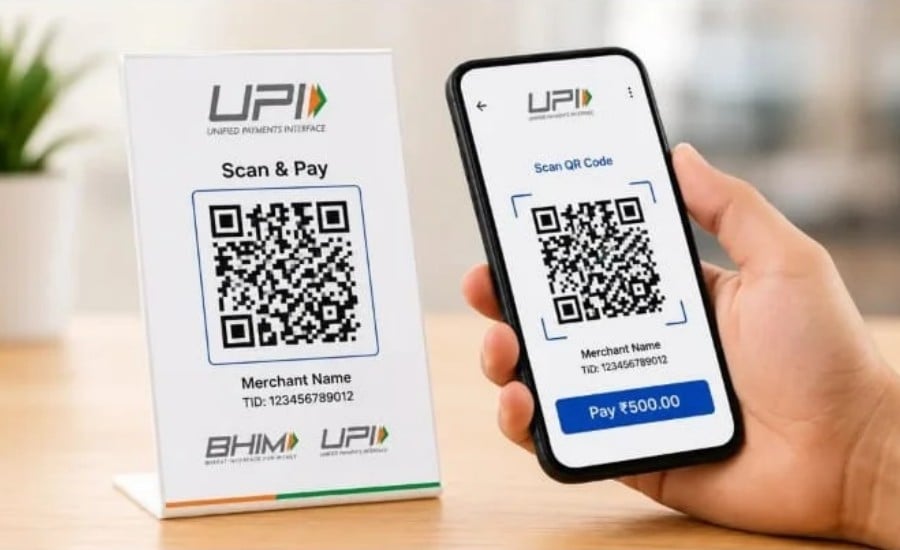
New Delhi: Ten years after its launch, the Unified Payments Interface (UPI) has evolved from a new payment system backed by 21 banks into the backbone of India’s digital payments ecosystem, with 703 banks live on the platform and more than 24,161 crore transactions recorded in FY 2025–26.
Launched on April 11, 2016, by the National Payments Corporation of India (NPCI) under the regulatory oversight of the Reserve Bank of India (RBI), UPI has expanded rapidly in both transaction volume and value while becoming an increasingly important channel for everyday retail payments.
From 373 Transactions to 24,000 Crore
UPI’s growth over the past decade has been marked by a dramatic increase in usage.
Read Also: UPI Charges: No Fee for Users, MDR May Apply Only to Select Large Merchant Transactions
- FY 2016–17: 2 crore annual transactions
- FY 2025–26: 24,161.69 crore transactions
- Transaction value in FY 2016–17: ₹0.07 lakh crore
- Transaction value in FY 2025–26: ₹314 lakh crore
- Year-on-year volume growth: 30%
- Year-on-year value growth: 20.59%
- Banks live on UPI: 21 at launch → 703 by March 2026
The platform recorded 2,264 crore transactions in March 2026, its highest monthly volume, involving transactions worth ₹29.53 lakh crore.
Why UPI Became an Everyday Payment Tool
The growth of UPI is not limited to high-value transfers. A substantial portion of its activity comes from frequent, small-value payments.
According to the PIB release, 86% of UPI person-to-merchant (P2M) transactions in FY 2025–26 were below ₹500.
This points to UPI’s widespread use for routine purchases and merchant payments, alongside its role in person-to-person transfers.
UPI’s payment mix
- P2M transactions: 63% of transaction volume
- P2P transactions: 71% of transaction value
- P2M transactions below ₹500: 86%
- P2P transactions below ₹500: 59%
The figures show how UPI serves two distinct purposes: frequent low-value retail payments and larger transfers between individuals.
703 Banks Now Part of the UPI Ecosystem
The platform’s institutional network has expanded substantially since its launch.
UPI began with 21 participating banks in April 2016. By March 2026, the number had risen to 703 banks, spanning public sector banks, private banks, small finance banks, payment banks and cooperative banks.
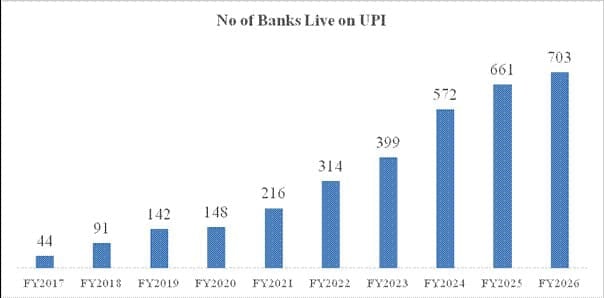
This wider participation has helped extend UPI’s reach across different parts of the banking ecosystem.
India Accounts for Nearly Half of Global Real-Time Payments
UPI’s scale has also made it a significant player globally.
The PIB release states that UPI accounted for nearly 49% of global real-time payment transaction volume in 2024. The platform processes an average of around 66 crore transactions a day, according to FY 2025–26 figures.
The International Monetary Fund has also recognised UPI as the world’s largest real-time payment system by transaction volume.
UPI Goes Beyond India’s Borders
The payment system has also expanded internationally, with UPI-enabled payments available in several countries.
The list includes:
- UAE
- Singapore
- France
- Bhutan
- Nepal
- Sri Lanka
- Mauritius
- Qatar
The expansion allows UPI to support cross-border payment use in addition to its extensive domestic network.
What the Numbers Mean for India’s Digital Economy
UPI’s decade-long expansion reflects more than the growth of a payment interface. Its interoperability and integration across hundreds of banks have helped create a common digital payments layer for consumers, merchants and financial institutions.
The platform’s increasing use for small-value merchant payments has also embedded digital transactions into routine economic activity, while its scale has strengthened India’s position in real-time payments.
At a glance
- Annual transactions: 24,161.69 crore in FY 2025–26
- Annual transaction value: ₹314 lakh crore
- Daily average transactions: 66 crore
- Record monthly transactions: 2,264 crore in March 2026
- Banks live on UPI: 703
- Share of India’s digital payments: 85%
- Share of global real-time payment volume: Nearly 49%
The Next Decade of UPI
As UPI enters its second decade, the government’s focus is expected to remain on expanding participation, bringing more users and merchants into the ecosystem and supporting further technological and policy innovation.
From its first few hundred transactions in April 2016 to tens of thousands of crore transactions annually, UPI’s journey has transformed how Indians transfer and spend money—and established India’s digital public infrastructure as a model with growing global relevance.
Read Also: Digital India Revolution: How AI, UPI and BharatNet Are Transforming Governance