Changes in the scheme of examination after independence
While the basic philosophy and structure of the examination remain the same, there have been many changes to make it more attuned to democratic aspirations. However, they have also resulted in a dilution of standards as we have pursued the path of the lowest common denominator. For many years there has been a felt need for reforms. Many committees have made many suggestions including by the Baswan committee whose report was submitted in 2016. Many changes are required but I am mentioning a few. These are briefly discussed below.
Age and attempts
The most important reform relates to reducing the maximum age and number of attempts. Currently the maximum age for general candidates is 32 while for OBC and SC/ST it is 35 and 37 respectively. The number of attempts is 6 for general, 9 for OBC and unlimited for SC/ST. Clearly there is no logic at all in this and it is populism gone astray. In the literature there are enough reasons given which recommend that civil servants should be taken at a young age including the fact that the younger are more idealistic, enthusiastic and more amenable to fit into the groove of public service. I need not go into them. Entry at higher age also removes the greatest incentive for good performance which is the possibility of rising to the top. And, if this goes away, perverse incentives develop. The maximum age clearly needs to be drastically reduced to 28, if not 26 which it used to be. This needs to be done for all categories since such candidates are essentially competing amongst themselves. This only adversely affects the younger aspirants within them. This aberration has another deleterious effect. By swinging the scale in favour of older aspirants it prevents them from reaching the highest positions because of their early retirement while separately it is argued that they do not reach highest positions. That is because it is so structured. The large number of attempts has also ensured that the average age of entry becomes higher. More importantly, it favours rote learning and competing through practice rather than basic brilliance. Imagine the mind set of a person who is sitting again and again every year. And literally thousands go though this terrible experience of repeatedly sitting and failing making this exercise itself virtually a profession and losing the chance and time to do something else. And the worst consequence is the creation of a lecherous and exploitative coaching industry. If age and attempts are reduced this will largely disappear putting lakhs of rupees back in the hands of people spent wastefully and unproductively otherwise.
Too many services
The main examination is being used to select persons for many services which is not logical at all as I have explained in my book. Its time we think about this more deeply. Even if the preliminary examination is used to select candidates for all services, the later examination, or different papers, must be held for different services. In earlier times the ICS and IP had different exams and the nature of the papers was different. Tax and Accounts services could have separate exams. The IFS and IAS should have separate exams. This will get people to different services better qualified for each. It will also reduce the number of people who will be called for the personality test for IAS etc. This will allow much longer time for the personality test than currently available. And when this restructuring happens, this test could have more marks than the 13% although maybe not much as was originally so. Because this is important. Finally, since mostly engineers are qualifying who take humanities as an optional subject, which they have not studied in the university, the paper construction should be such that it really tests the knowledge. The coaching centre must be beaten. Alternatively, there could be papers on the pattern suggested by the Alagh Committee where there is no optional paper at all.
Too many candidates
Each year about 12 lakh candidates apply but only about half actually take the examination. This is a colossal waste of resources and puts strain on the system. The proposals above will reduce the number considerably but we have to find other means to discourage those who are really not interested or those who have no chance. The examination is not a lottery and should not be treated as such.
It must be remembered all the time that merit must be the criterion for selection and that should not be compromised at all. As has been well said this is not a welfare scheme but selection to the highest services where we need very capable people. There is a rare unanimity of opinion against the present system amongst experts, various stakeholders and civil servants but there is a complete divergence of views with a wide spectrum of the political class. The so-called political imperative seems to have trumped logical reasoning with an adverse impact on the structure and quality of India’s premier services.
Reforms within the service
We must distinguish between the administrative system and processes symbolised by the red tape and the ills of the larger bureaucracy where little improvement is being made including in ease of doing business and the services themselves where improvement in its quality requires urgent reforms. I will take the example of the IAS which service is greatly criticised. This is justified, in part, hence the need for changes. I feel there are a few easily implementable reforms that I have examined in my book that will make a huge difference, some in the short term, others over the long term. The necessary examination reforms mentioned earlier will also help. At least four changes are immediately required.
First, we should do away with distinction between promotion and empanelment. The latter only allows one to come to central government while a person who is allegedly not good enough to come to the centre can rise to the highest position/s in the state. At each state of empanelment i.e. JS and AS level there should be a minimum standard to cross and those who do not make it (about 15% at each stage) should be pensioned off. Dead wood must be removed and only the really meritorious should go up. They should continue till at least 62. Two basic principles are involved here. A system which allows its poor performers to be rewarded punishes its real performers and adversely affects the morale and attitude of the entire service. Everybody must know that only performance matters in your journey to the top. Further, security in service is to protect honest officers and against mala fide action not protection against incompetence or bad conduct. One cannot overemphasise the need to have effective measures to protect the honest officer and equally strong measures to identify and quickly punish the corrupt including taking away the ill-gotten gains.
Second, it follows that appraisal systems need to change. Currently both the ACR and the 360 degree evaluation have systemic defects. They have become routine and even non-transparent. So, at these two stages we need to have this task handed over to the UPSC which will ask all candidates to give a detailed note on the work they have done which will be followed by a comprehensive personal interaction. Currently, UPSC does DPCs for most services but not the IAS, IPS and IFS. Even in the DPCs the promotion criterion is very modest, mostly good making promotion certain unless for some reason the officer is declared unfit. The system just does not ask for or recognise merit or excellence while the country’s needs are crying out for this. Both this structure and the higher education system is rewarding and promoting mediocrity. No country will become a leader in this way.
Third, the patronage links must be cut off. Therefore, there should be no extensions in service without exception. Further, no officer who has been in a sensitive leadership position in any service should be given another government job or allowed to stand in election or join as advisers in PM/CM Secretariat for two years after they retire. Once this was an exception, now this has become the routine. Nobody is irreplaceable. No body should be made so. If they have to join other organisations they should be sent there earlier at least two years before retirement. In fact, government should encourage and use many retired persons who have gained valuable experience and expertise by setting up think tanks.
Finally, officers must be encouraged and made to professionalise. But both the career graph and training modules of officers should enable them to become experts in different fields. Today this is simply not with officers shunted around without any planning and mostly not posted in the area of their expertise. Then they are branded as generalists, though that has its own virtue, as I have also discussed. The appraisal system should also take this into account which by itself will work wonders.
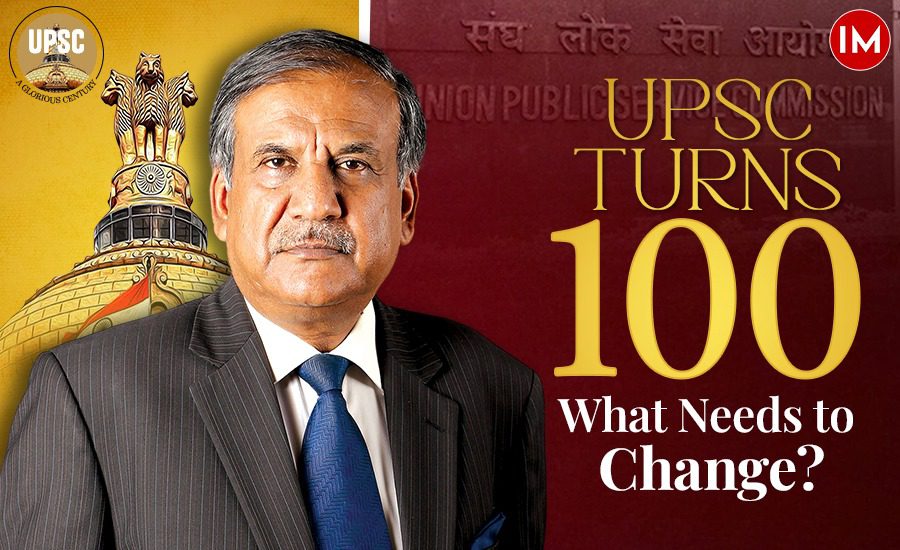
These measures are all urgent. Change is taking place very fast and we must create conditions quickly for having a robust systems and meritorious services. As UPSC celebrates its centenary year we have much food for thought, and a call to action.
(Deepak Gupta is a former chairman of the Union Public Service Commission. He is an IAS officer of 1974 batch and an alumnus of the St. Stephens College.)