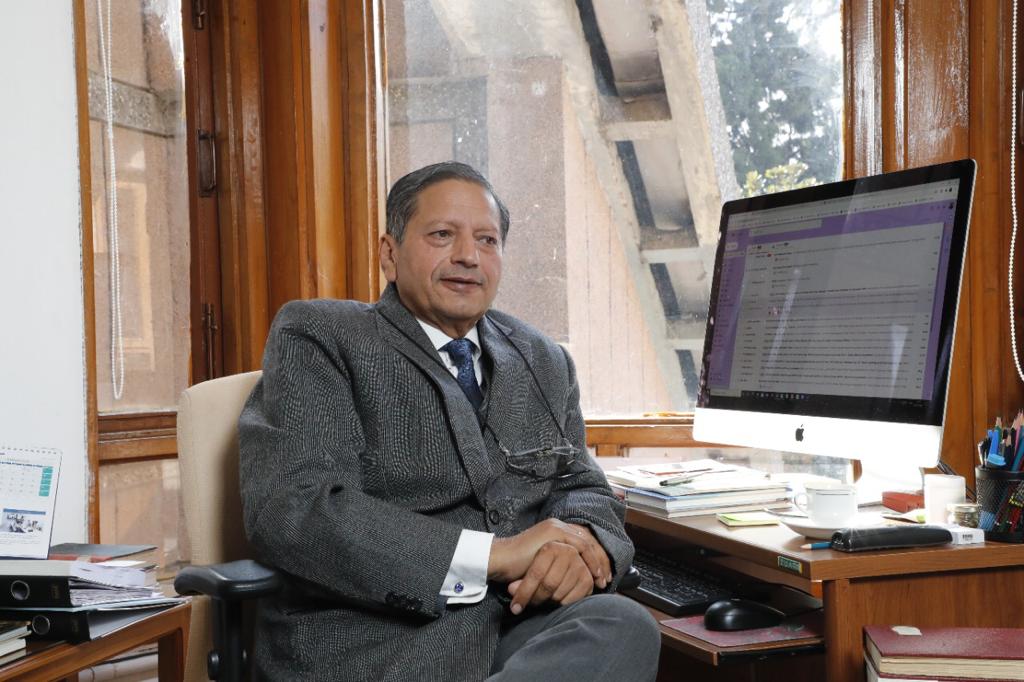
‘Above and Beyond (A & B): Exploring the Amazing World of Aviation’ by the CISF veteran Shiv Kumar Mohanka is certainly India’s (and perhaps the world’s) most comprehensive ‘cover-to-cover’ offering about anything and everything connected with aviation – from the earliest history of aerial reconnaissance by l’Entreprenant, a lighter-than-air balloon by the French army in their engagement with the Austrians in the Battle of Fleurus in 1794, to the remote-controlled drones of today which hit precise targets at the time and place of choosing by their handlers.
This monumental work of five hundred-plus pages is encyclopedic in its range of every possible entry in the dictionary of aviation. The work is spread over eight chapters , with the first two relating to the infrastructure design, operations and management of airports. From the naming (and renaming) of airports to the protocol related to the transport of everything – from human beings to racehorses, from mobile phones to life-saving drugs – every possible aspect of the physical infra of the airport and the aeroplane is covered. The third chapter is on environmental concerns and safety considerations, as well as their interconnectedness. We learn about the environmental impact assessment of aviation, as also of aviation meteorology. Today, pilots can avoid hazardous weather conditions like turbulence, thunderstorms and poor visibility based on critical information regarding atmospheric conditions like temperature, wind speed, wind direction, visibility and cloud cover.
Mohanka tells us about the bothersome phenomenon of ‘icing’, which occurs when an aircraft flies through clouds containing supercooled water droplets that freeze upon coming into contact with the aircraft’s surface. This is one of the major causes of fatal air crashes. A&B has spelt out the evolution of aircraft communication systems over the last eleven decades – from the first, hesitant trial round of ‘wireless telegraphy’ by the Royal Flying Corps in 1912 to the VoIP ( voice over internet protocol) by the turn of the century. As things stand today, the aircraft communication technology is marked by new digital and advanced satellite-based systems and the integration of AI in this chain.
Perhaps the chapter of A&B which will resonate most with the readers is that which deals with passengers and pilots, for at the end of the day, the entire ecosystem exists for these two key stakeholders. In fact, in my view, passengers take precedence even over pilots, for if passengers do not put in their money to undertake the journeys which they do, the aviation sector would have a crash of the financial kind! We become aware of the rights of air passengers as well as the charter of duties of airlines and the airport authorities. We also learn that many times, one passenger’s preferred choice – like that of an accompanying pet – could be a nightmare for her co-passengers. The airlines do make an effort to ensure the right balance!
Mohanka is in his element when it comes to safety and security challenges. Having spent more than three decades in the CISF – India’s premier security agency, which handles all airport security – we learn how, over the years, and especially after 9/11, passengers are now more than willing to co-operate with the security procedures at airports. A frequent flyer like Martina Navratilova has said, ‘Security used to be an inconvenience sometimes but is now a necessity all the time.’ We learn about the history of hijackings – starting from the first incident in Peru in 1931 to the politically motivated and terror-linked cases which peaked in the sixties and seventies, after which three major international agreements – the Tokyo, Hague and Montreal conventions – were signed to address crimes on aircraft, hijacking and (potential) sabotage, respectively. The point to note is that even amongst nations which are competing with each other on every single parameter, there is a unanimity that, come what may, hijacking of aircraft cannot be tolerated. This is ensured by banning items like firearms, knives and pepper sprays on the persons of the passengers. In India, this is drawn up by the BCAS and enforced in letter and spirit (to the tee) by the CISF. No wonder then that at airports across the country, we have panels which display the pictures of CISF personnel who have done their duty with meticulous care and responsibility. Irksome though frisking and baggage checking may be, everyone now realises that it is for passengers’ own safety and security. However, it must be placed on record that thanks to apps like DigiYatra, the process is much smoother than it was up until last year when there were multiple queues – for airport entry, at the airline counter, as well as for security check.
In Sneak Peek into History, Mohanka gives us the ‘helicopter’ view of the aviation industry, for there are many operations which a commercial airline cannot do. While it is great to transport humans and cargo from one airport to another – for terrains that are rugged and for operations that require landing in places which are remote, as for example oil rigs, medical evacuation, military operations and outer space explorations – we have to fall back on helicopters. The author turns poetic when he calls the helicopter ‘an aerial virtuoso, with the remarkable talent of vertical take-offs and landings, midair suspensions like a graceful ballet dancer, and fluid movements in all directions – forward, backwards and sideways’. This is why ‘choppers’ can operate with minimal facilities and from almost anywhere – be it a crowded urban setting or a remote, uncharted territory in the higher reaches of the Himalayas.
It was the Italians who introduced air power to modern warfare when, in 1911, their aviators took to the skies in their war with Turkey. And from then onwards there has been no looking back. By the end of the First World War, military aviation had rapidly evolved to embrace diverse roles – from artillery spotting to air superiority, bombing, ground attacks and anti-submarine patrols. While the interwar period saw great technological leaps, by the time WWII began, the air force(s) of both Allied and Axis powers had unleashed a frenzied burst of aircraft technology improvements like the introduction of jet engines , radars, missiles and electronic warfare. As recent US operations in the Af-Pak region have shown, an air force gives her nation the logistics depth to assert itself, not just in territories proximate to its borders, but anywhere in the world.
The Indian pioneers in air warfare include legends like Hardit Singh Malik, India’s first military aviator, who joined the RAF way back in 1917. The first martyr to the skies was Indra Lal (Laddie) Roy, who received the Distinguished Flying Cross (albeit posthumously). The Indian Air Force is now an integral part of our defence forces with its motto “Nabhah Sparsham Diptam” (“Touch the Sky with Glory”), taken from the eleventh chapter of the BG.
The penultimate chapter is on the future of aviation. As eco-consciousness grows, there will be newer vistas opening up – supersonic and hypersonic aircraft with light materials and improved aerodynamics are all set to make travel even more inclusive and accessible – electric personal air transportation on the one hand to economy class double-decker seats. But let’s move on from aircraft to drones, for as Bill Gates says, ‘Drones will be more impactful than people (currently) recognise.’ In positive ways to help society. But the reader may ask What is a drone? Well, the Oxford dictionary calls it ‘an aircraft without a pilot, controlled from the ground, used for multiple tasks – from target delivery of bombs to aerial spraying for crop protection’.
The last chapter is called Bonus Conant, in which Mohanka shares some useful tips: carrying headphones and portable chargers, snapping your check-in luggage, seeking a complimentary upgrade, opting for the left-hand checkpoint, packing wet wipes, ensuring online check-in, carrying an empty water bottle, checking the current status of the flight, logging into the complimentary Wi-Fi and choosing your seat preferences carefully.
In fine, this is a book which gives you both the big picture to understand the world of aviation and the micro detail to make your flight more comfortable. Congratulations to Mohanka for bringing out such a handy compendium on everything you wanted to know about air travel and did not know where to seek the answers from!