Farewell, Beloved Mother
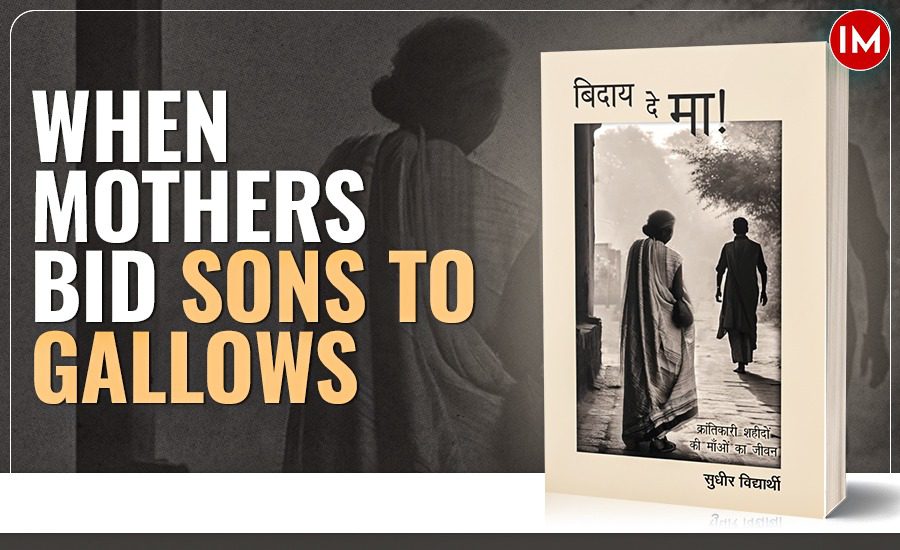
Sudhir Vidyarthi’s poignant offering of the stories in Bidai De Ma! (Bid me Farewell, Mother) is a recollection of the mothers and sisters of thirteen revolutionaries who smiled their way to the gallows or to the dreadful panopticon in the Andaman Islands in the 1920s. While the history of the non-cooperation movement led by the Mahatma has been documented in the Collected Works of Mahatma Gandhi (CWMG), Towards Freedom (Publications Division, GoI), and Transfer of Power (His Majesty’s Stationery Office), the equally important struggle of the revolutionaries who believed in a violent confrontation with the Empire has not received its due attention. Folk history and popular imagination have helped resurrect only some martyrs of the freedom movement. Subhadra Kumari Chauhan created her famous ballad ‘Jhansi Ki Rani’ based on the bards of Bundelkhand, much before it appeared in school textbooks, which itself parallels a Bundeli saying about Rani Jhalkari Bai’s bravery.
In recent years, many political dispensations have understood that electoral capital can be made by invoking the names of Bhagat Singh, Rajguru, Sukhdev, Ram Prasad Bismil, Ashfaq Ullah Khan, Shachindranath Sanyal, Manindra Nath Banerjee, Sohan Singh Bakhana, Pratap Singh Barhad, Chandrashekhar Azad, Subhash Bose and Khudiram Bose. Their photographs and busts can now be seen in party offices and ministerial residences.
However, Vidyarthi has gone beyond this to delve into the lives of their mothers, many of whom had to struggle to make both ends meet in the sunset boulevard of their lives. We, who are so sanctimonious about wanting a public apology from the UK for the firing at Jallianwala Bagh, must also, in all fairness, ask our own countrymen — why did we turn our backs on these mothers when all they needed from us was some dignity and self-respect?
Bismil’s mother, Moolmati, who faced her son’s death stoically, was a broken person by the time the country gained independence, for she had no money to provide treatment to her younger son, who died of typhoid. There was a Bismil Dwar (commemorative gate) named after her son, and subscriptions were raised on behalf of ‘Bismil the Martyr’, but this was later appropriated by the so-called organisers. Shiv Verma, a fellow revolutionary, recalls in his diary of 23 February 1946 that ‘She who had refused to shed a tear on meeting him a day before his supreme sacrifice, she who had stood up on a bench when his funeral procession was passing through the Urdu Bazar of Gorakhpur on 19th December 1927 to say “Bharat Mata Ki Jai, Death to the Imperialist” was now shedding copious tears. “What has this world come to? Why have I been abandoned at this hour? Thousands of rupees had been collected in his (Bismil’s) name – and now I am shunned to this life of penury and misery.”’
Sukhdev’s mother, Ralli Devi, was aghast at the horrors of Partition and wondered if this was what her son had sacrificed his life for. Rajguru’s mother refused to visit her son when the authorities denied permission to his father’s eldest brother (who had raised him). Sohan Singh Bhakhna’s mothers – his birth mother Ram Kaur and spiritual mother Har Kaur – died pining for him. Their landholdings had been forfeited on account of his involvement with the Ghadar party, and they died as ‘poor relations’ of a zamindar family. As his mother had died young, Khudiram was brought up by his sister, whom he wanted to meet before his death. But that was not to be, as his brother-in-law was a government employee.
Ashfaq Ullah was very close to his mother, and in his last letter to her from jail, he wanted her to get herself photographed by the ‘husband of Safina (his sister)’ so that her memory could be preserved forever. We are not sure if he could ever see this photograph, for no record remains. In his prison notebook, he notes that since his forebears had supported the British in 1857, his sacrifice was a small recompense for that act of betrayal.
All four Sanyal brothers, Shachindranath, Ravindranath, Jitendranath and Bhupendranath, were wedded to the revolutionary cause, and their mother Shirodevasini Devi, was indeed proud of them. In her last letter to Shachindranath, she wrote: ‘I may be poor from the point of view of this world; I may not have any material possessions, but I have borne four sons who follow the righteous path in the service of their motherland… who can be more blessed than me!’
Manindranath Banerjee’s mother, Sunayana Devi, was cast in the same mould. In addition to Manindranath, who was hanged in the Fatehgarh jail, all her other sons – Prabhash, Amiya, Mohit, Bhupendra, Fanindra and Basant – also served jail terms for their involvement with the revolutionary cause. She insisted on spending her own money in litigating for her sons: ‘Let the funds for the national cause be utilised by those who have greater need.’
Pratap Singh’s mother was upset with him for not disclosing that he was leaving home to join the freedom struggle. ‘If he had told me that he wanted to serve his motherland, I would have bid him farewell with a tilak on his forehead and garlanded him with flowers. Why did he think that I would not support this noble cause?’
Chandrashekhar Azad’s mother led a very difficult life after his death at Allahabad’s Alfred Park in a police encounter. She also lost her eyes to cataracts. It was only after independence that the governments of UP and Madhya Bharat (one of the predecessor states to MP) sanctioned a pension of Rs 25 per month (each) to her.
Bhagat Singh’s mother was declared Punjab Mata, although Bharat Mata would have been more apt. Government honours and accolades did not deter her from supporting the strike of bus drivers and conductors and the hunger strike by their wives. Her heart was always in the right place.
From Subhas Bose’s letters to his mother, Prabha Devi sent from different jails in Mandalay, Calcutta, Behrampore and Cuttack, we know of their great affection, and conversations on contemporary affairs. In a letter dated 5th November 1929, Subhas writes to his mother that under the influence of the Mahatma, Jawaharlal has given up his independent thinking!
Both the sons of Sharath Kumari Sinha served long prison sentences: Raj Kumar Sinha spent ten years in jail for his involvement in the Kakori case, while his younger brother was transported to Andaman for life in the Lahore conspiracy case. A self-educated woman who later became a proficient writer in Bangla and Hindi, she wrote against child marriage and all the ills associated with it in newspapers like Ananda Bazar Patrika, Bengalee, and the Indian Mirror. While they held their mother in high esteem, their regard and love for their sister were perhaps unparalleled. The dedication in the book Andaman: The Indian Bastille says it all: ‘To my sister Sushil Ghosh, who always stood by our side during storm and stress, who through her intense pain and agonies symbolised in my life the silently suffering womanhood of our vast motherland.’ This could well be said for all the mothers and sisters of the revolutionaries.