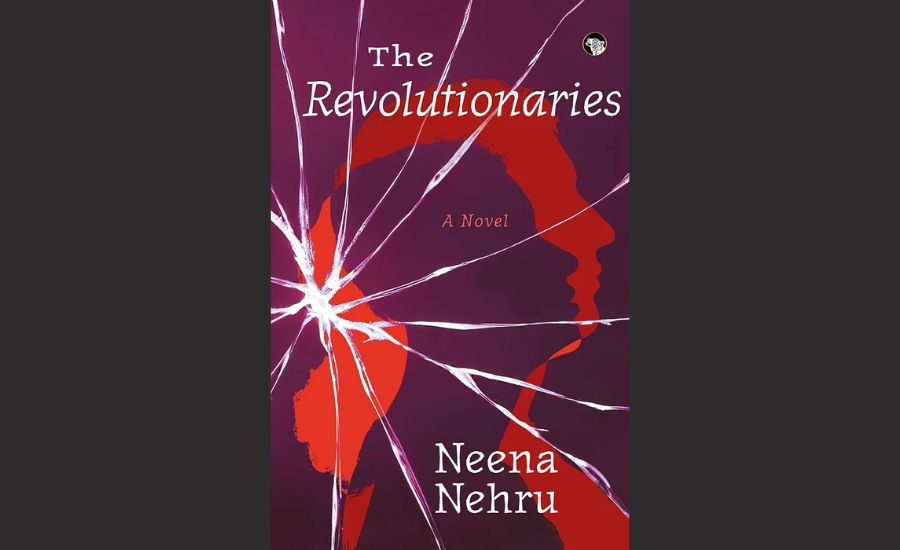
Neena Nehru – The Revolutionaries: A Novel
“And so, we finally / See / through the looking glass / beyond the flickering screen, into the window pane, bumping / nose-to-nose, those racked / d i s t a n c e s / between / OUGHT / and / IS / whose wistful, taunting edges / fling back / in disturbing distortions and dissonances / those pure anthems that once / rang out”.
In 1960s London, two young Indians – a South Indian girl from an administrative family and a North Indian boy from a feudal family – come together over Frank Sinatra songs and François Truffaut films. Aruna and Sandeep share rooms and thoughts with Nigerian and Indonesian and Iranian students whilst learning from British professors who encouraged them to question everything. They share an upper-middle-class sympathy, fostered through elite liberal college education, for the struggles of the proletariat; they critique India’s “mai-baap” mentality and the descent into nepotism which accompanies every successful dynasty; they are critical also of self-indulgent “Palace Plotter” Pakistani revolutionaries quoting from Mao in planning to support Balochi independence alongside erstwhile Indian princesses who enjoy discussing Lenin’s What is to be Done?
Everyone, after all, is a communist in their 20s. Except sometimes those members of the working class who do not have time to read Engels’ The Dialectics of Nature. When Aruna attempts to politicise a group of Indian Punjabi housewives while on a “declassing mission”, she realises that her Hindi does not have the complexity – and simplicity – required to translate theory into dialogue. And her shock at aspects of their lives is a steady undercurrent: “Although she hid her feelings, Aruna was seething with indignation at the way the women were treated, no better than servants.”
Yet she is aware of class disparity, and switches her academic career from interior design to architecture because: “I know that inequalities of wealth and opportunity can only truly be erased through political means, but I feel that is a very long-term ideal; in the meantime, everyone needs to be properly housed, educated, and have their basic needs met, and I would like to be able to contribute to that.” As founder of a “Third World Unit” focused on ecological sustainability, for the specific issues faced by the Global South, Aruna has only a few second thoughts about returning to India to work towards liberty and equality for all.
In 1970s Chandigarh, where they settle during the Emergency, Aruna is amazed to realize that referring to a “lower-caste” slum-dweller with the polite “aap” has made him deeply emotional: “…to think that the choice of word for ‘you’, something she had never even thought about, could reduce a man to tears!… For them, the caste system was just an abstract construct, an evil anachronism, but for millions of their fellow countrymen, it was something that totally defined and contained their entire lives.” Despite their sincerity, the couple at the heart of this story – like many of us reading this – are fundamentally and foundationally removed from the people with whom they share citizenship. Language itself is often an insuperable barrier.
Idealism cannot always sustain against reality. Train travel while visiting Bihar to develop low-cost indigenous architecture becomes legitimately dangerous for Aruna. This is not an isolated incident attributable to a specific area or class of individual: intellectual Marxists and altruistic Gandhians are also terrible to women. Everywhere, individual rot seeps into collective causes as internal damage.
Our protagonists – although they observe and are disturbed by these paradoxes – are not immune to contradiction themselves. They feel keenly the unfairness of a system which has granted so much to them and so little to others. Aruna had briefly worked as a char-woman for extra money in London and felt the awful panic of being falsely accused of thievery by a wealthy white woman. At that time, she had considered the slender but significant luxury of pride which enabled her to stop working for that employer, unlike the cleaning woman in her childhood home who had also been falsely accused but had no option for self-preservation outside of returning to them for employment regardless.
But despite this empathy, they are not always able to reconcile the rights of their own domestic staff. When Sandeep’s mother is gheraoed by workers at her farm, their sympathies are naturally more attuned to her than to the unorganized labour force protesting for standardized wages. Eggs are always broken while making an omelet, as some of their friends argue, but when the cracks are within their own family — this truth is harder to accept. Humans are susceptible to universal weakness despite earnest effort to overcome the gap between theory and praxis.
Aruna is sometimes self-aware and sometimes not: she immediately recognizes that her momentary envy towards the “classic beauty” of a friend’s wife with glossy hair and a swan-like neck do not align with her feminist ideals, but doesn’t reckon with her covert bias in being surprised at the loveliness of a “mixed-caste” woman who does not possess the “coarse features” generally associated with her tribal background.
By their 30s, most people abandon idealistic dreams of revolution and become part of the same “burjwa” which oppresses the less fortunate. This is a cycle so well-established that even a knowledge of its rhythms does not allow for fracture from its inevitability. The book raises impossible questions — at what point does sincere compassion mutate into unsavoury saviour complex? Can one predict the right course of action at the right time such that a tide, taken at the flood, could lead to true fortune? What really is true fortune? Is there a necessary limit to the quest for improving the self in balance with service towards society? Contemplative honesty takes precedence over easy answers.
Portions of this novel may be considered almost-autobiographical: Neena studied architecture in London in the 1960s and appears to have an inclination towards social justice. There is a sense of authenticity to the characters and accents and incidents covered in the book. In particular, the discomfiting sensation of fading naïveté is deeply evocative. Another great strength is the unflinching unselfconsciousness throughout. Perhaps that is what leads to the recognition that although a chasm remains between what “ought” to be and what “is”, there is also an enduring bridge: “Reality is tarnished, but the / Dream still shines.”