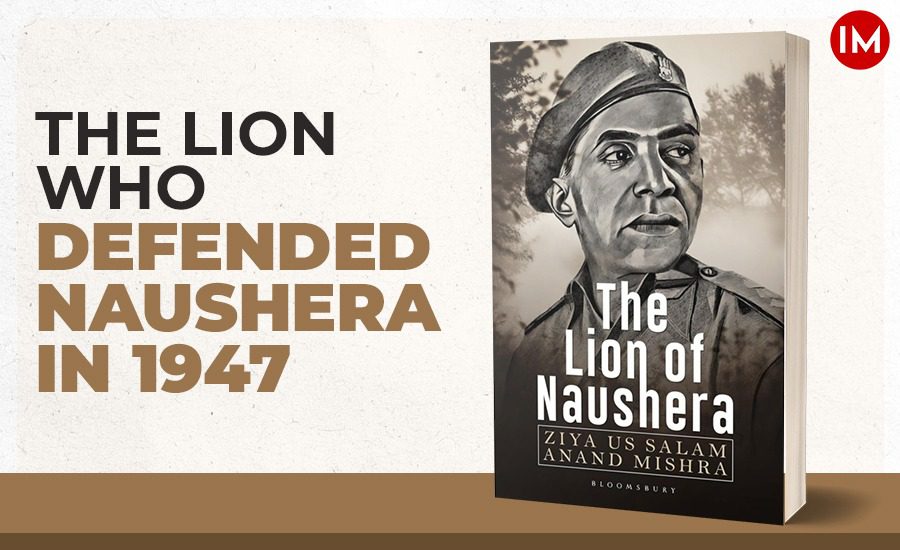
Biographies are of two kinds: the first where material is so abundant that the challenge is to select the ‘relevant’ from the ‘ubiquitous’; the second where information is so scant that one has to dig deep, far, and wide to gather scattered details from accounts of contemporaries on landmark events of the times. The difficulty is compounded if several decades have gone by, the person was unmarried, and the siblings have long departed from this world!
The Lion of Naushera: The Life and Times of Brigadier Mohammed Usman clearly falls in the latter category. Although at the time of his martyrdom, this MVC-decorated Brigadier was buried with full state honours – Prime Minister Nehru and the three service chiefs were in attendance – it is only now that an authentic study of this great patriot can be made. He laid down his life to foil the Pakistani incursions immediately after our Independence in 1947, which has been brought together for us by Ziya Us Salam and Anand Mishra.
The narrative begins in the context of the bloody, brutal partition in which Jinnah sought a separate homeland for the Muslims. It posed a major dilemma for everyone, for those in the defence forces. The authors quote Wajahat Habibullah, an ex Director of the LBSNAA, that upon Partition, the Muslim officers of the British Indian army were given the option to stay in India, or opt for Pakistan. But were they to opt to stay in India, they would have to leave the army. To a man like my father, who considered India his beloved homeland and the Indian army his home, the choice was unacceptable. They sought an appointment with Nehru to get this Defence Ministry advisory rescinded.
Thus, Brigadier Usman, from the last batch of Sandhurst-trained Indian army officers, was commissioned into the 5/10 Baloch (Jacob’s rifles) in the Baloch regiment of the British Indian army in March 1935. He was the Battalion’s 2IC (second in command), and saw service with the highly decorated General Zorarwar Bakshi. Incidentally, he was placed above Sam Manekshaw, Smith Dun and Mohammed Musa – from the first batch of the IMA cadets who went on to lead the armies of India, Burma and Myanmar.
The Riyasat in Turmoil
While Train to Pakistan by Khushwant Singh, A Country Called Childhood by Deepti Naval, and The Punjab by Ishtiaq Ahmed have documented the trauma of partition in Punjab, the situation in Jammu was ‘much worse’. While in the Punjab, there was still some modicum of administration, the state had literally collapsed in J&K. Writes Zafar Choudhary in The Kashmir Conflict and the Muslims of Jammu, ‘the 1947 upheaval across Jammu is one of the least reported and dishonestly recorded tragedies in human history’. Muslims were massacred in thousands, Hindus and Sikhs were killed as well in varying numbers in areas where they were the minority population.
The indecision of the Maharaja and the lack of professionalism in the army and civil administration of the state, coupled with Sheikh Abdullah’s preference for India, had thrown the state into a cauldron. As Hari Singh vacillated, Pakistan broke the standstill agreement with J&K and launched Operation Gulmarg on October 22, 1947. Over fifteen thousand ‘kabailis’ with the support of Pak army regulars flung themselves across the Muzaffarabad-Chakoti-Uri-Baramulla-Srinagar axis. They were able to occupy the brigade headquarters at Jhangar, besides posing a serious threat to the battalion at Kotli, two companies at Naushera, one at Mirpur, a horse cavalry squadron at Bhimbar, and smaller detachments at Munawar and Tharochi.
To meet his challenge, a task force – the 50 parachute brigade under Brigadier Y.S. Paranjpye was dispatched to face the Kabailis and the Pak regulars, but when he fell ill, he was replaced by Brigadier Mohammed Usman, who was then commanding the 77 Parachute brigade. Given the complexities of the terrain and the overwhelming pressure from the enemy, he had to make the hard decision to make a tactical withdrawal to Naushera. While India could hold on to Kotli, Mirpur fell to the invaders, and together with 400 of the state troops, over 30,000 civilians escaped to the town of Jhangar, which too was lost in the blitzkrieg by the Pakistan army.
Enter the Lion of Naushera. Tasked by Lt Gen K.M. Cariappa, better known as ‘Kipper’, to secure ‘Kot feature’, the highest point on a ridge to the northeast of Naushera. He organized a two-battalion silent attack, keeping the enemy guessing about the intended target. On the day of the attack, Usman’s troops advanced under the cover of darkness, successfully capturing the village of Kot, marking the first major triumph of the Indian army in defence of the homeland. Thus it is that the 6th February of each year is celebrated as Naushera Day.
But the Lion was not content to rest. Jhangar had to be retaken; he designed a three-phase strategy. The first two were designed to probe the key features of the enemy position, and the third was the final assault on Jhangar town with artillery and air support. After months of sleeping on the hard floor, Usman asked for a cot, for he had vowed to his comrades that he would not sleep on the bed until Jhangar had been retaken!
After the fall of Jhangar, the Pakistani guns had fallen silent. Then, at an unexpected moment, on July 3, after a routine meeting with his troops, the Lion of Naushera fell victim to a 25-pounder artillery shell which had fallen on a rock close by, thereby bringing to a close the life of a legend who was just thirteen days short of his thirty-sixth birthday.
There is much more to explore in the book than the life of Brigadier Usman. It is also about the days of his boyhood at Bibipur, his upbringing under a strict yet affectionate patriarch, the lives of the other members of his distinguished family, including his brothers, Brigadier Ghufran, the journalist Subhan, and the recollections of his first cousin, the former Vice President, Hamid Ansari, about their family. Media Lens records the coverage of events on the Indian and Pakistani side, and we also learn about the previous attempts to make a biopic on the Lion of Naushera. And last, but not least it is also a multifaceted narrative of India – of how people of all faiths, castes, regions, fought for – and continue to do so – for the independence of the country and the protection of her borders.