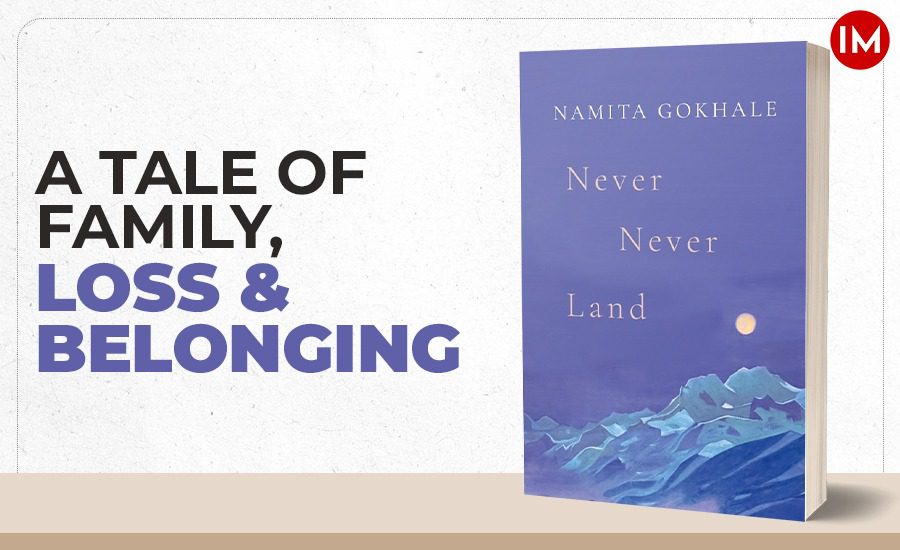
Call it happenstance: I picked up this latest offering from one of India’s finest fiction writers, Namita Gokhal, in late August, and – as in the novel – in real life, a red alert has been declared in the hill districts of Uttarakhand. Schools have been closed by a government order, the rivers are in spate, the mountains are hurling rocks onto newly built highways, and the Char Dham Yatra has been suspended in the Garhwal region of the state.
Never Never Land is an expression of the utopian territory where children retain their childlike innocence forever. It is the story of Iti Arya, the first-person narrator in her mid-fifties; her grandmother Badi Amma, a.k.a. Leela/Lily, in her nineties; her centenarian employer, Rosinka; and her Gen-Z grandniece, Nina, who has been told that she is actually Badi Amma’s granddaughter.
The story is set in The Dacha, an estate in the highlands of Kumaon that belongs to Rosinka Paul Singh, a Russian émigré married to Peter Paul Singh, who is of mixed Sikh and German heritage. Iti had spent her childhood years at this estate under the protective care of Rosinka, who had ensured that both she and her mother were educated in convent schools and learned proper English. Iti’s mother remained resentful of the fact that she was a maid’s daughter, but for Iti, her grandmother and Rosinka were the only family she really knew and grew up with. It is after a decade spent in soulless Gurgaon, where both her professional and personal life are floundering, that Iti returns to this space. Her affection is reciprocated in full measure, for in her last will, Rosinka had made Iti the sole inheritor of the Dacha. This made her a tad uncomfortable with Nina, who moved about the house with the ease and authority of being as much a part of the household as her. Prior to this recent visit, Iti had not heard of her. Neither Rosinka nor her Badi Amma is forthright in giving her a straight answer about Nina, but can there be any true answer?
For even when the ageing matriarchs try to be honest, the vicissitudes of age on the body, mind, and memory have clearly left their imprint. The narrative that is closest to the truth comes to us from the chapters ‘Dream Diaries of Rosinka’ and ‘Badi Amma’s Memories.’ In the former, events are juxtaposed with meaningful metaphors. Thus she writes, “Arthritic fingers and pens that leak are not the only way to write. One can write on water and even in thin air. The elements are always receptive, if sometimes volatile… We have no trains in these hills; we never did, so that midnight express to ‘never-never land’ was dredged up from my dreaming imagination.” But the one nightmare that Rosinka dreaded—that of Lily pinning her on the ground and rubbing her face and body with nettles—is the exact opposite of what Badi Amma recalled: that of Rosinka throwing the boiling nettle brew on her and trying to rub the nettles on her feet. Being physically stronger, she was able to run out of the kitchen, pick up the palak leaves—an antidote to nettles—and lock herself in the outhouse for two days, till a repentant Rosinka sought forgiveness. Badi Amma also confesses to her relationship with Peter. He had always been fond of her, but after the ‘nettle attack,’ she decided to settle a score with Rosinka by ‘allowing love to flower between them, as between man and woman.’ But then she felt guilty and told him, ‘Peter Saheb, I cannot live in this house like a namak haraam. I eat your salt, Rosinka’s salt. We will be like brother and sister from now on. And from then till his death a year later, this was how they dealt with each other.
Why did Badi Amma narrate this episode? For in telling stories, one feels lighter about the humiliations of the past and in coming to terms with one’s grief. She gives Iti a life lesson about crossing the Lakshman Rekha: “Sometimes, it is self-destructive to allow people to cross the line—in love or in hatred. I allowed Peter Saheb to cross these lines in letting our love flower; I allowed Rosinka to cross these lines in all that I have let her do to me. Perhaps it was my guilt that led me to forgive, or at least to forget the things that she did.”
Nina adds to the drama and the tension in the story with her juvenile delinquency: running away from home after stealing two priceless Roerich paintings and moving in with her ‘Avinash,’ who ran a charming café with internet, books, and overpriced organic millet cookies. But she gets trapped in a landslide after a very heavy downpour, and after the rescue operation, which left her bruised, broken, and fractured but with ‘Instagram fame,’ she too realises that the only place she can call home is The Dacha. Earlier in the narrative, she tries to fix her interior emotion by changing the color of her contact lenses: “Every emotion has a color; I am feeling blue this week, and so that’s how I represent myself.”
Finally, the season changes. Autumn digs in, the trees change color, there is an abundance of red and yellow, and the night sky is clear. As it snows in the Himalayas, Iti dreams of the white raven, which morphs into a magpie and flies away, and the Dacha gets a patchy internet line. Iti reconnects with her school group, only to get this sombre post with a heartbreak emoji: “Remember Anita Shivdasani? She had died by suicide, all these years ago. Her mom was my aunt’s neighbour in Denver. She died last week in a mass shooting at a supermarket there, RIP, Aunty Shivdasani. Hope you meet Anita on your journey to heaven, Om Shanti.”
Iti quits her WhatsApp group. She does not need to ‘belong’ elsewhere. She is in her own Never Never Land, alone, but in a place where she belongs: ‘For sometimes we have to retreat to return.”