Life is full of mysteries, but your identity should not be one of them.
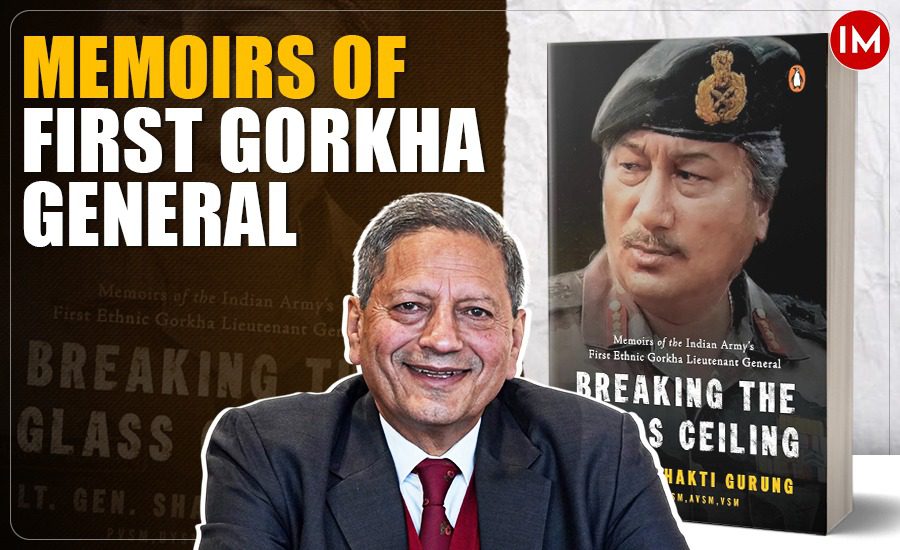
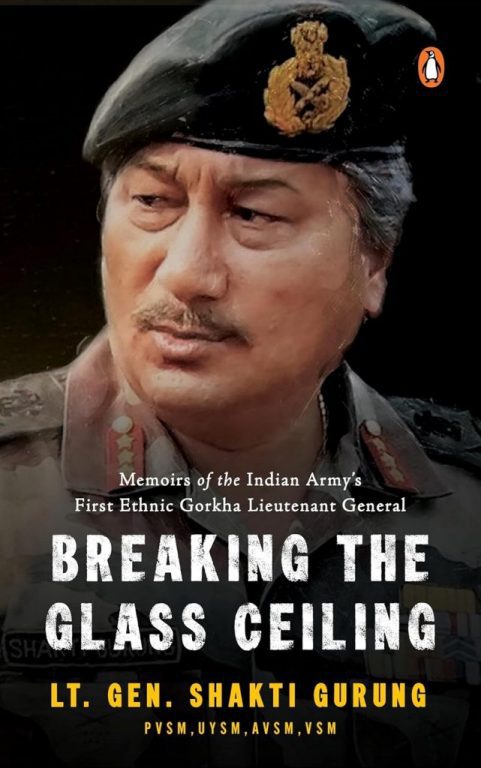
This quote from the Nigerian author Samuel Awolumate provides the context to the title of the book – Breaking the Glass Ceiling: Memoirs of Indian Army’s First Ethnic Gorkha Lieutenant General. ‘As the land of my forefathers, writes Gen Shakti Gurung, Nepal will always hold a special place for me, but it is India where I was born, and where I have served, that I have laid down my heart’
Let’s face it. The overwhelming impression amongst those who wrote and commented on military matters was that ‘Gurkha soldiers were fine and fearless troops with fierce loyalties to their Commanding officers’.
But imagining them as officers – taking up command positions and giving strategic direction on India’s critical frontiers – the LAC and the LOC was certainly not part of the cantonment folklore. I grew up in one of them in the seventies, and interacted with officers from across the country – Singhs, Yadavs, Josephs, Mazumdars, Kapoors, Joshis, Tripathis, Mitras, Patnaiks and Deshmukhs – but do not recall interacting with a Gurung or Lama – for they were indeed few and far between.
THE LEGENDARY SOLDIERS
But yes, Gurkha troops were the stuff of legend in the writings of John Masters, on Manekshaw, Gen Ian Cardozo and Probol Dasgupta, among others. So this is an important offering from a Gurkha officer, who had to face questions about his national identity, right up to his days as a participant at the National Defence College.
There were two possible ways to review this fascinating book of 371 pages. The easier option was to follow the author’s narrative, and capture the space-time sequence of his life and personality -his days in Cambrian Hall ( named after a peak in Wales ), his pre-commission training in the NDA ‘from a boy to a man’, life as an officer ‘stars in my eyes’, and the usual drill of a Fauji life as he picked up appointments, staff courses and prestigious assignments culminating in the position of Military Secretary, and working closely with the COAS (pre-CDS days). However, I have taken the view that my critique should focus on his observations on the LAC and the LOC, and also about the critical role which Myanmar has to play in our Look East Policy, besides of course, his lament on the political future of the Indian Gurkhas in their quest for identity.
PATRIOTIC INDIANS
My first posting in Kalimpong in 1986 coincided with the time when the Gorkha National Liberation Front (GNLF) agitation and the anti-Bengali sentiment was at its peak. But I recall very clearly that every protestor would make it a point to state that they were patriotic Indians, and that their agitation was for statehood, ethnic and linguistic identity within the union of India.
Among the postings that he (and his family) enjoyed the most was at Yangon in Myanmar as the Defence Attaché (DA) – a member of the armed forces, whose legal status is covered under Article 7 of the 1961 Vienna Convention on Diplomatic Relations. There were twenty two of them in Myanmar at that time – including US, Russia, China, Bangladesh and Pakistan – while competing with each other professionally, they also came together for a fortnightly game of golf.
THE MYANMAR CONNECTION
Until 1937, Myanmar (then called Burma) was administered as a province of British India. This was where the British had exiled the last Mughal king of India, Bahadur Shah Zafar – whom Musharraf described as the ‘last Emperor of Pakistan’ in the visitor’s book.
From a contemporary geo strategic perspective, Myanmar is like a yam stuck between two major powers of Asia, India and China. For China, it is the gateway for its landlocked Yunnan province to the Indian ocean, while for India it is the land bridge that joins the Indian sub-continent to South East Asia and the markets of the Mekong sub region.
While working with Ambassadors Shyam Saran, V.K. Katju, and R.K. Bhatia, he developed a strong rapport with the Tatmadaw – the Myanmar military – and travelled extensively across the country, from Putao in the north to Kawthaung in the south, and from the Chindwin River in the west to Tachilek in the Golden Triangle in the east.
THE CHINESE THREAT
China’s intent and ambitions in Myanmar have to be watched very carefully: the term used is ‘pauk phaw’ which means siblings from the same mother. Just before Covid, in January 2020, President Xi Jinping visited Myanmar and signed thirty nine agreements – including the China Myanmar Economic corridor (CMEC). India’s counter to the CMEC are two major infrastructure projects within our Look East policy. These include the Kaladan Multi Modal Transit Transport Project (KMTTP) and the India-Myanmar-Thailand Trilateral (IMT).
The problem is the internecine conflict between the insurgent militia of two states within Myanmar – the Arakan army of Rakhine and the Chin National front of the Chin state. However, progress on the IMT is better, and both Manipur and Mizoram will have a link to this highway. Over time, this road can link our NER with the Greater Mekong South East Corridor.
INDIA’S DILEMMA
However, democratic India does have a problem – for unlike China which is firmly aligned with the military junta, we are often seen as running with the hare (pro-democratic forces) and hunting with the hounds (Tatmadaw). While there can be multiple views on how we should conduct our affairs with Burma, there is near unanimity on one point: the need to establish specialist institutions to study the country’s languages, ethnicities, polity, and cultural practices. We share a porous, riverine, and heavily forested 1,650-kilometre border with Burma, where even a border pillar – if it exists – is merely a silent and mute spectator.
Let me now dwell on his understanding of India Nepal relations, especially in the context of the current tensions between the two countries with a deep civilizational connect. The three major irritants are the India Nepal Treaty of 1950 – the Lipu Lekh Kalapani border issue and the Agnipath scheme.
IRRITANTS IN RELATIONS WITH NEPAL
With regard to the first, there is a general consensus about the ‘format flaw’: it was signed by then Prime Minister of Nepal Mohan Shumshere Jung Bahadur Rana with the Indian ambassador C.P.N. Singh. On the Lipu Lekh Kalapani issue, India’s claim is buttressed by the fact that a UP PAC unit has been in position there from 1955. Besides, this area was clearly demarcated on the Indian side in the India China trade agreements of 1954.
On the Agnipath, the general’s view is that in the long run, it will have grave implications on our strategic outreach with Nepal, for if the Gurkha troops are also inducted into the PLA, the danger to India will be ‘more than grave’. As it is, through its Belt and Road initiative, China is trying to transform Nepal from a ‘land-locked’ into a ‘land-linked’ country. Perhaps a comprehensive dialogue on both sides is required – India needs to convince Nepal that what is being offered to the youth of Nepal is not in any way less compared to their Indian counterparts.
OTHER USEFUL NUGGETS
There are other useful nuggets in the book – the most significant among them being that contrary to popular belief, the 2/9 Gurkhas were not the only troops which opened fire in the Jallianwala Bagh. Others in the firing squad included the 54 Sikh and the 59 Sindh Rifles. He also discusses the dilemmas of the Gurkha POWs in WWII who were torn between their fidelity to their paltan, and the rather tempting offer of joining the INA of Subhas Bose.
We also get an insight into the (failed) attempt of the British to retain Andaman and Nicobar islands as military bases, and that the issue was resolved when it was agreed that some Gurkha troops would remain with the British army, thereby making the Gurkhas the only soldiers to serve three countries – Nepal, India and UK! Now of course, they are also at the helm!
You can buy the book from the following link…