A project aimed at strengthening Gram Sabhas by giving them community forest rights and encouraging community participation in boosting the minor forest produce (MFP) sector, is showing good results in Maharashtra’s Gadchiroli. Named Ekal project, it was started by the district administration to help the tribal population, which constitutes around 38 percent of the total population of the district.
Indian Masterminds spoke to IAS officer Sanjay Meena, who is the DM of Gadchiroli, to get more details about this project.
EKAL PROJECT LAUNCHED
Being implemented in four phases under the guidance of DM Meena, the project is turning out to be a life-changing opportunity for the tribal people who live a secluded life inside or near the forests.
Under the Scheduled Tribes and Other Traditional Forest Dwellers Act, 2006, the protection of schedules tribes and other traditional forest dwellers by balancing it with the protection of the environment, was enacted, along with the right to life and livelihood. Gram Sabhas have been given various functions under this Act, which includes determining the nature and extent of forest rights, pass resolutions on the claims of forest rights, and constitute, control and monitor a committee for wildlife, forest and biodiversity protection.

Speaking with Indian Masterminds, Mr. Meena said, “From 2010 onwards, Gadchiroli has recognized around 33,000 individual forest rights and 1,438 community forest rights (CFR). With a total area of 14,412 sq km, Gadchiroli distributes 5110 sq. km to CFR. Hence, there is a huge opportunity of employment generation and rejuvenation of forest from the Gram Sabha.”
This is how the Ekal project came into existence in September 2021, with the main aim of integrating the 1,438 Gram Sabhas in a productive manner so that livelihoods can be generated and uplifted.
REMOVING MIDDLEMEN
Around 68 percent of the total area in Gadchiroli is covered with forest cover. The tribal population, which also include the Particularly Vulnerable Tribal Groups, are mostly dependent on minor forest produce like Tendu and Mahua when there is no developmental work going on. However, there is no structure in place to monitor how much MFP is available and how it is being managed at the local level.

Moreover, the market is also dominated by the thekedaars who act as a mediator between the buyers and the producers and earn maximum profits. This results in lowering down the financial outcomes of the Gram Sabha and even conning incidents by not following the stipulated terms and conditions.
Hence, to streamline the process, the administration launched the Ekal initiative in four phases.
FOUR PHASES OF EKAL
In the first phase, a Memorandum of Understanding (MoU) was signed between the administration and Gram Sabhas, to support each other in the intervention. Mr. Meena said, “As we did not have the funds to train all the 1,438 gram sabhas at one go, therefore we wanted to do a MoU with them. There were around 364 gram sabhas under the MoU, and 30 more were added recently.”

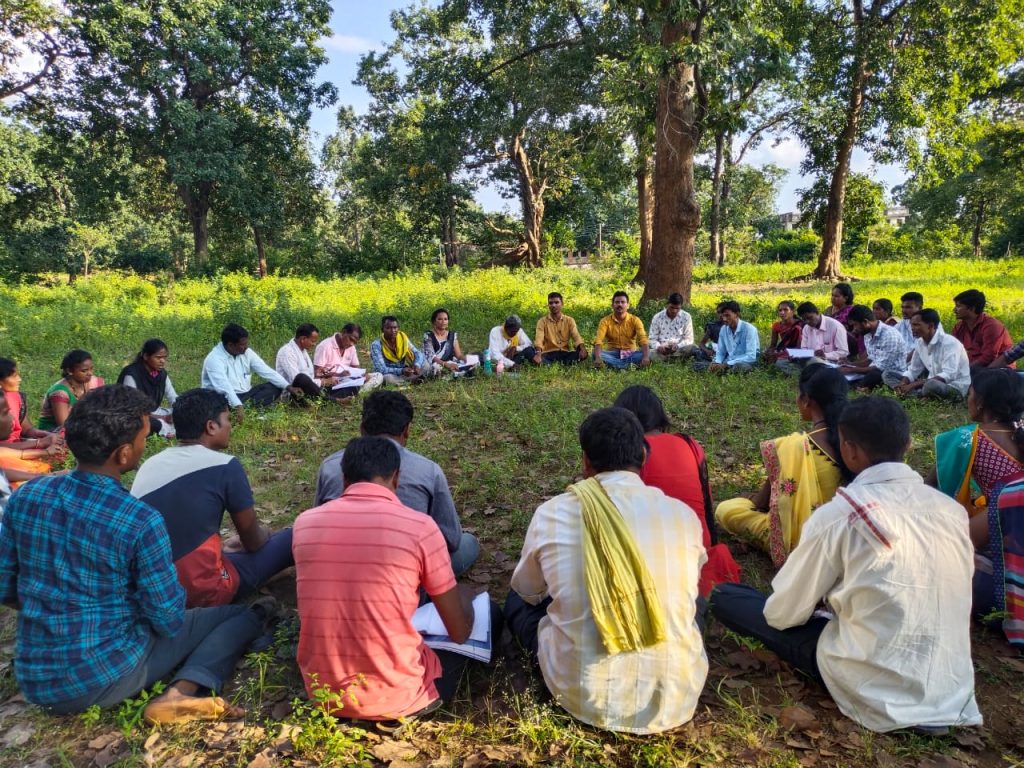
On signing the MoU voluntarily, the gram sabhas are provided with a 15-days training module. It is divided in two parts, a residential training of seven days and field training of eight days. The programme is conducted through the Gondwana University, which is the knowledge partner of the district administration.

The field training is centred around the implementation of the forest rights acts, biodiversity act and MGNREGA at the gramsabha level. During the field training, trained representatives constitute committees, and make people of the village aware about their rights. They also exercise shivar feri or ‘walk through their forest’ to assess its status and diversity. In the last two days of field training, they go through the records of the gramsabha to see the scope of improvement, also adding records that were not maintained earlier.
EKAL CENTRE
Then, there are the Ekal centres, that are like offline marketplaces where buyers and producers, which are the tribal people, meet directly without any interference with the thekedaars. It is an administrative unit of the district administration which has been started to streamline the process of transaction in relation to minor forest produce and improve transparency in this process.
Mr. Meena said, “The first Ekal centre is in Gadchiroli and the second one in Desaignaj. The third one is coming up in Mendha and we have proposed three more such centres as we have a total of 12 talukas. Therefore, one centre can cater to two or three talukas.”

Moreover, the proposal for 50 godowns for the gram sabhas have been sanctioned under the Mana Vikas program and NREGA. “The infrastructure is being created and is under process,” Mr. Meena said.
These Ekal centres will charge 10% (5% from gramsabhas and 5% from direct purchaser companies or unit) on complete sell in order to cover administrative and maintenance cost of the centres. This mechanism will create a self-sustainable ecosystem, providing more benefits to the gramsabha while promoting sustainable use of forest resources.

MONITORING
A dedicated dashboard is created for the monitoring of the project. The dashboard includes the data about three major aspects of the project which includes details of gramsabhas engaged with the district administration, training of gramsabhas and performance of representatives during the training and CFR claims.
For the purpose of proper implementation of the project the district administration has defined 23 Key Success Indicators. These indicators capture the input and output of the project.

BENEFITS
Lastly, Mr. Meena pointed out the benefits this project will bring in the lives of the tribal people: “Firstly the project will bring mass employment among the people of the district. The MFP cycle of tendu, mahua and bamboo will keep the people engaged for five to six months, and besides this, they will be engaged in three months of Khareep and NREGA work. We expect around 10 months of employment.”