In policing, strength is often measured in control—of crime, of chaos, of situations spiraling out of hand. But true leadership is measured elsewhere. In how an officer treats his people. In what he chooses to fix when no one is watching.
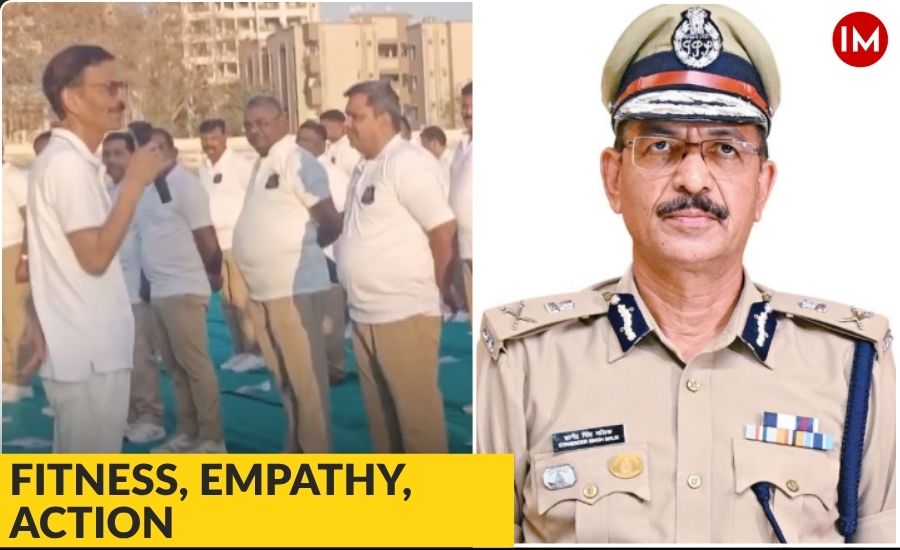
Gyanendra Singh Malik, a Gujarat cadre IPS officer and the current Police Commissioner of Ahmedabad, represents that rare blend of authority and empathy. Known recently for decisive enforcement actions, Malik is now quietly driving a different kind of mission—one that focuses not on criminals, but on the well-being of his own force.
Years ago, a single letter from him transformed a crumbling government school. Today, that same instinct—to intervene where it matters—has led him to launch a health movement within the police.
MISSION FIT KHAKI: REBUILDING THE FORCE FROM WITHIN
Policing is relentless. There are no fixed hours. No guaranteed breaks. Meals are often skipped or delayed. Stress is constant.
Malik understands this reality closely.
That is why he launched “Mission Fit Khaki”, a structured 12-week programme aimed at improving the physical and mental health of Ahmedabad Police personnel.
The initiative began with a simple observation—many officers were struggling with obesity and related health issues. Around 100 personnel with a Body Mass Index (BMI) above 30 were identified and enrolled.
They underwent detailed medical assessments. Height, weight, and overall health indicators were recorded. But this was just the starting point.
“Police personnel routine can never be fixed. Their job demands 24×7 availability. They can’t even take proper meals on time,” Mr. Malik said during a conversation with Indian Masterminds.
Instead of imposing strict regimens, the programme is designed to fit into their lives.
Every Monday, officers assemble for a 90-minute session at the police headquarters. What used to be a routine parade has now evolved into a holistic wellness session.
There are fitness drills. Yoga and meditation sessions. Guidance on diet. Regular monitoring of progress.
But the approach is practical, not prescriptive.
“Rather than telling them what to eat, we are asking them what not to eat,” Malik explained.
The idea is not to burden them with rules, but to help them make better choices within their constraints.
Importantly, their regular duties continue as usual. The programme adapts to the demands of policing, not the other way around.
HEALTH AS A FORCE MULTIPLIER
For Malik, this initiative is not just about individual well-being. It is about institutional strength.
A healthier police force is more alert. More resilient. Better equipped to handle stress.
The programme also addresses mental health—often ignored in uniformed services.
“Their work is full of stress which leads to poor health. This programme is about improving both body and mind,” he noted.
This shift—from enforcement to care—reflects a deeper understanding of what policing requires in today’s world.
A SCHOOL TRANSFORMED WITH ONE LETTER
This is not the first time Malik has acted on a concern that others overlooked.
In 2010, during his tenure as Joint Police Commissioner in Vadodara, he visited Kavi Dayaram Prathmik Shala as part of an education drive.
What he saw stayed with him.
More than 300 students were studying in a single hall. Classes were divided by corners, not walls. The building was old and rented. Basic facilities were inadequate.
“There was just one hall. Students from different classes sat in separate corners. Even the building was in poor condition,” Malik recalled.
For many, it would have been just another visit.
For Malik, it became a responsibility.
He wrote to the state government, highlighting the urgent need for better infrastructure. The letter reached senior officials. Action followed.
By 2014, the school had been transformed.
A new three-storey building stood in place of the old structure. Thirteen classrooms replaced the single hall. Separate washrooms ensured dignity for students.
For the children and teachers, it was not just a new building. It was a new beginning.
A PATTERN OF PURPOSE
From classrooms to police lines, Malik’s work reflects a consistent pattern.
He identifies gaps that affect people directly. Then he acts—quietly, effectively, and with persistence.
In the school, it was about creating space for learning.
In the police force, it is about creating space for well-being.
Both required more than authority. They required intent.
LEADERSHIP THAT LOOKS INWARD
At a time when policing is often judged by visible action—raids, crackdowns, operations—Malik’s initiatives stand out for a different reason.
They look inward.
They focus on strengthening the system from within.
A fitter police force. A better learning environment for children. These may not always make headlines, but they create lasting impact.
As Police Commissioner of Ahmedabad, G.S. Malik continues to balance firmness with empathy.
His journey shows that leadership is not just about taking charge of situations. It is about taking responsibility for people.
And sometimes, the most powerful changes begin not with grand announcements—but with a simple decision to act.