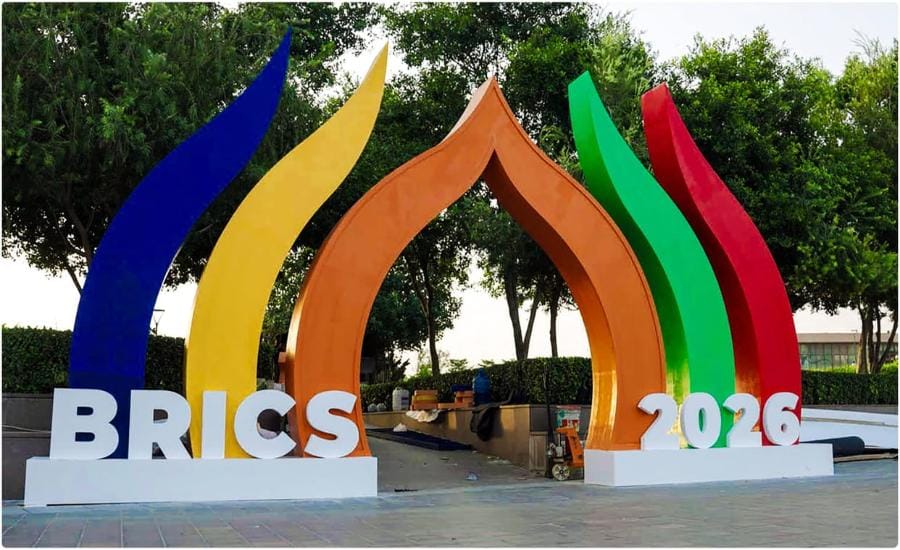
New Delhi: The 12th BRICS Parliamentary Forum (BRICS PF) concluded in New Delhi with the adoption of a Joint Declaration titled “Fostering Parliaments for People-Centric Development.” Held on October 26–27, 2026, the forum brought together presiding officers and representatives of the parliaments of BRICS member countries to strengthen parliamentary cooperation and address shared global challenges.
The declaration was adopted by representatives of Brazil, China, Egypt, Ethiopia, India, Indonesia, Iran, Russia, South Africa and the United Arab Emirates (UAE). It also welcomed the participation of BRICS partner countries and acknowledged their contributions to inter-parliamentary cooperation.
The declaration outlines a shared commitment to sustainable development, institutional resilience, digital innovation, climate action, international peace and security, and reform of global governance institutions. It also supports India’s BRICS Chairship in 2026 under the theme “Building for Resilience, Innovation, Cooperation and Sustainability.”
BRICS Parliamentary Forum Reaffirms Commitment to Strategic Partnership
The participating parliaments reaffirmed their commitment to strengthening the BRICS Strategic Partnership within their respective constitutional mandates and competencies.
The declaration identifies three key pillars of BRICS cooperation:
- Political and security cooperation.
- Economic and financial cooperation.
- Cultural and people-to-people exchanges.
The members reiterated the principles of mutual respect, equality, solidarity, openness, inclusiveness and consensus. They also welcomed India’s successful hosting of the 18th BRICS Summit on September 12–13, 2026, and the adoption of the New Delhi Leaders Declaration.
The participating countries expressed support for India’s BRICS Chairship for the remainder of 2026 and encouraged greater involvement of partner countries in BRICS engagements and practical cooperation in areas of shared interest.
Read also: Nine Nations, One Stage: BRICS Theatre Festival Coming to New Delhi in October
Cultural Exchanges and Parliamentary Cooperation
The declaration emphasised the importance of cultural and people-to-people exchanges in promoting mutual understanding, friendship and cooperation among BRICS countries.
It welcomed initiatives under India’s Chairship in areas including culture, sports, art, education, women and youth affairs. The participating countries also called for greater respect for cultural diversity and stronger international exchanges that encourage creativity, innovation and the preservation of cultural heritage.
The declaration recalled the adoption of United Nations General Assembly Resolution A/RES/78/286, titled “International Day for Dialogue among Civilizations.”
It further recognised inter-parliamentary cooperation as an important component of the BRICS framework, helping build trust, strengthen international cooperation, support the peaceful resolution of disputes and promote sustainable development.
The members acknowledged the contributions of the 11 preceding BRICS Parliamentary Forum meetings in advancing dialogue and cooperation among member countries.
BRICS Countries Call for Sustainable Development and Poverty Eradication
The declaration reaffirmed the commitment of BRICS countries to implementing the 2030 Agenda for Sustainable Development and its Sustainable Development Goals (SDGs).
The members called for coordinated and balanced action to achieve the goals and targets of the agenda in line with national policies and regulations.
The declaration identified the eradication of poverty in all its forms, including extreme poverty, as a major global challenge and a prerequisite for sustainable development.
It also highlighted the importance of innovative, coordinated and environmentally responsible approaches to development. BRICS countries expressed their readiness to contribute to shaping the global sustainable development agenda beyond 2030.
The participating countries also stressed that parliamentary diplomacy and inter-parliamentary dialogue can support more representative and inclusive global governance within the constitutional mandates of their respective parliaments.
Climate Change and Financial Support for Developing Countries
Recognising the urgency of addressing climate change, the declaration called for stronger international cooperation to implement nationally determined contributions (NDCs), strengthen climate change mitigation and adaptation, and promote just transition pathways.
The members reaffirmed their commitment to the objectives of the United Nations Framework Convention on Climate Change (UNFCCC) and the goals of the Paris Agreement, as applicable.
The declaration stressed the importance of equity and the principle of common but differentiated responsibilities and respective capabilities, taking into account different national circumstances.
It also called on developed countries to provide additional, adequate, predictable and accessible financial resources, capacity-building support, and technology development and transfer to developing countries on mutually agreed terms for climate adaptation.
BRICS Emphasises AI Cooperation and Digital Transformation
The declaration recognised the transformative potential of emerging technologies, particularly Artificial Intelligence (AI) and Information and Communication Technologies (ICTs), in promoting economic growth and sustainable development.
The participating countries called for the open, safe, secure, stable, equitable, peaceful and interoperable development and use of ICTs while respecting national sovereignty and security.
The members highlighted several priorities for AI cooperation:
- Ensuring equitable access to AI resources, knowledge, capacity building and opportunities in line with national priorities and applicable laws.
- Promoting the safe, secure, inclusive and reliable development and use of AI.
- Improving the energy efficiency of AI systems.
- Encouraging AI science, research and innovation.
- Using AI to support economic growth and social good.
- Addressing potential risks associated with AI technologies.
- Strengthening digital sovereignty by protecting data privacy and personal information.
- Building resilient national technological ecosystems.
The declaration particularly highlighted the potential of AI-driven solutions and digital technologies to improve parliamentary research, analysis, public outreach, citizen interaction and feedback mechanisms.
It encouraged BRICS parliaments to share successful practices and experiences in deploying digital tools and AI-enabled systems to improve legislative functions and ensure that the benefits of technological progress are accessible equitably.
Digital Public Infrastructure to Support Inclusive Growth
The participating countries reaffirmed their commitment to achieving universal and meaningful connectivity for all.
They encouraged cooperation in deploying digital infrastructure, including digital public infrastructure (DPI), to promote economic development, social inclusion, improved public service delivery, resilience and innovation.
The declaration took note of a proposal to establish a digital public infrastructure repository for BRICS countries and develop pilot projects involving digital public infrastructure solutions to support digital transformation.
These initiatives are intended to facilitate the exchange of knowledge and promote practical cooperation in the development and deployment of digital systems.
BRICS Calls for Reform of Global Governance and the United Nations
The declaration reiterated the need to reform global governance institutions to make the international system more just, equitable, representative, democratic, effective, efficient, responsive and accountable.
The members highlighted the importance of extensive consultation, joint contributions and shared benefits in strengthening multilateral cooperation.
They noted that multipolarity and multilateralism can create greater opportunities for emerging markets and developing countries (EMDCs) to realise their potential and participate in inclusive and sustainable economic globalisation.
The declaration also reaffirmed the role of the Global South in driving positive change and called for BRICS to continue voicing its concerns and priorities through development cooperation and capacity-building initiatives.
The members stressed the importance of upholding international law and the principles of the United Nations Charter, including sovereign equality, mutual respect, non-intervention in internal affairs and the peaceful settlement of international disputes.
They recognised the central role of the United Nations in maintaining international peace and security, advancing sustainable development, protecting human rights and fundamental freedoms, and promoting cooperation among nations.
The declaration called for comprehensive reform of the United Nations, including the Security Council, to make it more democratic, representative, effective and reflective of contemporary global realities. It also welcomed the statement contained in Paragraph 13 of the BRICS New Delhi Declaration 2026.
BRICS to Strengthen Its Voice in International Parliamentary Forums
The participating countries expressed their intention to strengthen BRICS interaction within international parliamentary forums, including the Inter-Parliamentary Union (IPU), to amplify the voice of the Global South.
In this context, the declaration took note of Russia’s initiative to consider establishing a BRICS Plus geopolitical group within the IPU.
The members also highlighted the importance of parliamentary diplomacy and inter-parliamentary dialogue in advancing a more inclusive and representative international governance structure.
Declaration Condemns Violations of International Humanitarian Law
The BRICS members strongly condemned violations of international humanitarian law, including deliberate attacks on civilians and civilian infrastructure, the denial or obstruction of humanitarian access, and attacks targeting humanitarian personnel.
The declaration called for accountability for all violations and acknowledged international efforts undertaken by BRICS members to promote respect for and effective implementation of international humanitarian law.
The members also expressed concern over the continued escalation of tensions in the Middle East and West Asia.
While recalling their respective national positions, they called for maximum restraint and urged all parties to avoid actions that could further aggravate the situation.
The declaration stressed the need to protect civilians and civilian infrastructure in accordance with the United Nations Charter, respect the sovereignty and territorial integrity of states, and intensify dialogue and diplomacy to achieve lasting peace, security and stability in the region.
It also highlighted the importance of maintaining the smooth flow of global trade, supply chains and energy in accordance with applicable international law.
BRICS Opposes Unilateral Sanctions and Calls for Their Elimination
The declaration condemned unilateral coercive measures that are contrary to international law, including unilateral economic sanctions and secondary sanctions.
It stated that such measures can have far-reaching negative effects on human rights, including the right to development, health and food security among the populations of targeted states.
The participating countries called for the elimination of such measures, arguing that they undermine international law and the principles and purposes of the United Nations Charter.
BRICS Reaffirms Zero Tolerance for Terrorism
The declaration strongly condemned all acts of terrorism, describing them as criminal and unjustifiable regardless of their motivation, location or perpetrators.
The members specifically condemned the terrorist attack in Jammu and Kashmir on April 22, 2025, in which 26 people were killed and several others were injured.
The participating countries reaffirmed their commitment to combating terrorism in all its forms and manifestations, including the cross-border movement of terrorists, terrorist financing and the provision of safe havens.
The declaration emphasised that terrorism should not be associated with any religion, nationality, civilisation or ethnic group. It called for all individuals and entities involved in terrorist activities or providing support to them to be held accountable under relevant national and international laws.
The members also stressed the following priorities:
- Maintaining zero tolerance for terrorism and rejecting double standards in counter-terrorism efforts.
- Strengthening cooperation against terrorist threats while complying with international law.
- Respecting international human rights law, international refugee law and international humanitarian law, as applicable.
- Deepening cooperation through the BRICS Counter-Terrorism Working Group (CTWG) and its five subgroups.
- Expediting the finalisation and adoption of the Comprehensive Convention on International Terrorism within the United Nations framework.
- Taking coordinated action against all UN-designated terrorists and terrorist entities.
The declaration welcomed the work of the BRICS Counter-Terrorism Working Group, guided by the BRICS Counter-Terrorism Strategy, the BRICS Counter-Terrorism Action Plan and the CTWG Position Paper.
BRICS Reiterates Support for a Two-State Solution to the Israeli-Palestinian Conflict
The participating countries reaffirmed their support for a peaceful resolution of the Israeli-Palestinian conflict based on the two-state solution.
The declaration called for the establishment of two states living side by side in peace and security, in accordance with international law and relevant United Nations resolutions.
It also reaffirmed the Palestinian people’s right to self-determination, freedom and an independent, sovereign state.
Parliamentary Capacity Building and Cooperation on Sports
The declaration recognised training and capacity building as essential to effective inter-parliamentary cooperation.
It encouraged exchanges of experiences, knowledge sharing and collaboration among parliamentarians and their technical and legislative advisers to strengthen professional capabilities and networks.
The members also took note of Russia’s proposal to consider establishing an inter-parliamentary BRICS Working Group on Sport.
The proposed group, in line with Paragraph 8 of the Protocol to the Memorandum of Understanding on the BRICS Parliamentary Forum dated July 11, 2024, could provide a platform for voluntary exchanges of experience and best practices in sports and physical education, in accordance with national laws and priorities.
BRICS Women Parliamentarians Forum Marks 10th Anniversary
The declaration marked the 10th anniversary of the BRICS Women’s Parliamentarians Forum and recalled the 2016 Jaipur Declaration, which called for institutionalising the meeting as an annual event to promote more inclusive inter-parliamentary deliberations.
The participating countries also encouraged stronger interaction among the chairpersons of the international affairs committees of BRICS parliaments.
Such meetings, the declaration noted, can deepen mutual understanding and facilitate the exchange of legislative experiences and best practices.
India Congratulated on Hosting the 12th BRICS Parliamentary Forum
The participating countries congratulated the Parliament of India on successfully hosting the 12th BRICS Parliamentary Forum and expressed gratitude for the hospitality extended by the Indian Parliament and people.
The declaration concluded with the members expressing their intention to reconvene in 2027 under China’s BRICS Chairship.
The 12th BRICS Parliamentary Forum Joint Declaration outlines a broad framework for strengthening cooperation among member countries, with particular emphasis on people-centric development, technological innovation, climate action, sustainable development, parliamentary diplomacy and a more representative international order.
By bringing together shared priorities across economic, social, technological and security issues, the declaration seeks to reinforce the role of parliaments in addressing common challenges and supporting inclusive global development.
Read also: From Disaster Alerts to Farm Markets: How BRICS Cooperation Could Benefit Uttarakhand