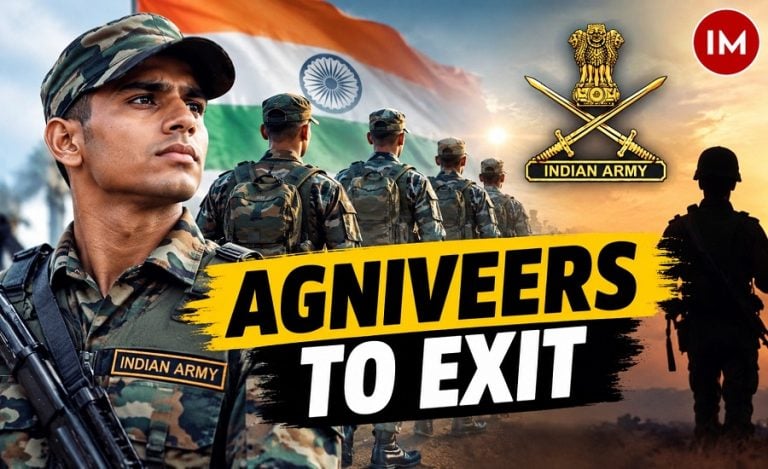
New Delhi: The first batch of Agniveers recruited under the Centre’s Agnipath scheme is preparing to transition into civilian life after completing four years of military service, with approximately 18,300 personnel from the Army, Indian Navy and Indian Air Force expected to leave the armed forces by December 31.
The transition marks a significant milestone for the recruitment programme introduced in June 2022. While the outgoing Agniveers will have to explore new career opportunities after completing their fixed-term service, several state governments have announced measures to facilitate their entry into government employment, particularly in police forces and other state services.
Haryana has emerged as one of the states preparing to offer direct employment opportunities to the outgoing personnel. Chief Minister Nayab Singh Saini has said that the state government has completed the necessary preparations to issue joining letters to Agniveers arriving for induction into state services.
Maharashtra, Assam and Gujarat have also announced recruitment-related measures aimed at providing employment opportunities to Agniveers after their military tenure.
First Batch of Agniveers to Complete Four-Year Military Service
According to a report by Hindustan Times, officials familiar with the development said that the first batch of Agniveers would begin transitioning out of military service from mid-November, with the process expected to continue through December 31.
Under the Agnipath scheme, 75% of the personnel recruited under the programme leave the armed forces after completing four years of service. The remaining 25% may be selected for regular service, subject to the prescribed selection process and service requirements.
Official figures cited in the report indicate that 24,400 Agniveers were recruited across the three services as part of the first batch. Of these, approximately 19,000 were recruited into the Indian Army, while the Indian Air Force accounted for 2,850 personnel and the Indian Navy for 2,550.
Together, the three services recruited around 24,400 Agniveers in the first batch. With approximately 75% expected to leave after completing their four-year tenure, around 18,300 personnel are set to transition into civilian life by the end of December.
The departure of this first group will be an important test of the employment pathways available to Agniveers after their military service. Their experience, training and exposure to a disciplined working environment are expected to be relevant to recruitment in police forces, security organisations and other public-sector establishments.
Read also: Chhattisgarh Announces 10% Reservation For Ex-Agniveers In These Key Government Departments
Haryana Government Prepares to Issue Joining Letters to Agniveers
The Haryana government has announced plans to provide employment opportunities to Agniveers transitioning out of the armed forces.
Chief Minister Nayab Singh Saini, speaking in Chandigarh on Sunday, said the government had already made the necessary arrangements to facilitate their induction into state services. He reiterated a commitment he had previously made in the Haryana Legislative Assembly to provide joining letters to eligible Agniveers.
“I had made a declaration in the Haryana Legislative Assembly that any ‘Agniveer’—whoever may arrive—would be issued a direct joining letter by the Haryana government. We have made all the necessary preparations for this,” Saini said.
He added that the first batch was expected to arrive on November 26 and that he had recently met officials to instruct them to issue joining letters as soon as the Agniveers arrived.
The announcement signals Haryana’s intention to provide a structured transition for former military personnel entering state employment. For Agniveers completing their four-year tenure, the availability of government jobs could offer an opportunity to continue working in public service while applying the skills and experience acquired during military training.
The proposed arrangement is particularly significant because the first batch’s transition comes at a time when the long-term employment prospects of Agniveers remain an important part of the wider debate surrounding the Agnipath recruitment model.
The government’s preparations will be closely watched as the first group begins leaving military service and seeks opportunities in civilian employment.
Maharashtra Announces Police Jobs for 282 Navy Agniveers
Maharashtra has also taken steps to provide employment opportunities to Agniveers after their military service.
Deputy Chief Minister Devendra Fadnavis recently announced that orders had been issued to provide appointment letters in the state police to 282 Navy Agniveers who are residents of Maharashtra.
The decision is aimed at helping former naval personnel transition into civilian employment while allowing the state police to benefit from their military training and experience.
For personnel who have spent four years serving in the Navy, recruitment into the state police could provide a continuation of their public-service careers in a different capacity. Their exposure to discipline, teamwork, operational responsibilities and security-related duties may also be relevant to policing, subject to the requirements of the positions concerned.
The Maharashtra initiative is part of a broader effort by state governments to create employment opportunities for Agniveers who do not continue in regular military service after completing their four-year tenure.
Assam Reserves 12% of Constable-Level Posts for Agniveers
The Assam government has also announced a measure intended to support Agniveers returning to civilian life.
The state cabinet, led by Chief Minister Himanta Biswa Sarma, has decided to reserve 12% of posts at the constable level and equivalent ranks for permanent residents of Assam who have completed four years of military service under the Agnipath scheme.
The reservation is designed to create a pathway into state police and equivalent services for eligible former Agniveers.
By setting aside a portion of these posts, the Assam government aims to provide trained military personnel with an opportunity to enter law enforcement after completing their initial service commitment.
The measure also reflects a broader policy approach under which states seek to use the training and experience of former Agniveers in public safety and security-related roles.
However, the reservation applies to eligible permanent residents of Assam and is subject to the relevant recruitment framework and conditions.
Gujarat Reserves 20% of State Police Positions for Agniveers
Gujarat has announced another measure to facilitate the recruitment of former Agniveers.
According to the information provided, the state’s Deputy Chief Minister has stated that 20% of positions in the state police have been reserved for Agniveers. The announcement also indicated that eligible candidates would be appointed without having to appear for a written examination.
The proposed arrangement is intended to make it easier for former military personnel to enter state police service after completing their four-year military tenure.
The decision places Gujarat among the states that have announced specific employment measures for outgoing Agniveers, alongside Haryana, Maharashtra and Assam.
The precise implementation of such provisions, including eligibility conditions and the recruitment process, will determine how many former Agniveers can benefit from these opportunities.
Taken together, the state-level initiatives indicate that employment in police and security services is emerging as an important avenue for Agniveers who leave the armed forces after four years.
What Is the Agnipath Scheme?
The Agnipath scheme was announced by the Central Government in June 2022 as a new recruitment model for personnel at the lower ranks of the Indian Army, Indian Navy and Indian Air Force.
Under the scheme, recruits are inducted as Agniveers for a fixed period of four years. The model was introduced as a departure from the traditional system of recruiting personnel into regular military service, and it has remained a subject of significant political debate since its announcement.
The scheme initially faced strong opposition, including protests and criticism over the implications of short-term military service for recruitment, job security and the future employment prospects of personnel leaving the armed forces.
Under the recruitment framework described in the supplied information, eligible candidates enter service within the prescribed age range of 17.5 to 21 years, subject to the applicable recruitment notification. The upper age limit was temporarily relaxed to 23 years for the first recruitment cycle in 2022.
During their four-year tenure, Agniveers undergo military training and perform duties in their respective services. At the end of the term, up to 25% of a batch may be selected for regular enrolment in the armed forces, subject to organisational requirements and performance-based selection.
Those selected for regular service can continue their military careers under the applicable service conditions. The remaining personnel are released after completing the four-year engagement.
The first batch’s departure therefore represents the point at which the scheme’s provision for post-service transition begins to apply on a significant scale.
What Happens to the 75% Who Leave Military Service?
The employment prospects of the 75% of Agniveers who leave after four years have been central to discussions surrounding the scheme.
The government has announced measures intended to provide these personnel with opportunities in other uniformed services and public-sector organisations. These include the Central Armed Police Forces (CAPFs), state police forces, the Indian Railways, the Coast Guard and public-sector undertakings associated with the defence sector.
The aim is to provide former Agniveers with additional avenues for employment while making use of the training, discipline and experience they gain during military service.
Among the most significant measures announced by the Centre is the provision for former Agniveers to receive a 10% reservation in recruitment to specified constable-level posts in the Border Security Force (BSF), Central Reserve Police Force (CRPF), Central Industrial Security Force (CISF), Indo-Tibetan Border Police (ITBP) and Sashastra Seema Bal (SSB), subject to the applicable recruitment rules and notifications.
The supplied information also refers to opportunities in the Assam Rifles. The exact reservation provisions and eligibility conditions vary by force and recruitment notification, so candidates must refer to the rules applicable to the posts for which they apply.
These central recruitment measures complement state-level initiatives such as the arrangements announced in Haryana, Maharashtra, Assam and Gujarat.
The availability of such opportunities, however, does not mean that every outgoing Agniveer will automatically secure a government job. Candidates must meet the eligibility conditions and comply with the relevant recruitment and appointment procedures, except where a specific government order provides otherwise.
Why the First Batch’s Exit Is Significant
The departure of approximately 18,300 Agniveers is a crucial moment for the Agnipath scheme because it brings the issue of post-service employment from policy planning into practical implementation.
Until now, much of the discussion surrounding the scheme has focused on military recruitment, training, the four-year service period and the selection of a limited number of personnel for regular enrolment.
With the first batch completing its tenure, attention is shifting towards how effectively the transition into civilian life will be managed.
The initiatives announced by state governments demonstrate one approach: creating pathways into police forces and other state services for eligible former military personnel. The central government’s provisions for recruitment into CAPFs and other organisations offer additional possibilities.
For the outgoing Agniveers, the challenge will be to navigate the available recruitment opportunities and secure suitable employment after their military service. For governments, the task will be to ensure that announced measures translate into clear recruitment processes and actual appointments.
Haryana’s plan to issue joining letters to arriving Agniveers, Maharashtra’s announcement concerning 282 Navy Agniveers, Assam’s 12% reservation for eligible former Agniveers and Gujarat’s 20% reservation in state police positions illustrate the range of approaches being adopted by state governments.
As the first batch begins leaving the armed forces, the implementation of these measures will be an important indicator of the employment support available under the Agnipath framework.
The transition will also shape the experience of subsequent batches, which will eventually face the same decision about their careers after completing four years of military service.