Raipur: A major transformation is taking shape in Chhattisgarh’s Bastar region, where 70 security camps are being converted into ‘Jan Suvidha Kendras’ to bring essential government and public services closer to remote tribal communities.
The first phase of the initiative is now in its final stage, with most of the selected camps already beginning to provide public facilities. The remaining centres are expected to become operational by the end of 2026.
The initiative marks a shift in the use of security infrastructure in areas that have historically faced Left Wing Extremism (LWE). Instead of serving primarily as Forward Operating Bases (FOBs), selected camps with reduced operational requirements are being developed as multi-service centres for local communities.
70 Camps in First Phase, 200 Planned
Under the Bastar 2.0 roadmap, the government plans to convert a total of 200 security camps into Jan Suvidha Kendras in phases.
The first phase covers 70 camps and is expected to be completed by the end of this year. The government is also aiming to complete the first phase before the likely visit of Prime Minister Narendra Modi to Chhattisgarh in the first week of November, subject to the situation.
The initiative was launched as a pilot model earlier this year at Netanar village in Bastar.
Read Also: Chhattisgarh Signs MoU with ASI to Upgrade Heritage Tourism Infrastructure
From Security Infrastructure to Public Services
For more than two decades, security forces established fortified camps in forested and tribal areas to improve security, protect important routes and counter insurgent activities.
With the security situation improving in several parts of Bastar, the government is now looking at how some of this existing infrastructure can serve another purpose.
The Jan Suvidha Kendra model aims to bring several services under one roof, particularly in villages where residents often have to travel long distances to reach block or district headquarters.
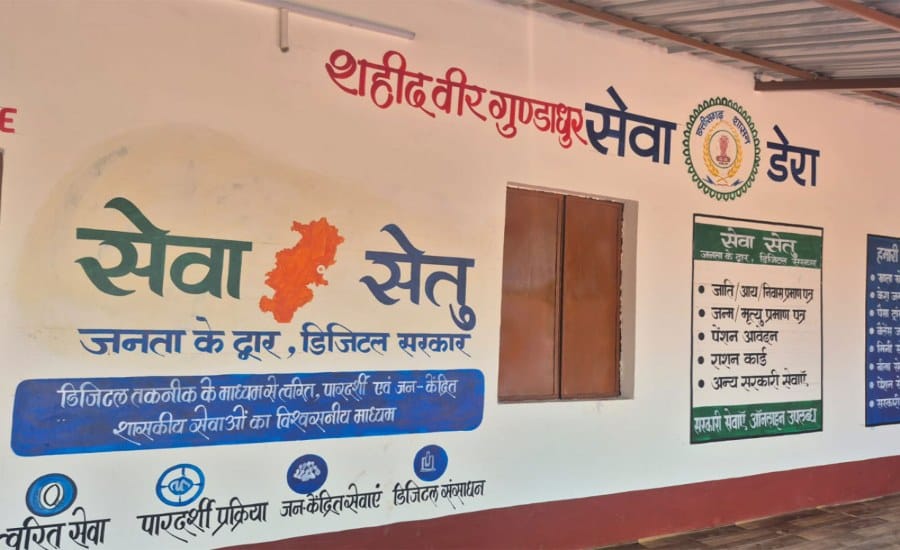
The centres are expected to provide services such as:
- Aadhaar updates and other digital services
- Banking facilities and bill payments
- Income, caste and domicile certificate applications
- Ration card and Ayushman Bharat services
- e-Shram registration
- Railway and bus ticket booking
- Printing, scanning and online application facilities
For remote families, access to these services closer to home could reduce travel time, expenses and dependence on intermediaries.
Healthcare to Become Part of the Model
The planned Jan Suvidha Kendras are not limited to administrative and digital services.
According to officials involved in the process, the centres will also support primary healthcare, vaccination, maternal and child healthcare, nutrition programmes and malaria-control activities.
This could be particularly important in villages located far from hospitals and health centres.
Pregnant women, children and elderly people often face greater difficulty when healthcare facilities require long-distance travel. Bringing basic health services closer to these communities could make access easier and allow people to seek assistance without travelling to larger administrative centres.
The model therefore connects security infrastructure with a broader public-service network covering health, welfare and digital access.
Banking and Digital Inclusion for Tribal Communities
One of the key expected benefits of the Bastar Jan Suvidha Kendras is improved digital and financial inclusion.
Many remote areas have historically had limited access to banks, internet connectivity and government offices. With banking and online services available locally, residents can potentially access welfare schemes and essential documentation without repeated visits to distant towns.
Officials also expect the initiative to reduce dependence on middlemen and make welfare delivery more transparent.
Access to Aadhaar-related services, ration cards, pensions, certificates, banking and government applications from a nearby centre can make a significant difference for families living in remote forest and tribal areas.
Beyond Welfare: Jobs, Skills and Livelihoods
The proposed centres are also expected to support livelihood opportunities.
The government plans to incorporate skill-development training, employment guidance for youth, agricultural advisory services, PM-Kisan assistance and information related to forest produce and forest rights.
This expands the purpose of the centres from basic service delivery to economic empowerment.
Local youth and self-help groups are also expected to participate in the operation and management of the centres. Such involvement could create local opportunities while making the facilities more closely connected with the communities they serve.
For Bastar’s tribal population, better access to information on agriculture, forest produce and forest rights could also help strengthen existing rural livelihoods.
Development Hubs, Not Just Service Centres
The planned infrastructure goes beyond government counters.
Officials said the centres will also include facilities such as fair price shops, drinking water, internet connectivity, community meeting halls, primary schools and Ashram hostel facilities.
This means the Jan Suvidha Kendra model is being positioned as a broader rural development hub rather than a conventional government service centre.
Infrastructure upgrades will include electricity, water, internet connectivity and sanitation before different departmental services are integrated into the facilities.
A New Approach to Bastar’s Development
The transformation is taking place against the backdrop of the government’s announcement of a Naxal-free India on March 31, 2026. Following that announcement, officials said the opening of new Forward Operating Bases has stopped, while some existing FOBs are being repurposed.
The change reflects an evolving approach in areas that have historically required a strong security presence.
Security remains an important part of the region’s development journey, but the government is increasingly focusing on what comes after improved access and stability: schools, healthcare, banking, digital connectivity, employment and welfare services.
For communities that have faced limited access to basic administrative facilities for years, this transition could have a direct impact on everyday life.
From Security to Development
The conversion of 70 camps is only the first stage of a larger plan involving 200 centres. Its success will depend not only on infrastructure but also on whether services remain accessible, reliable and responsive to local needs.
If the model expands as planned, Bastar Jan Suvidha Kendras could become an important example of how existing public infrastructure can be repurposed to strengthen governance and development in remote regions.
The broader significance lies in bringing the state closer to communities through everyday services. From Aadhaar and banking to healthcare, education, agriculture and livelihood support, the initiative seeks to make development more visible at the village level.
For Bastar, the transformation of security camps into public-service hubs represents a symbolic and practical shift — from infrastructure built primarily around security towards infrastructure designed to deliver development and opportunity.
Read also: A New Chapter in Dairy: Madhya Pradesh Sets White Revolution 2.0 in Motion