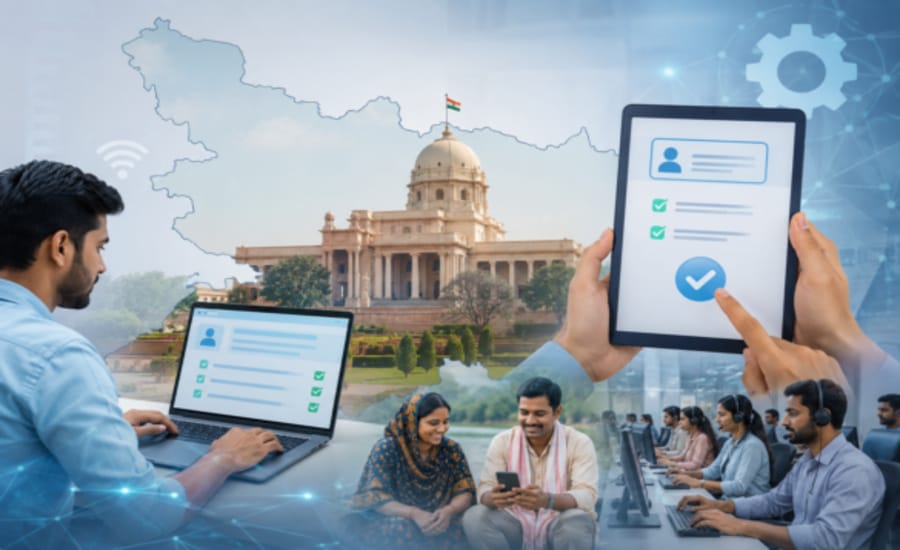
Patna: Bihar’s digital governance initiatives are transforming the delivery of public services in rural areas. The state has processed 33.48 lakh applications through Public Service Centres (Lok Seva Kendras) established at the panchayat level, reducing the need for villagers to travel to block or district offices for routine government services.
According to the General Administration Department, the initiative has made government services more accessible, transparent and time-bound. Along with expanding e-services, the state has introduced digital grievance redressal, an auto-appeal system, HRMS digitisation and citizen helplines to strengthen governance.
Government Services Reach Villages
The Panchayat-level Public Service Centres have become the first point of contact for citizens seeking government services.
So far:
- 33.77 lakh applications have been received.
- 33.48 lakh applications have already been processed successfully.
With services now available at the village level, citizens no longer have to visit sub-divisional or district headquarters for many routine government tasks.
Read Also: Bihar SC-ST Welfare Minister Orders Suspension of Sitamarhi Data Operator Over Bribery Complaint
More E-Services Available at Panchayat Centres
Since July 2025, more than 64 e-services have been offered through Public Service Centres operating from Panchayat Government Buildings and Panchayat Bhawans.
These complement the services already provided under the Bihar Right to Public Services (RTPS) Act, 2011, which covers 153 services across 14 departments.
People can access services such as:
- Caste, income and residence certificates.
- New ration cards.
- Driving licences.
- Labour accident assistance.
- Social security pension schemes.
Overall, Bihar has processed more than 53.80 crore service applications under the RTPS framework.
RTPS Gets Auto-Appeal Feature
To make service delivery more citizen-friendly, Bihar launched an auto-appeal facility on the RTPS Appeal Portal on June 23, 2026.
The system automatically initiates the appeal process for eligible pending cases, reducing delays and making grievance redressal more efficient.
The reform has been introduced under the Government of India’s Deregulation and Compliance Reduction (Bihar) Phase-II initiative.
Over 19 Lakh Public Grievances Resolved
The state has also strengthened its grievance redressal system.
Under the Bihar Public Grievance Redressal Rights Act, 2015, citizens can seek resolution for 514 services and schemes across 45 departments.
Since January 2016, the government has resolved more than 19.38 lakh complaints and petitions.
An online grievance system for government employees, operational since June 2019, has also disposed of 16,106 complaints.
HRMS Fully Digitised
Bihar has completed the digitisation of its Human Resource Management System (HRMS) to improve administrative efficiency.
The initiative includes:
- Digitisation of 2.72 lakh service records.
- Scanning of over 1.23 crore pages.
- Digital management of service and salary records for nearly 8 lakh employees across 48 departments.
The government also publishes the annual asset and liability declarations of Group A, B and C employees on its website to promote transparency.
Citizen Helplines and Capacity Building
The state continues to strengthen citizen support through dedicated helplines.
The Jigyasa Central Helpline (14403) has assisted over 8.19 lakh citizens since 2010. Meanwhile, the Samadhan Call Centre (1800-345-6284) has handled more than 12.93 lakh complaints and information requests since 2016.
To improve administrative capacity, Bihar has made one hour of weekly study and iGOT training mandatory for Bihar Administrative Service and Secretariat Service personnel.
The state has also selected 107 fellows under the Chief Minister Fellowship Scheme, launched in September 2025. An MoU between BPSM and IIM Bodh Gaya will support the programme by placing young professionals in key government departments.
A Step Towards Better Rural Governance
Bihar’s digital governance reforms are making public services faster, more transparent and easier to access. By expanding e-services to villages, strengthening grievance redressal and digitising government processes, the state is improving service delivery while reducing the burden on citizens. The initiatives also support broader goals of digital governance, administrative efficiency and inclusive rural development.
Read Also: NeVA Expands Nationwide: 33 States, UT Legislatures Sign MoUs; 21 Go Fully Digital