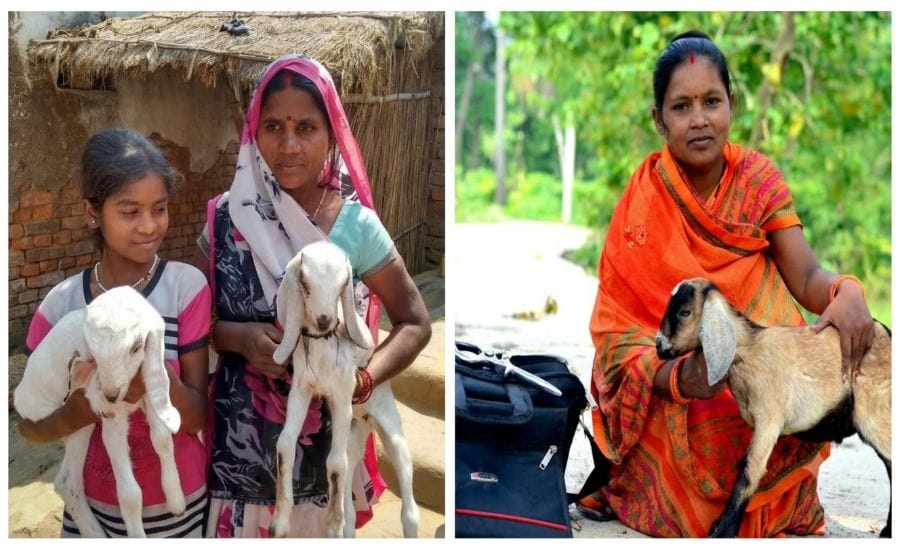
Patna: Nearly 20,000 women across Bihar’s Seemanchal region are turning goat farming and meat production into a growing organised business, creating a new model of women-led rural enterprise.
Linked to the Seemanchal Jeevika Goat Producer Company Limited, women from Araria, Purnia, Katihar and Kishanganj have collectively contributed to a cumulative turnover of ₹15.49 crore as of August 2026.
The initiative, supported through Bihar’s Jeevika self-help group network, has gradually moved goat farming beyond individual household activity by connecting producers with organised procurement, animal healthcare, transparent pricing and meat markets.
A Company Built Around Goat Farmers
The Seemanchal Jeevika Goat Producer Company Limited was established in December 2020 and began commercial operations in September 2021.
By August 2026, the company had 19,956 shareholders, taking its total share capital to ₹99.78 lakh.
The model has brought thousands of women goat farmers into a common business structure. Instead of depending entirely on local and informal markets, producers can access an organised value chain covering procurement, animal health services and meat sales.
The scale of participation has also helped transform goat rearing into a collective commercial activity across four districts.
Read Also: Bihar’s Big Investment Push: Gadkari Says State Can Become Major Economic Hub
Annual Turnover Rises More Than 20 Times
The growth in the company’s annual turnover shows how quickly the business has expanded.
In the financial year 2021-22, the company recorded a turnover of ₹25.50 lakh. By 2025-26, this had increased to ₹530.63 lakh, or around ₹5.31 crore.
That represents an increase of more than 20 times in five years.
The growth has also translated into higher payments to farmers involved in goat farming and meat production. Payments made to producers across the four districts rose from ₹11.47 lakh in 2021-22 to ₹146.70 lakh in 2025-26.
By August 2026, cumulative turnover had reached ₹15.49 crore, while ₹5.71 crore had been paid directly to producer women.
Transparent Pricing Changes the Market
A key feature of the model is the use of a transparent pricing system based on live body weight.
This approach gives farmers a clearer basis for determining the value of their goats and can reduce dependence on informal negotiations at the time of sale.
The company has also established 44 demonstration-cum-collection centres at the block level. These centres are designed to make procurement and sale easier for producers and bring organised market access closer to villages.
The structure allows women farmers to participate in a value chain rather than limiting their role to rearing animals at the household level.
700-Plus Pashu Sakhis Support Farmers
Animal healthcare is another important part of the model.
More than 700 trained Pashu Sakhis are working across the region to provide animal health services closer to villages. Their network helps farmers access basic veterinary support and preventive care without having to depend entirely on distant facilities.
During 2025-26, the network provided more than:
- 2.15 lakh deworming services
- 1.95 lakh vaccination services
Such preventive interventions are particularly important in livestock-based livelihoods because animal health directly affects productivity, survival rates and household income.
Meat Outlets Add Another Link to the Value Chain
The initiative has also expanded beyond livestock procurement into direct meat sales.
Through the Seemanchal Jeevika Meat Outlet, more than 14,566 kg of meat had been sold by August 2026. The outlet generated business worth more than ₹1.03 crore during the period.
This creates another link between rural producers and consumers and allows the enterprise to participate in more stages of the value chain.
Rather than depending only on the sale of live animals, the model is gradually connecting production with processing and retail markets.
Four Districts, One Collective Enterprise
The initiative covers four districts of Seemanchal — Araria, Purnia, Katihar and Kishanganj.
For women in these rural areas, collective participation can provide access to services and markets that may be difficult to secure individually. The producer-company structure brings together farmers, animal health workers, collection centres and market outlets under a connected system.
The expansion also shows how self-help groups can move beyond savings and credit activities towards larger livelihood and enterprise models.
From Livelihood Activity to Rural Business
Goat rearing has long been an important livelihood activity for rural households. The Seemanchal model attempts to add an organised commercial layer to it.
The combination of collective ownership, transparent pricing, animal healthcare, procurement centres and meat outlets creates a more structured route from livestock production to market.
For participating women, the reported ₹5.71 crore in direct payments by August 2026 indicates the scale at which the enterprise has begun moving money back to producers.
Rural Development Minister Shravan Kumar described the initiative as an example of what collective entrepreneurship among rural women can achieve. He also said the department intends to take the model to other parts of Bihar.
What the Seemanchal Model Shows
The growth of the Seemanchal Jeevika Goat Producer Company demonstrates how rural women can participate not only as livestock owners but also as shareholders and producers within an organised enterprise.
With nearly 20,000 shareholders, a cumulative turnover of ₹15.49 crore and an expanding network of animal health and market facilities, the initiative has developed into a significant rural business model.
Its longer-term impact will depend on continued market demand, animal health, producer participation and the company’s ability to expand value-added activities.
For Bihar’s rural economy, however, the model highlights a wider possibility: when women farmers gain collective ownership, organised market access and technical support, traditional livelihood activities such as goat farming can develop into scalable enterprises with direct economic benefits for rural households.
Read Also: Bihar Tightens Anti-Corruption Net: 6 Officials Face DA Probes Across 5 Cases