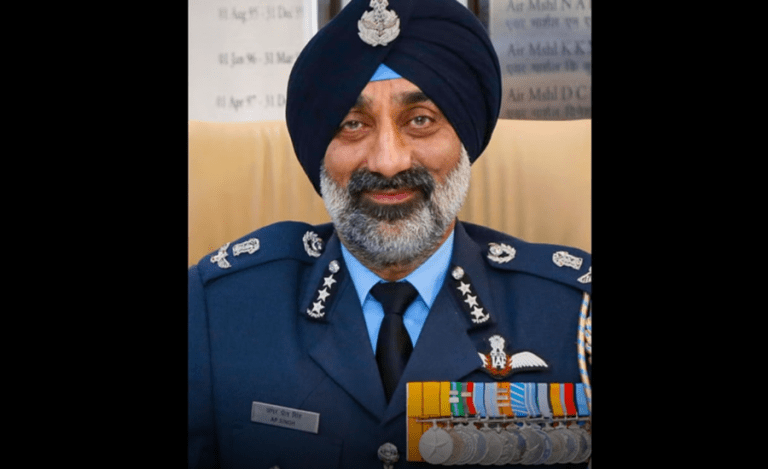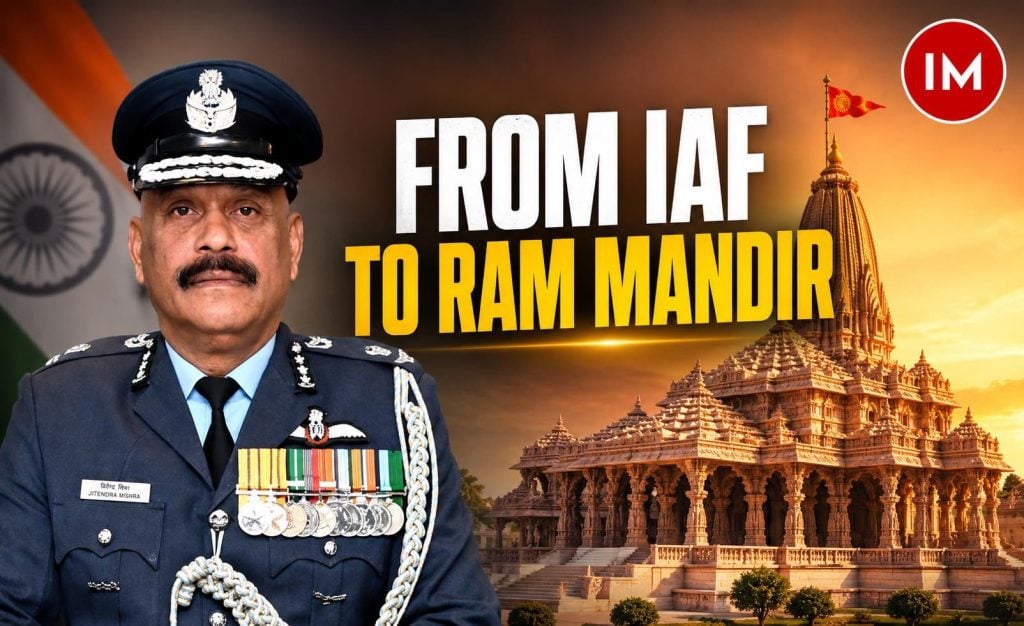
Ayodhya: Former Air Marshal Jeetendra Mishra, who retired from the Indian Air Force earlier this year after a distinguished career spanning nearly four decades, has been appointed as the first Chief Executive Officer (CEO) of the Ayodhya Ram Mandir.
The decision was taken unanimously during a meeting of the Shri Ram Janmabhoomi Teerth Kshetra Trust held on Wednesday at Maniramdas Chhavni in Ayodhya, chaired by Trust president Mahant Nritya Gopal Das.
Mishra, who served as the Air Officer Commanding-in-Chief (AOC-in-C) of the Western Air Command, brings extensive experience of commanding large organisations, managing complex operations and coordinating across multiple agencies.
He had taken charge of the Western Air Command on January 1, 2025, and led the strategically important command during Operation Sindoor.
Now, months after retiring from the IAF, the decorated former three-star officer has taken on a completely different but equally significant responsibility — overseeing the administrative and operational functioning of the Ram Mandir in Ayodhya.
Why Jeetendra Mishra’s Appointment Is Significant
The appointment comes at a crucial stage in the development of the Ram Mandir complex, as the institution moves beyond its primary construction phase towards the establishment of a structured, large-scale operational system.
The Ayodhya temple is expected to handle a massive and sustained flow of devotees from across India and abroad. Its operations require coordination across areas including darshan arrangements, crowd management, security, staff administration, infrastructure, visitor amenities and coordination with government agencies.
Mishra’s experience in leading large military formations and handling complex operational responsibilities is expected to be useful in managing this scale of activity.
His new role will require him to coordinate administrative systems around the temple while working with the Trust, government agencies, security authorities and other stakeholders.
Read Also: Ram Mandir CEO Race: Ex-IPS ‘Encounter Specialist’, Former Ayodhya DM Among 18 Contenders
From Deoria Village to the IAF’s Top Ranks
Jeetendra Mishra’s journey to the top levels of the Indian Air Force began in Bhopatpura village in the Bhatpar Rani area of Deoria district, Uttar Pradesh.
He went on to join the National Defence Academy (NDA) and subsequently trained at the Air Force Academy.
Mishra was commissioned into the fighter stream of the Indian Air Force on December 6, 1986.
Over a career spanning more than 38 years, he built a reputation as a fighter pilot, fighter combat leader, experimental test pilot and senior military commander.
He accumulated more than 3,000 hours of flying experience and flew more than 18 types of fighter and transport aircraft and helicopters.
His career included operational flying, test flying, instructional assignments, command positions and senior staff appointments.
Fighter Pilot Who Helped Operationalise Laser-Guided Bombs
One of the notable phases of Mishra’s early operational career came during the Kargil War.
While serving as a Squadron Leader, he was part of the team involved in operationalising laser-guided bombs on Mirage 2000 aircraft at the beginning of the conflict.
The weapons were subsequently used in important air operations during Operation Safed Sagar, including attacks associated with Tiger Hill and Muntho Dhalo.
The experience contributed to his credentials as an operational fighter officer and later helped shape his career in combat operations, testing and senior command.
Experienced Test Pilot and Aviation Specialist
Mishra was not limited to operational fighter flying. He also developed considerable expertise in aircraft testing and evaluation.
He served as a Chief Test Pilot and later became Commandant of the Aircraft and Systems Testing Establishment (ASTE).
He also served as Chief Test Pilot at Hindustan Aeronautics Limited’s Nashik Division while holding the rank of Wing Commander.
As a Group Captain, he served as Chief Test Pilot at ASTE and later handled responsibilities as Director, Operational Planning and Assessment Group, at Air Headquarters in New Delhi.
His test-flying background gave him a combination of operational and technical expertise that distinguished his career within the IAF.
Commanded Two Major Air Bases
After progressing through the senior ranks, Mishra took on important command responsibilities.
As an Air Commodore, he commanded 15 Wing at Air Force Station Bareilly and 18 Wing at Air Force Station Pathankot.
He subsequently served as Air Commodore, Air Staff Requirements at Air Headquarters.
As an Air Vice Marshal, he held the position of Assistant Chief of Air Staff (Projects) at Air Headquarters and later served as Commandant, Aircraft and Systems Testing Establishment.
These assignments gave him extensive experience in command, procurement-related requirements, aviation systems, training and operational planning.
Senior Role in Integrated Defence Staff
Mishra’s career later expanded beyond the IAF’s conventional command structure.
After being promoted to the rank of Air Marshal on January 9, 2023, he assumed the position of Deputy Chief of Integrated Defence Staff (Doctrine, Organisation and Training).
On December 5, 2023, he took charge as Deputy Chief of Integrated Defence Staff (Operations).
These appointments placed him in senior positions dealing with joint defence planning and operations involving the country’s armed forces.
His experience in integrated defence structures further strengthened his credentials in inter-service coordination and complex operational management.
Took Command of Western Air Command in 2025
Mishra reached one of the most important appointments of his military career when he took over as Air Officer Commanding-in-Chief of the Western Air Command on January 1, 2025.
He succeeded Air Marshal Pankaj Mohan Sinha, who retired on December 31, 2024.
The Western Air Command is one of the Indian Air Force’s most strategically important commands, responsible for a critical operational area.
Mishra’s tenure at the helm coincided with a period of heightened operational significance for the command.
Led Western Air Command During Operation Sindoor
Mishra’s tenure as Western Air Command chief also included Operation Sindoor, during which the command played a significant role in India’s air operations.
His leadership during the operation became one of the defining chapters of his military career.
For his role during Operation Sindoor, Mishra was awarded the Sarvottam Yudh Seva Medal (SYSM) on Independence Day 2025.
The decoration is among the country’s highest military honours for distinguished service during wartime or operational circumstances.
Decorated With Three Presidential Honours
Mishra’s military career has been recognised with several prestigious decorations.
He was awarded the Vishisht Seva Medal (VSM) in 2013, followed by the Ati Vishisht Seva Medal (AVSM) in 2024.
He was subsequently awarded the Sarvottam Yudh Seva Medal (SYSM) in 2025 for his role during Operation Sindoor.
His name is therefore associated with all three of these significant military decorations: VSM, AVSM and SYSM.
Trained in India, US and UK
Mishra has also undergone training at some of India’s and the world’s leading defence institutions.
He is an alumnus of the National Defence Academy, Khadakwasla, and the Air Force Academy, Dundigal.
He also trained at the Air Force Test Pilots School, developing specialised expertise in flight testing.
For advanced professional education, he attended the Air Command and Staff College in Montgomery, Alabama, USA, and the Royal College of Defence Studies in the United Kingdom.
The combination of operational experience, test flying, command and international defence education contributed to his broad leadership profile.
Retired From IAF After Nearly Four Decades
Mishra was commissioned into the Indian Air Force on December 6, 1986, and retired on April 30, 2026.
His career spanned almost four decades and included assignments ranging from fighter squadron command and test flying to senior operational command and integrated defence responsibilities.
By the time he retired, he had served as one of the country’s senior-most air officers, culminating in his tenure as AOC-in-C of the Western Air Command.
His appointment as the first CEO of the Ram Mandir now marks his transition from military leadership to institutional and administrative management in the religious sector.
What Will Be the Role of Ram Mandir CEO?
The appointment of a CEO reflects the growing scale and complexity of the Ram Mandir’s operations.
With Ayodhya emerging as a major religious and tourism destination, the temple administration will have to manage large numbers of devotees while maintaining efficient systems for security, movement, accommodation and darshan.
Mr Mishra is expected to oversee areas such as:
- Daily temple operations and administration
- Coordination for large-scale devotee movement and darshan
- Security and coordination with government agencies
- Staff and institutional management
- Expansion of visitor amenities and facilities
- Coordination between the Trust and various government and other agencies
His military background in discipline, operational planning, institutional management and coordination is expected to be particularly relevant to these responsibilities.
Three New Members Also Join Ram Mandir Trust
The Trust meeting also announced the appointment of three new members.
They are Madan Mohan Pandey of Ayodhya, Mahesh Bhagchandka of Delhi, and Nirmala Yadav of Ayodhya.
With these appointments, the Trust’s broader institutional structure now includes its existing key members, newly appointed trustees and ex-officio representatives from the Central and Uttar Pradesh governments.
Key Members of Shri Ram Janmabhoomi Teerth Kshetra Trust
The Trust includes several prominent religious, legal and administrative figures.
Among its key and permanent members are K. Parasaran, senior Supreme Court advocate and founding member; Mahant Nritya Gopal Das, president of the Trust; Swami Govind Dev Giri Ji Maharaj, treasurer; and Krishna Mohan, interim general secretary.
Other members include Jagatguru Shankaracharya Swami Vasudevanand Saraswati Ji Maharaj, Jagatguru Madhvacharya Swami Vishwaprasanna Teertha Ji Maharaj, Yugpurush Parmanand Ji Maharaj, and Mahant Dinendra Das, representing the Nirmohi Akhara.
The three newly announced members are Nirmala Yadav, Madan Mohan Pandey, and Mahesh Bhagchandka.
The ex-officio and government representatives include Nripendra Mishra, chairman of the Temple Construction Committee; Prashant Lokhande, representing the Central Government; Sanjay Prasad, representing the Uttar Pradesh Government; and Shashank Tripathi, District Magistrate, Ayodhya.
From Fighter Pilot to Ram Mandir CEO
Jeetendra Mishra’s appointment represents an unusual transition from the highest levels of India’s military establishment to the administration of one of the country’s most significant religious institutions.
Born and raised in a village in Deoria, Mishra rose through the Indian Air Force to become a fighter pilot, experimental test pilot, senior commander and finally the AOC-in-C of the Western Air Command.
He commanded major air bases, held senior positions within the Integrated Defence Staff and led the Western Air Command during Operation Sindoor.
After retiring in April 2026, he has now been entrusted with the responsibility of becoming the first CEO of the Ayodhya Ram Mandir.
The appointment places a decorated former Air Marshal at the helm of an institution entering a new phase — one focused not merely on construction, but on the long-term management of a major religious complex receiving devotees from across the country and the world.
Jeetendra Mishra: Career at a Glance
- Service: Indian Air Force
- Commissioned: December 6, 1986
- Retirement: April 30, 2026
- Hometown: Bhopatpura village, Bhatpar Rani area, Deoria
- Final Military Appointment: AOC-in-C, Western Air Command
- Western Air Command: January 1, 2025 onwards
- Major Command: 15 Wing, Bareilly; 18 Wing, Pathankot
- Senior Defence Roles: Deputy Chief, Integrated Defence Staff (Doctrine, Organisation & Training); Deputy Chief, Integrated Defence Staff (Operations)
- Flying Experience: More than 3,000 hours
- Aircraft Flown: More than 18 types
- Specialisation: Fighter pilot, fighter combat leader, experimental test pilot
- Ram Mandir Role: First Chief Executive Officer
- Awards: SYSM, AVSM, VSM