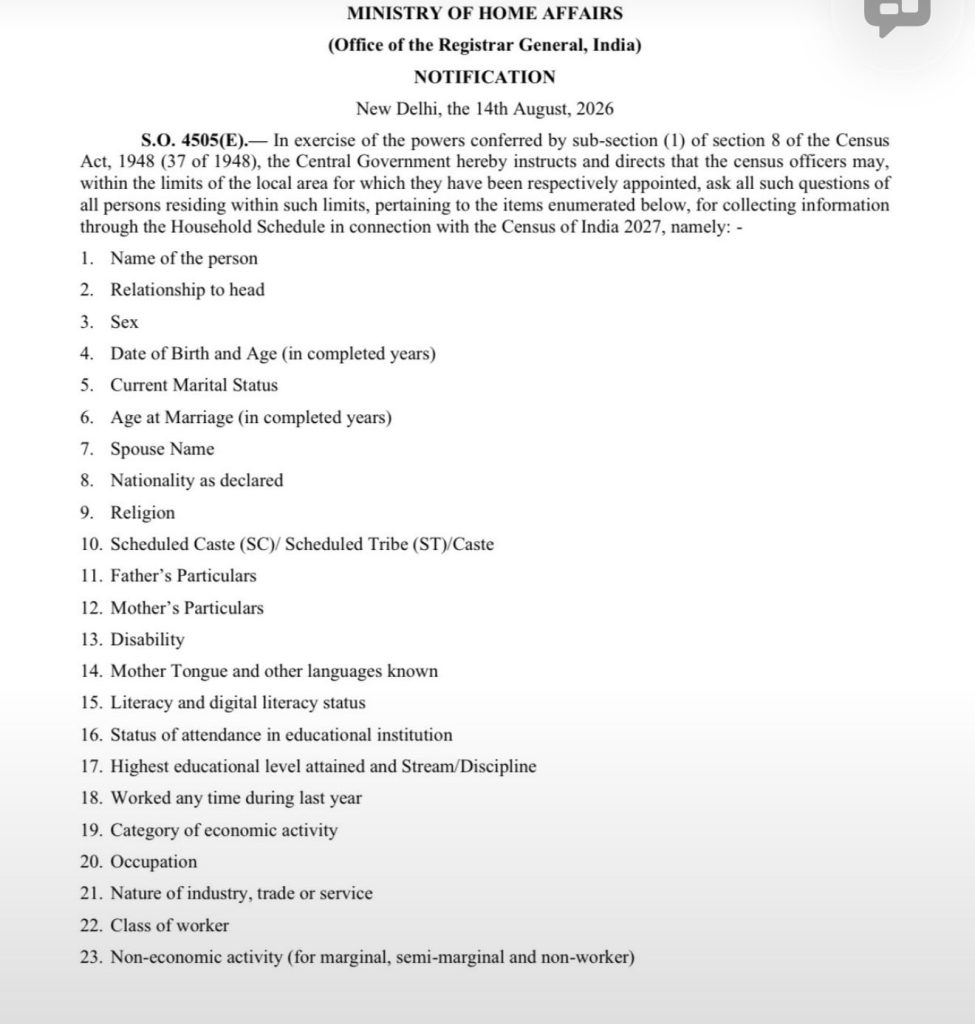
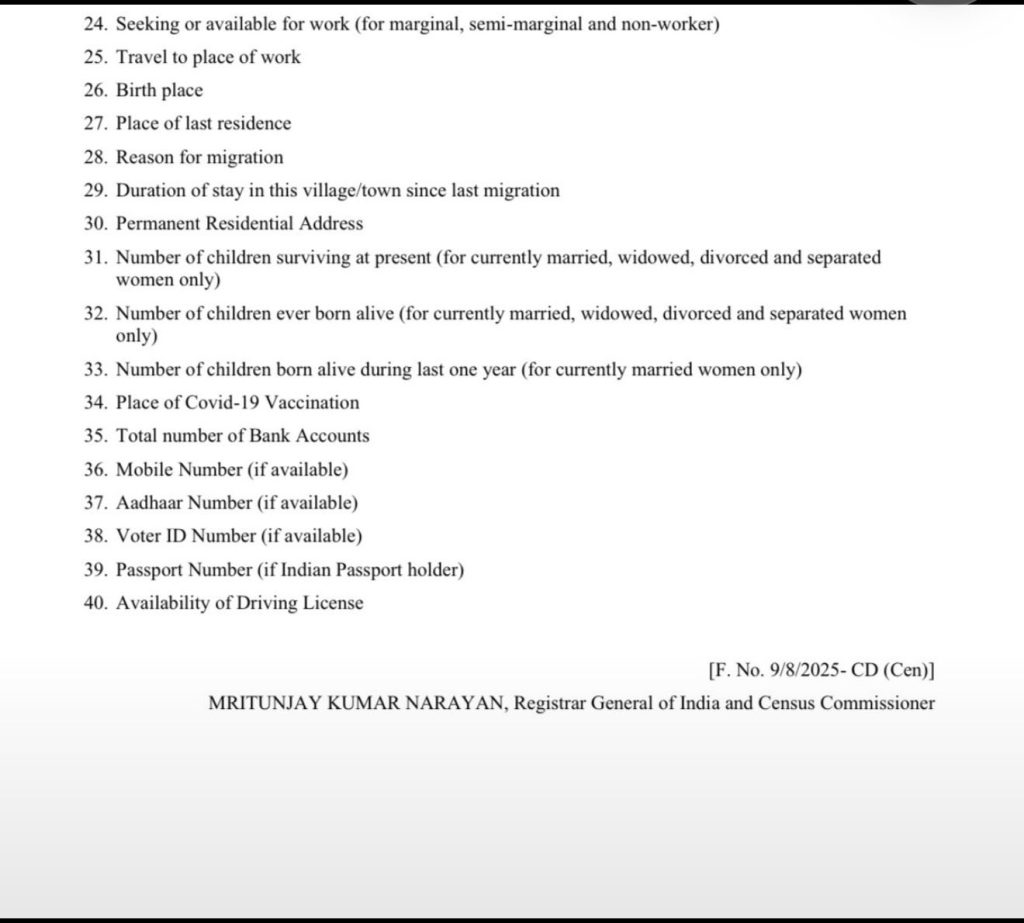
New Delhi: The Ministry of Home Affairs (MHA) has notified a set of 40 questions that census officials will ask households during the population enumeration phase of the Census of India 2027.
The notification has been issued by the Office of the Registrar General, India, under the powers conferred by the Census Act, 1948. It authorises census officers to collect the specified information through the Household Schedule from persons residing within their respective enumeration areas.
The questionnaire covers a wide range of demographic, social, educational, economic and migration-related information, along with details concerning caste, disability, digital literacy, bank accounts and identity documents.
The inclusion of caste is among the most significant features of the upcoming Census, as Census 2027 will be the first post-Independence Census to collect caste details across the population.
Caste, Religion and Other Personal Details
The population enumeration schedule will seek basic personal information about every individual, including their name, relationship with the head of the household, sex, date of birth and age.
Respondents will also be asked about their marital status, age at marriage, spouse’s name and nationality.
The questionnaire includes questions on:
- Religion
- Scheduled Caste (SC) or Scheduled Tribe (ST) status
- Caste
- Father’s and mother’s particulars
- Disability
- Mother tongue
- Other languages known
- Literacy and digital literacy
- Attendance at educational institutions
The caste question is particularly significant because the exercise will provide an official nationwide dataset on caste for the first time in independent India’s regular Census.
Sources cited in reports said the questionnaire is not expected to contain a pre-defined list of castes. Instead, responses are likely to be recorded as provided by respondents.
The decision to include caste enumeration was taken by the Cabinet Committee on Political Affairs (CCPA), chaired by Prime Minister Narendra Modi, at its meeting on April 30, 2025. The government subsequently incorporated caste enumeration into the second phase of Census 2027.
Education Details to Be Recorded
The questionnaire will collect detailed information about the educational status of individuals.
Respondents will be asked whether they are attending an educational institution and about their highest educational level attained.
The schedule will also seek information on the stream or discipline studied, allowing the Census to capture a broader picture of India’s educational profile.
Along with conventional literacy, the questionnaire includes digital literacy, reflecting the growing importance of digital skills in education, employment and access to public services.
Employment and Economic Activity
The 40 questions also cover employment and economic participation.
Respondents will be asked whether they worked at any time during the last year. Depending on their response, the Census will gather information on the nature of their economic activity.
The questionnaire covers:
- Category of economic activity
- Occupation
- Nature of industry, trade or service
- Class of worker
- Non-economic activity
- Availability for work
- Whether the person is seeking work
- Whether the person travels to their place of work
Questions concerning non-economic activity and availability or seeking of work will also apply to specified categories of marginal, semi-marginal and non-workers.
The employment-related information is expected to provide a detailed picture of India’s workforce, occupations and patterns of economic activity.
Migration and Place of Residence
Migration is another major component of the population enumeration.
The Census will ask respondents about their birthplace and place of last residence.
Those who have migrated will also be asked the reason for migration and the duration for which they have stayed in their present village or town since their last migration.
The questionnaire will also seek the respondent’s permanent residential address.
These details will help build a comprehensive picture of internal migration, including movement between villages, towns, districts and states.
Fertility Questions for Eligible Women
The Census schedule also contains questions concerning fertility and children for eligible women.
Currently married, widowed, divorced and separated women will be asked about the number of children surviving at present, the number of children ever born alive and the number of children born alive during the last year.
The questionnaire will also capture information on the number of children in the current marriage.
These questions will contribute to the collection of demographic and fertility data at the national level.
COVID-19 Vaccination Included
One of the notable questions in the new population enumeration schedule relates to COVID-19 vaccination.
Respondents will be asked about the place where they received COVID-19 vaccination.
The inclusion of the question comes years after the pandemic disrupted the original 2021 Census schedule. The government has now incorporated the vaccination-related information into the extensive individual-level questionnaire for Census 2027.
Aadhaar, Voter ID, Passport and Bank Accounts
The questionnaire also contains several questions concerning financial and identification-related information.
Respondents will be asked about the total number of bank accounts held by the household or individual as specified in the schedule, along with their mobile number.
The schedule also includes questions concerning the availability or details of:
- Aadhaar number
- Voter ID number
- Passport number for Indian passport holders
- Driving licence
- Total number of bank accounts
- Mobile number
The inclusion of these questions reflects the increasingly digital nature of government records and public services.
First Fully Digital Census
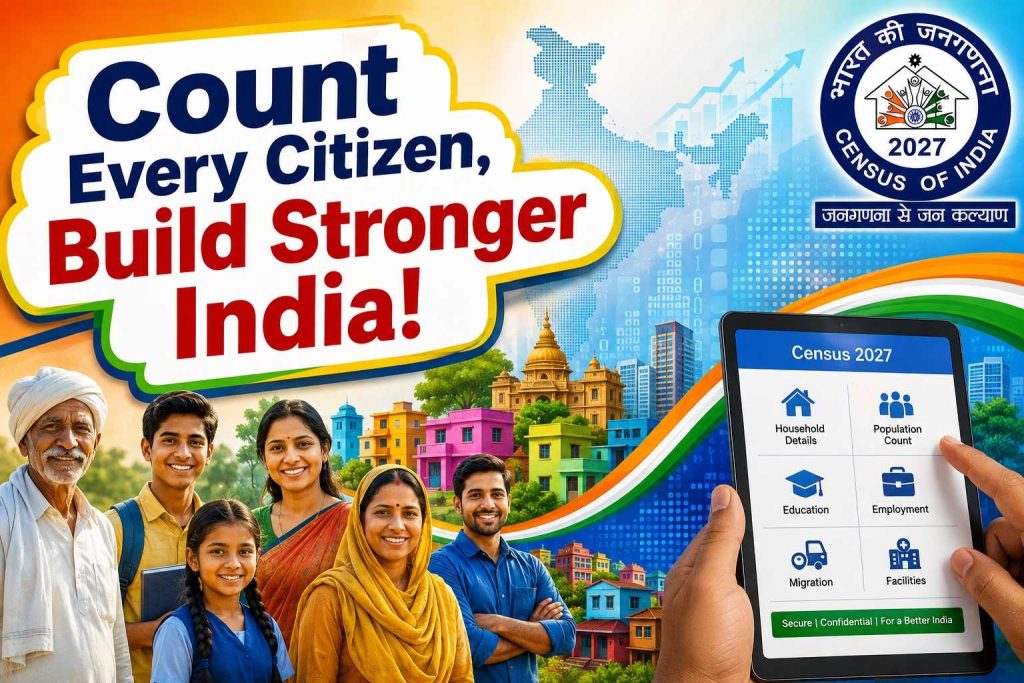
Census 2027 will be India’s first digital Census.
Instead of relying primarily on paper-based enumeration, census officials will use a mobile application to collect and submit information. A central portal will be used to monitor census operations.
The government has also introduced self-enumeration, allowing respondents to submit their information online before the house-to-house visit by enumerators. The facility is available in multiple languages, including Hindi and English.
More than 30 lakh field functionaries are expected to be involved in the massive exercise across the country.
The government has said that measures have been put in place for data security, including secure infrastructure for handling Census information.
Census to Be Conducted in Two Phases
Census 2027 is being conducted in two broad phases.
The first phase is the Houselisting and Housing Census, covering information about houses, housing conditions, household amenities and assets. This phase is being conducted between April and September 2026, with each State and Union Territory having a 30-day field period according to its administrative convenience.
The second phase is the Population Enumeration, during which information about individual members of households will be collected.
For most of the country, population enumeration is scheduled for February 2027.
However, the exercise will be conducted earlier in Ladakh and snow-bound non-synchronous areas of Jammu and Kashmir, Himachal Pradesh and Uttarakhand, where population enumeration is scheduled for September 2026.
Population Enumeration Begins in Snow-Bound Areas From September 1
According to the schedule cited in the latest notification, population enumeration in Ladakh and snow-bound non-synchronous areas of Jammu and Kashmir, Himachal Pradesh and Uttarakhand will take place from September 1 to September 30, 2026.
An option for self-enumeration will be available immediately before the house-to-house population enumeration in these areas, from August 17 to August 31.
For the rest of the country, population enumeration will take place in February 2027.
The different schedule for snow-bound regions is linked to the special reference date prescribed for these areas.
Census Reference Date
The reference date, or the Census Moment, for most of India is 00:00 hours on March 1, 2027.
For Ladakh and the snow-bound non-synchronous areas of Jammu and Kashmir, Himachal Pradesh and Uttarakhand, the reference date is 00:00 hours on October 1, 2026.
The reference date is important because it determines the point in time against which the population is enumerated.
First Caste Census Since Independence
The caste enumeration component is expected to make Census 2027 particularly significant.
While caste information has been collected in certain administrative surveys and exercises, the upcoming Census will mark the first time since Independence that caste details are being included in the regular population Census.
The CCPA decided on April 30, 2025, to include caste enumeration in Census 2027. The government has said the information will be collected during the population enumeration phase.
The inclusion is likely to make the Census an important source of demographic and socio-economic data for policymaking, welfare planning and analysis of social groups.
What Was Asked in the First Phase?
The 40 questions notified now relate to the second phase — Population Enumeration and should not be confused with the questions already notified for the first phase.
The first phase, or Houselisting and Housing Census, focuses on the physical and household environment.
During this phase, enumerators collect information on housing conditions, household amenities and assets, along with details such as the name and sex of the head of the household and ownership status.
The first-phase questionnaire was notified earlier in 2026.
Enumerators physically visit houses and buildings within their allotted areas to ensure that households are not excluded from the Census exercise.
Self-Enumeration Facility Introduced for the First Time
Census 2027 has introduced an online self-enumeration facility for the first time.
Under the system, respondents can enter their information themselves through a web-based platform before the enumerator’s house-to-house visit. The enumerator subsequently verifies the self-enumerated information as part of the Census process.
The facility is intended to make the process more convenient while also supporting the government’s broader move towards a digital Census.
Confidentiality of Census Information
The Census is conducted under the Census Act, 1948 and the Census Rules, 1990.
The government has reiterated that individual Census information is confidential. Under Section 15 of the Census Act, individual information collected during the Census is treated as confidential and is not made public as individual-level data. The government has stated that such information cannot be made public under the RTI Act, used as evidence in a court of law or shared with other institutions.
Only aggregated Census data is published for administrative and statistical purposes.
Census 2021 Was Postponed Due to COVID-19
The Census was originally scheduled for 2021, but the decennial exercise was postponed because of the COVID-19 pandemic.
Census 2027 will therefore be the next population Census after 2011. According to the government, it will be the 16th Census of India overall and the eighth since Independence.
The scale of the exercise is substantial, with more than 30 lakh enumerators, supervisors and other officials expected to participate.
₹11,718.24 Crore Approved for Census 2027
The Union Cabinet has approved an outlay of ₹11,718.24 crore for conducting Census 2027.
The allocation covers expenditure related to census functionaries, training, information technology infrastructure, logistics and other requirements for conducting the nationwide exercise.
The government has described Census 2027 as the world’s largest administrative and statistical exercise.
Census 2027 to Generate Wider Socio-Economic Data
With questions covering caste, religion, education, employment, migration, disability, fertility, digital literacy, financial access and identity documents, Census 2027 is designed to generate a much broader individual-level demographic and socio-economic picture.
The exercise will combine traditional demographic information with newer indicators such as digital literacy, COVID-19 vaccination and access to banking and identity documents.
The notification of the 40 questions marks another major step in preparations for the population enumeration phase of Census 2027, which will begin in the snow-bound regions from September 2026 and across the rest of the country in February 2027.