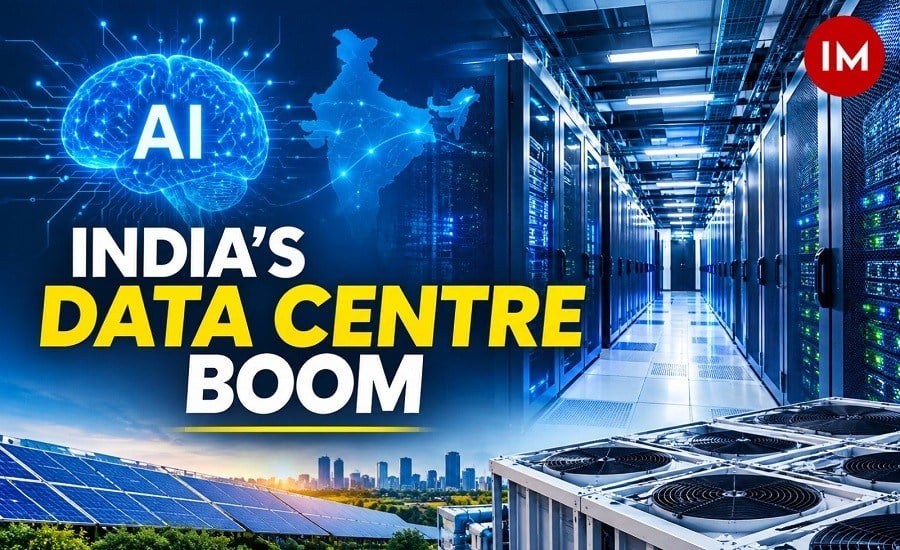
New Delhi: As India’s digital economy expands rapidly, data centres are emerging as critical infrastructure supporting everything from online banking and digital payments to e-Governance, cloud computing and Artificial Intelligence.
Often invisible to ordinary users, these facilities process, store and securely transmit enormous volumes of digital information every second. With India’s data-centre power capacity rising from around 375 MW in 2020 to 1.57 GW as of August 2026, the sector is entering a major phase of expansion.
The capacity is projected to reach nearly 8 GW by 2030, with investments of around USD 70 billion already underway and another USD 90 billion in announced projects.
What Exactly Is a Data Centre?
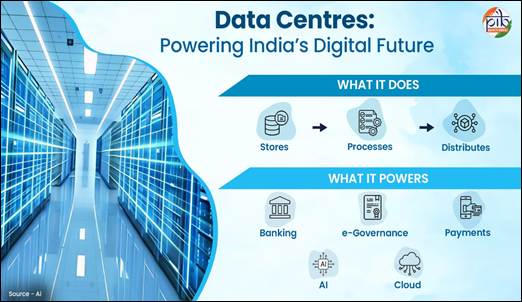
A data centre is a secure facility that houses computing, storage and networking equipment. It stores, processes, manages and distributes large volumes of digital information.
These facilities form the backbone of several services used every day, including online banking, digital payments, e-Governance platforms, cloud computing and emerging technologies such as AI.
Modern data centres combine computing equipment with power systems, cooling infrastructure, networking, physical security and management software. All these systems have to operate continuously to ensure reliable services and protect data.
As India becomes increasingly dependent on digital platforms, resilient data centres are becoming strategic infrastructure for innovation, competitiveness and sustained economic growth.
Read also: AI-Powered 1033 Helpline: NHAI Plans Smarter Emergency Response on National Highways
What Happens Inside a Data Centre?
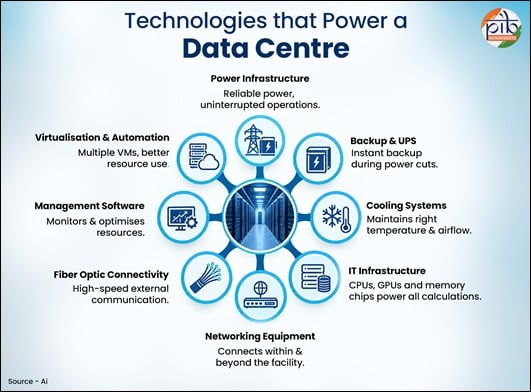
The functioning of a data centre depends on several interconnected systems.
Reliable power infrastructure is essential because data-centre computing equipment needs uninterrupted electricity. Uninterruptible Power Supplies (UPS) provide immediate backup during electrical interruptions, while generators and electrical distribution systems provide additional resilience during longer disruptions.
The computing equipment also generates considerable heat. Cooling systems therefore play a crucial role in maintaining suitable operating conditions. Heating, Ventilation and Air Conditioning (HVAC) systems regulate temperature and airflow, while advanced airflow management and liquid-cooling technologies can improve thermal efficiency.
The IT infrastructure performs the core computing functions. Servers process information and run digital applications, while storage systems hold large volumes of data through technologies such as Hard Disk Drives (HDDs) and Solid-State Drives (SSDs).
Security systems protect the equipment, networks and data from physical and digital threats.
Networking equipment, including routers and high-speed switches, enables information to move within the facility and between the data centre and external networks. Fibre-optic connections provide high-speed communication.
Management software continuously monitors systems and helps optimise computing resources.
Virtualisation allows several virtual machines to operate on a single physical server, improving resource utilisation. Automation tools help manage workloads, support maintenance and identify operational problems.
From a Click to a Response: How a Data Centre Works
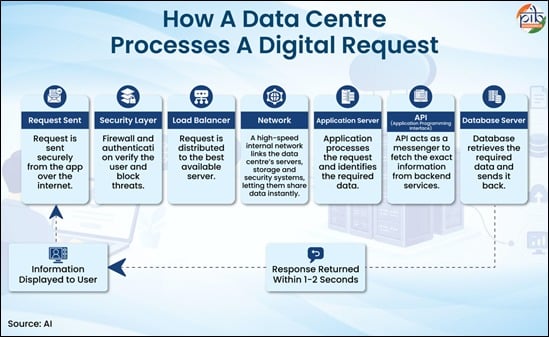
When a person opens an app, checks a bank balance or accesses an online document, a complex chain of processes takes place behind the scenes.
The request first travels through a network to the relevant data centre.
A security layer checks the request and protects the system against cyber threats. A load balancer then directs the request to an available server so that no individual server becomes overloaded.
The application server processes the request and determines what information or service is required. Where necessary, it communicates with other applications or services through an Application Programming Interface (API).
A database server retrieves the required information and sends it back to the application server. The processed information then travels through the network to the user’s device.
The entire process can take only one to two seconds.
The sequence can broadly be understood as:
Connect → Receive → Network → Process → Store → Secure → Respond
This interconnected system enables cloud services, e-Governance platforms and AI applications to deliver information quickly and reliably at scale.
The Data Centre Team in Simple Terms
The different components of a data centre can be understood through everyday examples.
The network works like corridors and an intercom system, connecting different parts of the facility so information can move quickly.
The security layer functions like a security guard, checking incoming requests and protecting the system.
The load balancer works like a traffic cop, directing digital traffic so that one server does not become overwhelmed.
The application server can be compared to a chef who receives an order and determines what information or service is required.
The API acts like a waiter, carrying messages between different applications.
The database server functions like a digital vault where information is securely stored and retrieved when required.
India’s Data Centre Infrastructure
India’s data-centre journey has developed alongside the rapid expansion of e-Governance and digital services.
The National Informatics Centre (NIC) has established state-of-the-art National Data Centres at its facilities in Delhi, Pune, Hyderabad and Bhubaneswar.
NIC has also established 37 smaller data centres at various State Capitals. These facilities provide digital services to government institutions at different levels and support round-the-clock operations, system management and skilled onsite personnel.
The growth of India’s digital economy is now creating significantly greater demand for commercial and government data-centre infrastructure.
Installed data-centre power capacity stood at around 375 MW in 2020. By August 2026, it had increased to 1.57 GW.
The capacity is projected to rise to nearly 8 GW by 2030.
The scale of investment is also significant. Around USD 70 billion worth of investments are already underway in India’s data-centre sector, while another USD 90 billion has been announced through upcoming projects.
Government Gives Data Centres Infrastructure Status
The Government has introduced policy and fiscal measures to support the sector.
A major step came through the Union Budget 2022–23, when data centres were included in the Harmonized List of Infrastructure.
This gave data centres infrastructure status and facilitated greater access to credit for digital infrastructure, supporting investment and capacity expansion.
In simple terms, infrastructure status places data centres in a category similar to major infrastructure such as highways, airports and power grids, helping them access long-term financing on more favourable terms.
The Union Budget 2026–27 introduced another major incentive: a tax holiday for eligible foreign cloud service providers until 2047.
The incentive applies to global operations using India-based data-centre infrastructure and covers Tax Years 2026–27 to 2046–47 for notified foreign companies.
Semiconductor and AI Policies Also Driving Growth
India’s data-centre expansion is closely linked to the Government’s wider push for semiconductors, AI and electronics manufacturing.
The second phase of the Semicon India Programme, or Semicon 2.0, was approved by the Union Cabinet on July 15, 2026, with an outlay of ₹1,27,500 crore under the India Semiconductor Mission.
The programme aims to build a trusted and resilient semiconductor ecosystem in India.
The IndiaAI Mission, with a total budget outlay of ₹10,371.92 crore, is another major driver. The AI ecosystem being developed under the Mission is expected to increase demand for computing infrastructure and therefore data-centre capacity.
The Electronics Components Manufacturing Scheme (ECMS) has also received higher financial support, with its allocation increased from ₹22,000 crore to ₹40,000 crore.
Meanwhile, PLI Scheme 2.0 for IT Hardware aims to strengthen domestic manufacturing of IT hardware such as servers, attract investments, reduce dependence on imports and establish India as a trusted global supply-chain hub.
The Growing Energy Challenge
Rapid expansion of data centres also brings a major energy challenge.
Data centres require large quantities of reliable electricity because their equipment operates continuously. Cooling systems add significantly to their energy requirements.
According to the Central Electricity Authority, electricity demand from the data-centre sector could reach 17 GW by 2031–32.
As capacity expands, India is therefore simultaneously focusing on cleaner power and more efficient resource use.
Renewable Energy for Digital Infrastructure
The Government is promoting renewable and cleaner energy through several initiatives, including the Green Energy Open Access Rules, Green Energy Corridor Scheme and National Green Hydrogen Mission.
The National Programme on High Efficiency Solar PV Modules and the Solar Park Scheme are also supporting clean-energy deployment.
These measures can help energy-intensive digital infrastructure access cleaner and more reliable electricity as the sector expands.
SHANTI Act and Nuclear Power
Nuclear energy is also emerging as part of the clean-power strategy for future digital infrastructure.
The Sustainable Harnessing and Advancement of Nuclear Energy for Transforming India, or SHANTI Act, strengthens the clean-power ecosystem and supports reliable nuclear power for emerging sectors, including AI and data centres.
The framework also enables the future deployment of Small Modular Reactors and Micro Nuclear Reactors.
BIS Standards for More Efficient Data Centres
Efficiency and sustainability are also being addressed through standards.
The Bureau of Indian Standards has developed standards covering data-centre efficiency through its technical committee LITD 31, which deals with Cloud Computing, Information Technology and Data Centres.
BIS has published standards covering Power Usage Effectiveness (PUE) and Carbon Usage Effectiveness (CUE), along with standards addressing Cooling Efficiency Ratio (CER) and Water Usage Effectiveness (WUE).
In simple terms, these metrics help measure how efficiently a data centre uses critical resources.
PUE and WUE can be viewed as green mileage ratings for electricity and water efficiency.
CUE measures the carbon emissions associated with the electricity consumed by a data centre, while CER measures the efficiency of its cooling systems in removing heat relative to the electricity they consume.
Energy Conservation and Water Management
The Bureau of Energy Efficiency has notified the Energy Conservation Building Code (ECBC) 2017 and the Energy Conservation and Sustainable Building Code (ECSBC) 2024.
These codes establish energy-efficiency and water-conservation norms for buildings and include provisions relevant to data-centre infrastructure.
Water management is particularly important because requirements vary according to the cooling technology used.
Groundwater extraction, including for industrial purposes, is regulated under guidelines issued by the Ministry of Jal Shakti.
At the same time, the growth of AI infrastructure is encouraging data centres to adopt more advanced cooling technologies.
These include direct-to-chip liquid cooling, adiabatic cooling and immersion cooling. Closed-loop liquid cooling systems are also emerging as resource-efficient alternatives.
Why Data Centres Matter for India’s Digital Future
India’s data-centre expansion is not simply about building more facilities to store information.
It is part of a broader effort to establish resilient and sovereign digital infrastructure capable of supporting the country’s growing digital economy.
Data centres are increasingly connected to issues of data sovereignty, digital trust, economic competitiveness and technological self-reliance.
The expansion of cloud computing and AI infrastructure is creating opportunities for innovation and economic growth, but it also brings challenges related to cybersecurity, energy consumption, water use, responsible data practices and accountability.
India will therefore need to balance rapid technological expansion with responsible governance.
Strong standards, robust cybersecurity, efficient resource management and responsible data practices will be essential. Greater domestic capabilities in computing, semiconductors, energy and other critical digital infrastructure will also strengthen India’s technological self-reliance.
As India moves towards the goal of Viksit Bharat by 2047, data centres are set to become a foundational layer of the country’s digital economy—supporting the services, technologies and innovations that will increasingly shape everyday life and economic growth.
Read also: From Lab to Market: AIC ANUSHAKTI Pushes BARC Innovations Through Industry Partnerships