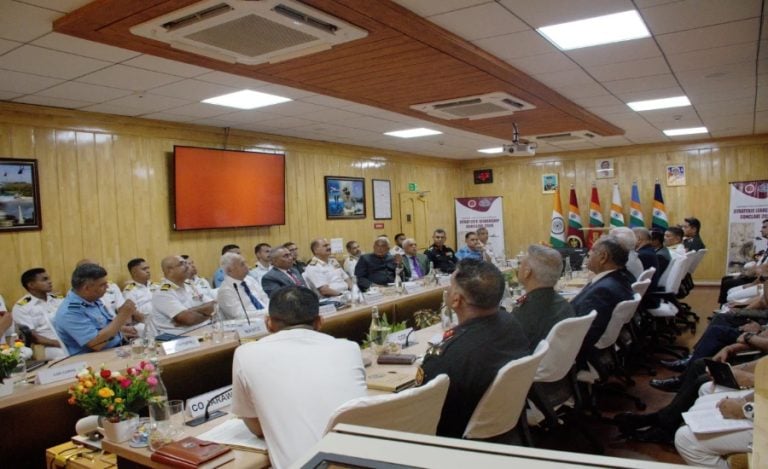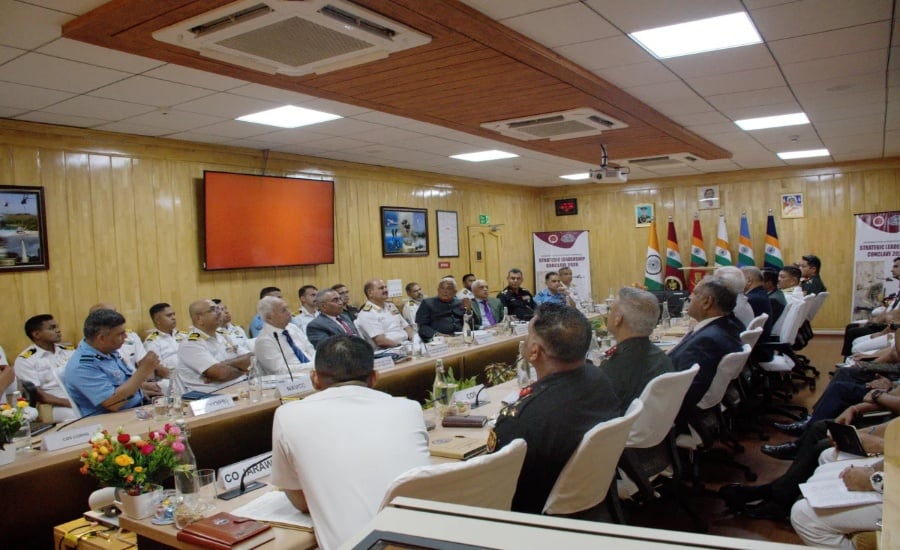
New Delhi: Strategic leaders have gathered at the Andaman and Nicobar Command (ANC) to discuss India’s future tri-services strategy, maritime security and defence priorities for the next 25 years. The conclave was organised as part of the command’s Silver Jubilee celebrations. Former commanders-in-chief and senior military leaders reviewed developments over the past 25 years and discussed the challenges ahead.
The discussions focused on the strategic importance of the Andaman and Nicobar Islands, growing maritime security challenges and the need for closer coordination between the Indian Army, Navy and Air Force.
Strategic Leaders Discuss India’s Future Defence Strategy in Andaman And Nicobar Command
The conclave brought together experienced military leaders to review the role of the Andaman and Nicobar Command in protecting India’s national interests.
Read also: How The Indian Navy Is Extending Its Reach Thousands Of Miles Beyond Indian Waters
According to the report, participants discussed the command’s future vision, operational priorities and the changing security situation in the Indian Ocean Region (IOR).
The discussions also focused on improving coordination among the three armed services. Better coordination is important for responding quickly to security threats and protecting India’s maritime interests.
The command’s Silver Jubilee provided an opportunity to review its achievements and identify priorities for the next 25 years.
Why Is The Andaman And Nicobar Command Important
The Andaman and Nicobar Command holds a special position in India’s defence structure. It is India’s only integrated tri-services operational command, bringing together personnel and assets from the Army, Navy and Air Force.
The command is responsible for protecting the Andaman and Nicobar Islands and supporting India’s maritime security objectives in the surrounding region.
The islands are located near important international shipping routes connecting the Indian Ocean with the South China Sea and the wider Indo-Pacific region. Their geographical position makes them important for monitoring maritime movements and responding to security challenges.
Strait Of Malacca: A Key Maritime Chokepoint
One of the major subjects discussed at the conclave was the strategic importance of the Strait of Malacca. The narrow waterway connects the Indian Ocean with the South China Sea and serves as a major route for international trade and energy transportation.
A large volume of commercial shipping passes through this route every year. It is particularly important for Asian economies that depend on imported oil, gas and other essential goods. China also depends heavily on the Strait of Malacca for energy imports. This makes the surrounding maritime region important for regional security and strategic planning.
India’s geographical position near these shipping routes gives the Andaman and Nicobar Islands significant value in maritime surveillance and defence planning.
Joint Operations Between Army, Navy And Air Force
The conclave highlighted the importance of maintaining close coordination between the Army, Navy and Air Force. The three services have different operational responsibilities, but their combined capabilities are essential for protecting India’s island territories and maritime interests.
Joint planning, intelligence sharing and regular coordination can help improve operational readiness. The command’s integrated structure supports cooperation between the services and helps them work towards common security objectives.
India’s broader defence planning also places importance on jointness and integrated operations. In February 2026, the Ministry of Defence reported that a joint operations conclave under the All Domain Joint Operations Exercise 2026 framework focused on strengthening cooperation among the armed services and other defence organisations.
Search And Rescue Operations Remain Important in Andaman and Nicobar Command
Apart from military responsibilities, the Andaman and Nicobar Command also supports humanitarian and emergency operations.
These include maritime search and rescue missions involving missing, injured or stranded seafarers. The command can play an important role in helping people in distress and supporting evacuations when required.
Such responsibilities make coordination between different services and agencies essential. The command must maintain readiness for both security operations and emergencies in the surrounding waters.
Managing The Islands’ Unique Geographic Challenges
The Andaman and Nicobar archipelago consists of hundreds of islands, but only a small number are inhabited.
According to the report, the archipelago contains 836 islands, of which 31 are inhabited. Its scattered geography makes defence management and the delivery of essential supplies challenging.
Military personnel must coordinate operations across distant locations while maintaining communication, surveillance and logistical support.
The report also highlighted practical difficulties involving electricity generation, transportation and the availability of essential goods.
Many island communities depend on supplies transported from mainland India. Disruptions to shipping can therefore affect the availability of important commodities.
These challenges make reliable transport, infrastructure and supply planning important for the command and the local population.
Andaman and Nicobar Command: Future Priorities For The Next 25 Years
The conclave also discussed the command’s future vision and strategic priorities for the next 25 years.
The focus is on strengthening the command’s role as a strategic frontier and maritime security asset for India.
Improved coordination between the armed services, stronger surveillance and better operational planning will remain important areas for future development.
The command’s location gives it a valuable role in supporting India’s interests in the Indian Ocean and the wider Indo-Pacific. As regional maritime competition and security challenges continue to evolve, the ability to coordinate military resources and respond effectively will remain essential.
FAQs
The islands are located near major international shipping routes, including the Strait of Malacca. Their location makes them important for maritime surveillance, regional security and protecting India’s interests in the Indian Ocean Region.
The Andaman and Nicobar Command is India’s only integrated tri-services operational command. It brings together the Army, Navy and Air Force to support the defence of the islands and India’s maritime security interests.
The conclave focused on India’s future tri-services strategy, maritime security, joint operations and the strategic importance of the Andaman and Nicobar Command. Leaders also discussed the command’s vision and priorities for the next 25 years.