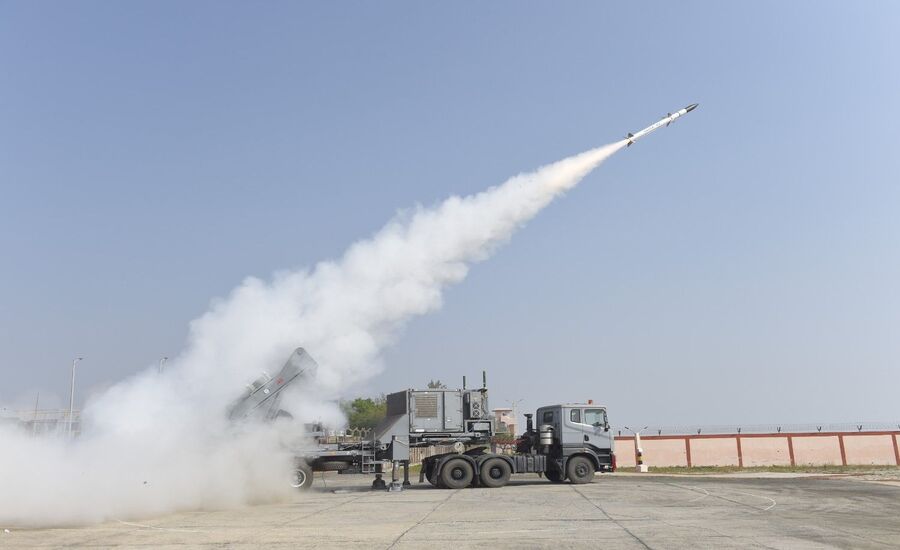
New Delhi: Armenia hails Indian Akash-1S air defence system after recent field exercises highlighted the platform’s mobility, automation, and ability to track and engage multiple aerial threats simultaneously. The Akash-1S, developed by India’s Defence Research and Development Organisation (DRDO), has received positive feedback from Armenian military operators, marking a significant milestone for India’s growing defence exports. The system’s strong performance in diverse operational conditions demonstrates the increasing global confidence in India’s indigenous defence technology.
Armenia became the first foreign customer of the Akash missile system after signing a defence deal with India in 2022. Since then, Armenian forces have been integrating the platform into their air-defence network and conducting extensive field evaluations.
Armenia Praises Akash-1S Air Defence System Performance in Military Exercises
According to reports from recent military exercises, Armenian operators praised the Akash-1S for its high mobility and advanced radar network. Military personnel noted that the system effectively tracked and responded to multiple airborne threats at the same time, improving battlefield air-defence capabilities.
Read also: India’s Akash-NG Missile Program Advances with Induction of MAK Controls’ Indigenous Launcher
Officials also highlighted the platform’s ability to operate efficiently across different geographical and weather conditions, an important factor for Armenia’s varied terrain.
Akash-1S Air Defence System Designed for Rapid Deployment
Unlike traditional fixed air-defence systems, the Akash-1S is designed for rapid movement and deployment. The entire battery system includes:
- Mobile launchers
- Surveillance radars
- Fire-control systems
- Command and control centres
- Logistics support vehicles
This integrated structure allows the system to move alongside ground forces and quickly establish protective air-defence coverage wherever required. Military experts often describe this capability as “shoot-and-scoot,” enabling forces to relocate rapidly after deployment and reduce vulnerability to enemy attacks.
What Is the Akash-1S Air Defence System
The Akash-1S is an upgraded version of India’s Akash surface-to-air missile system. It has been developed by DRDO and manufactured by Bharat Dynamics Limited (BDL) and Bharat Electronics Limited (BEL) for the Indian Armed Forces and export customers. The system is designed to defend against:
- Fighter aircraft
- Attack helicopters
- Drones and UAVs
- Cruise missiles
- Other aerial threats
Akash-1S Air Defence System: Advanced Radar and Multi-Target Tracking Capability
One of the key strengths highlighted during the Armenian exercises was the system’s radar performance. According to available technical specifications, the Akash weapon system can monitor dozens of aerial targets simultaneously and engage multiple threats in a short period.
Armenian operators reportedly praised the platform’s ability to process large amounts of target data while maintaining effective battlefield awareness. This capability is increasingly important as modern warfare involves large numbers of drones, missiles, and aircraft operating simultaneously.
Indigenous Seeker Improves Accuracy
The Akash-1S variant is equipped with an indigenous active radio-frequency seeker. This seeker significantly improves target acquisition and engagement accuracy, particularly against fast-moving and manoeuvring aerial threats. The upgraded technology enables the missile to perform better than earlier versions when engaging complex targets in dynamic combat environments.
Automation Reduces Human Workload
Armenian personnel also highlighted the system’s high degree of automation. Instead of relying on separate manual coordination between multiple units, the Akash-1S uses a digital network that connects surveillance, fire-control, and command systems. This integrated architecture helps operators:
- Process target information faster
- Improve reaction time
- Reduce operational complexity
- Conduct engagements with minimal delay
Extensive Training Supports Operational Readiness
Before conducting domestic field exercises, Armenian crews reportedly received technical and operational training related to the Akash system. Military personnel continue to participate in regular drills to improve their ability to manage radar operations, missile launches, communications, and rapid deployment procedures. Such training ensures that the system can perform effectively during real-world operational scenarios.
A Major Boost for India’s Defence Exports
The Akash export agreement with Armenia remains one of India’s most significant defence export achievements. The deal, reportedly valued at more than $700 million, marked the first international sale of the Akash missile system and strengthened defence cooperation between India and Armenia. The successful deployment and positive feedback from Armenia could further improve international interest in Indian-made defence equipment.
India-Armenia Defence Cooperation Continues to Expand
In recent years, Armenia has expanded defence procurement from India. Alongside the Akash system, Armenia has reportedly acquired or explored other Indian defence platforms, including:
- Pinaka multi-barrel rocket launchers
- Advanced Towed Artillery Gun Systems (ATAGS)
- Counter-drone technologies
The growing partnership reflects Armenia’s efforts to modernise its armed forces while diversifying defence procurement sources.