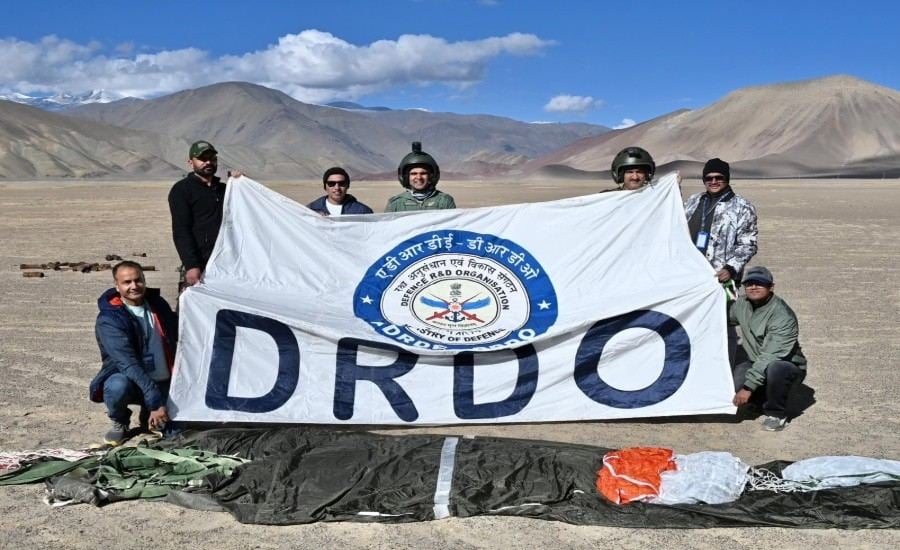
Ladakh: India has achieved another important defence milestone with the successful testing of the Advanced High-Altitude Parachute (AHAP). The Defence Research and Development Organisation (DRDO) carried out the maiden live jump trial of this indigenous parachute system at Nyoma (Mudh Drop Zone) in Ladakh, one of the highest-altitude drop zones in the country. The successful trial demonstrated the parachute’s effectiveness and operational capability in extreme high-altitude conditions.
What Is The DRDO Advanced High-Altitude Parachute
The Advanced High-Altitude Parachute (AHAP) is a static-line parachute system specially designed for the mass deployment of paratroopers in difficult mountain regions.
Read also: Defence Minister Rajnath Singh to Mark Delivery of 2,000th Aero-Engine at HAL Koraput on October 6
The system has been designed and developed by the Aerial Delivery Research and Development Establishment (ADRDE), Agra, a DRDO laboratory focused on aerial delivery technologies.
AHAP has been manufactured by the Ordnance Parachute Factory (OPF), Kanpur, inspected by the Directorate General of Aeronautical Quality Assurance (DGAQA), and certified by CEMILAC.
How Was The DRDO Advanced High-Altitude Parachute Trial Conducted
The maiden live jump was conducted at Nyoma (Mudh DZ) in Ladakh, a location known for its challenging high-altitude terrain. During the trial:
- The jump was carried out from 16,000 feet above mean sea level (AMSL).
- The parachute opened at 15,500 feet AMSL.
- The paratrooper safely landed at Nyoma, located at around 13,700 feet AMSL.
The successful jump proved that the parachute can operate effectively in demanding mountain environments where airborne operations are more difficult and risky.
Why Is DRDO Advanced High-Altitude Parachute Trial Important
Military parachute operations at high altitudes are much more challenging than operations at lower elevations. Thin air, difficult terrain, and strong environmental conditions increase operational risks. AHAP has been designed to address these challenges and provide safer deployment options for Indian forces.
Wider Operational Range
The parachute can operate at altitudes of up to 18,000 feet, making it suitable for India’s mountain warfare requirements, especially in regions such as Ladakh.
Safer Descent Rate
According to DRDO, AHAP offers one of the safest descent rates for high-altitude operations, helping reduce risks during troop deployment.
Boost To Aatmanirbhar Bharat
The successful trial highlights India’s growing capability to develop advanced defence equipment within the country.
Defence Minister Rajnath Singh congratulated DRDO, the armed forces, defence public sector units, and industry partners for the achievement. He described the successful test as another major step toward the vision of Aatmanirbhar Bharat in defence manufacturing.
Defence Secretary and DRDO Chairman Rajesh Kumar Singh also congratulated the teams involved in the design and development of the system.
Read also: DRDO Highlights Indigenous Innovation and Advanced Defence Systems at Land Forces 2026 in Australia
FAQs
The maiden live jump trial was conducted at Nyoma (Mudh Drop Zone) in Ladakh, one of India’s highest-altitude drop zones.
AHAP (Advanced High-Altitude Parachute) is an indigenous static-line parachute system developed by DRDO for mass deployment of paratroopers in high-altitude regions.
AHAP allows safer troop deployment in mountainous and high-altitude terrain, supports military operations up to 18,000 feet, and strengthens India’s indigenous defence capabilities.