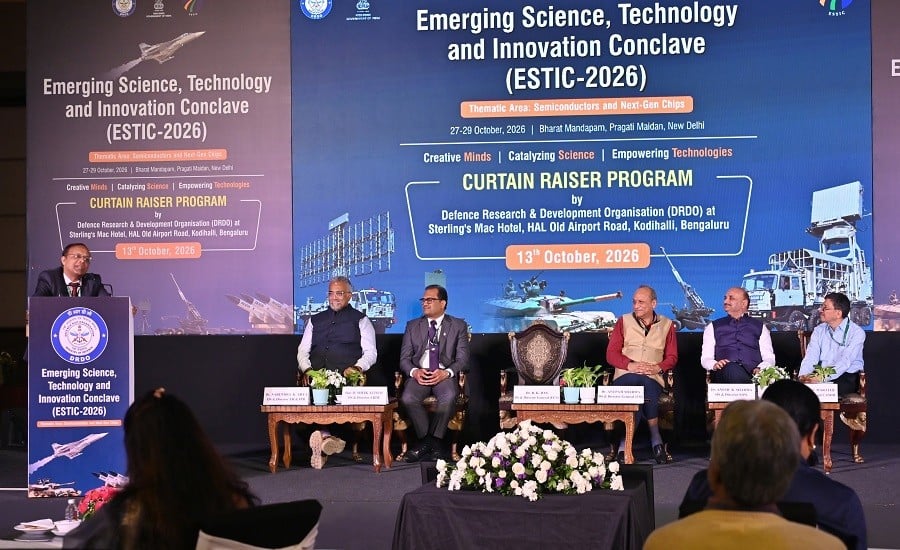
New Delhi: India’s Defence Research and Development Organisation (DRDO) has showcased indigenous semiconductor technologies designed for advanced radar systems, electronic warfare and tactical missiles. The display highlights India’s growing ability to develop critical defence technologies within the country and reduce dependence on foreign suppliers.
The technologies were presented at the Emerging Science, Technology and Innovation Conclave (ESTIC) 2026 in New Delhi. They included advanced microwave circuits, infrared sensors and specialised semiconductor chips for defence applications.
Details of DRDO GaAs and GaN Semiconductor Chips At ESTIC 2026
The ESTIC 2026 conclave was held at Bharat Mandapam in New Delhi from October 27 to 29, 2026.
Read also: How Can This Hidden Threat Can Ruin India’s Next Gen Advanced Missile and Anti-Drone Programme
DRDO presented several technologies developed by its Solid State Physics Laboratory (SSPL), Delhi. These included Monolithic Microwave Integrated Circuits (MMICs) and Infrared Focal Plane Arrays (IRFPAs).
These technologies are important for modern military equipment, including radar systems, electronic warfare platforms and tactical missiles. The showcase also demonstrated India’s progress in developing advanced semiconductor components for national defence.
What is the Application of DRDO GaAs and GaN Semiconductor Chips
DRDO displayed Gallium Arsenide (GaAs)- and Gallium Nitride (GaN)-based Monolithic Microwave Integrated Circuits.
It also presented Multi-Chip Modules (MCMs), which combine multiple electronic components into compact modules.
According to the Ministry of Defence, these technologies have already been used in several strategic missions.
They act as important building blocks for advanced radar systems and electronic warfare applications. Indigenous development of these components can help India strengthen its defence electronics capabilities and improve technological self-reliance.
Infrared Sensors To Improve Tactical Missile Capabilities
Another major attraction was the display of Infrared Focal Plane Arrays (IRFPAs). These components work as the sensing elements, or ‘eyes’, of tactical missiles. They help missiles detect and track targets during the terminal phase of flight.
The systems use Imaging Infrared (IIR) seekers to identify targets through infrared radiation. DRDO also presented different infrared technologies, including:
- Short-Wave Infrared (SWIR): Used for detecting infrared signals in the short-wave range.
- Mid-Wave Infrared (MWIR): Supports infrared sensing and target detection.
- Long-Wave Infrared (LWIR): Helps detect thermal radiation from objects.
The display highlighted DRDO’s domestic capabilities in developing advanced infrared semiconductor technologies.
ESTIC 2026: DRDO Displays Scramjet Engines And Other Advanced Technologies
Apart from semiconductor technologies, DRDO showcased several other advanced defence systems.
These included scramjet engine technology, neuromorphic accelerators, advanced communication systems and Quantum Random Number Generators (QRNGs). The organisation also presented Photonic Integrated Circuits (PICs) and laser proximity sensors.
These technologies demonstrate the wide range of research being carried out by DRDO in advanced electronics, computing, communication and defence engineering.
ESTIC 2026: DRDO Highlights India’s Growing Semiconductor Capabilities
DRDO was one of the key organisers of ESTIC 2026 and led a thematic session on ‘Semiconductors and Next-Generation Chips’.
The session was chaired by Dr BK Das, Distinguished Scientist and Director General of Electronics and Communication Systems.
A panel discussion examined developments in semiconductor technology, purpose-built Artificial Intelligence (AI) System-on-Chips (SoCs), intelligence at the silicon edge and the changing microprocessor landscape.
DRDO also highlighted its role in supporting industries and start-ups working on next-generation chip designs and indigenous technologies.
India’s Semiconductor Technology And National Security
The Ministry of Defence highlighted the importance of semiconductor technology for national security, economic growth and digital security. It also stressed the need to develop capabilities across the complete semiconductor supply chain. These capabilities include:
- Semiconductor chip design
- Chip fabrication
- Testing and packaging
- Industrial-scale production
- Reliable supply chains
India’s strategic defence laboratories and specialised semiconductor facilities have developed expertise in several important technologies.
These include Gallium Arsenide (GaAs), Gallium Nitride (GaN), Micro-Electro-Mechanical Systems (MEMS) and mature silicon process technologies. Some of the important facilities include:
- Solid State Physics Laboratory (SSPL)
- Gallium Arsenide Enabling Technology Centre (GAETEC)
- Semiconductor Technology and Applied Research Centre (STARC)
- Semiconductor Laboratory (SCL)
Their research supports the development of indigenous semiconductor technologies for strategic and defence applications.
ESTIC 2026 Highlights India’s Push For Indigenous Innovation
The ESTIC 2026 conclave was organised under the theme ‘Creative Minds, Catalysing Science, Empowering Society’.
Prime Minister Narendra Modi inaugurated the conclave, which was jointly organised by 12 ministries and departments.
The event brought together scientists, researchers, government organisations and technology experts to discuss India’s scientific and technological development.
DRDO’s participation highlighted the growing importance of domestic semiconductor research in strengthening India’s defence manufacturing ecosystem.
FAQs
These chips support advanced radar systems, electronic warfare equipment and tactical missiles. They help improve India’s ability to develop critical defence electronics domestically.
DRDO showcased GaAs and GaN-based Monolithic Microwave Integrated Circuits (MMICs), Multi-Chip Modules (MCMs) and Infrared Focal Plane Arrays (IRFPAs) for defence applications.
Infrared Focal Plane Arrays act as the sensing elements of tactical missiles. They help missiles detect and track targets during the terminal phase of flight using infrared imaging technology.