New Delhi: The Tejas Mk2 Roadmap has become clearer as Hindustan Aeronautics Limited (HAL) and the Aeronautical Development Agency (ADA) move forward with India’s next-generation indigenous fighter jet program.
According to recent updates from HAL officials, the first Tejas Mk2 prototype is expected to make its maiden flight between March and July 2027, while weapons trials are planned for 2030 and production clearance is targeted for 2031. The aircraft is a major part of the Indian Air Force’s long-term modernization strategy.
Details of Tejas Mk2 Roadmap
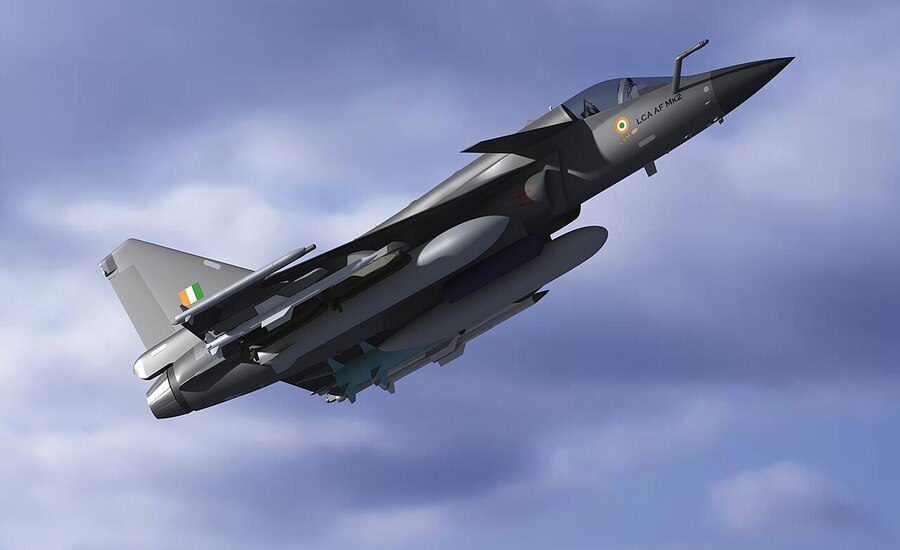
The Tejas Mk2, also known as the Medium Weight Fighter (MWF), is designed as a 4.5-generation combat aircraft. It is being developed jointly by ADA and HAL to meet the future requirements of the Indian Air Force (IAF). The fighter is expected to bridge the gap between the current Tejas variants and the future Advanced Medium Combat Aircraft (AMCA).
Read also: How HAL Is Quietly Building the Future of India’s Air Power Through Tejas Mk2 Fighter Jet
HAL Chairman and Managing Director Ravi Kumar recently confirmed that structural assembly of the first prototype is progressing according to schedule. The company currently expects the aircraft’s first flight to take place between March and July 2027.
Tejas Mk2 Roadmap: Four-Prototype Strategy To Reduce Development Risks
Instead of rushing multiple aircraft at the same time, HAL plans to follow a phased approach. The company intends to build four prototypes over several years, allowing engineers to analyze data from each stage before moving to the next phase. The first prototype is expected to fly in 2027.
The second prototype is planned for late 2027 or early 2028, while the third and fourth prototypes are expected in 2029 and 2030 respectively.
Tejas Mk2 Roadmap: Separate Roles For Each Prototype
The first two prototypes will mainly focus on flight performance and developmental testing. These tests will verify aerodynamic stability, flight safety, avionics performance, and flight envelope expansion before moving to combat-related evaluations. The third and fourth prototypes will focus on weapons integration and live-fire testing.
This phased approach is designed to ensure that the aircraft’s core systems are fully validated before advanced weapons trials begin.
Tejas Mk2 Roadmap: Weapons Trials Expected To Begin In 2030
One of the most important milestones in the Tejas Mk2 program is weapons testing. According to the roadmap, live weapons trials are expected to begin only after the third prototype becomes available around 2030. The fighter is expected to carry a payload of around 6,500 kilograms across 11 hardpoints. It will be capable of deploying air-to-air missiles, precision-guided bombs, anti-radiation missiles, and other advanced weapon systems.
Major Upgrades Over Existing Tejas Variants
The Tejas Mk2 will be powered by the GE F414-INS6 engine. This engine produces significantly more thrust than the powerplant used in the current Tejas Mk1A, allowing greater payload capacity and improved combat performance.
Advanced Sensors And Avionics
The aircraft is expected to feature the indigenous Uttam AESA radar, advanced electronic warfare systems, and modern mission computers. These technologies are intended to improve target detection, survivability, and network-centric warfare capabilities.
Improved Design
The Tejas Mk2 uses a canard-delta wing configuration that improves maneuverability and lift. It is larger than earlier Tejas variants and is designed to carry more fuel and weapons for extended combat missions.
Why The Program Faced Delays
The Tejas Mk2 project has experienced multiple schedule revisions over the years. Previous targets for first flight were set earlier, but timelines changed as the program focused on increasing indigenous content and validating critical technologies before flight testing.
Officials have stated that the goal is to prioritize technical maturity and reliability rather than meeting symbolic deadlines. This includes extensive testing of indigenous systems such as radar, flight control software, and composite structures.
Tejas Mk2 Roadmap: Production Clearance Targeted For 2031
If the current roadmap remains on track, the Tejas Mk2 could receive production clearance by 2031. This would create a development cycle of roughly four years between the first flight and production approval, significantly faster than the Tejas Mk1 program.
After certification, HAL’s production facilities in Bengaluru and Nashik are expected to support large-scale manufacturing for the Indian Air Force.
Strategic Importance For The Indian Air Force
The Tejas Mk2 is expected to replace aging fleets such as the Jaguar, Mirage 2000, and MiG-29 in the coming years. The aircraft will play a crucial role in maintaining squadron strength while reducing dependence on imported fighter jets.
It will also serve as a technology bridge for India’s future AMCA stealth fighter program. Many technologies being developed for the Tejas Mk2 are expected to support future indigenous combat aircraft projects.
Read also: Meet Divyastra MK2: The Indian Drone That Can Hunt Targets 2,000 KM Away Without Warning
FAQs
HAL currently expects the Tejas Mk2 maiden flight to take place between March and July 2027.
Weapons testing is expected to begin around 2030 after the third prototype becomes available.
The Tejas Mk2 is expected to gradually replace aging Jaguar, Mirage 2000, and MiG-29 fighter aircraft in the Indian Air Force.