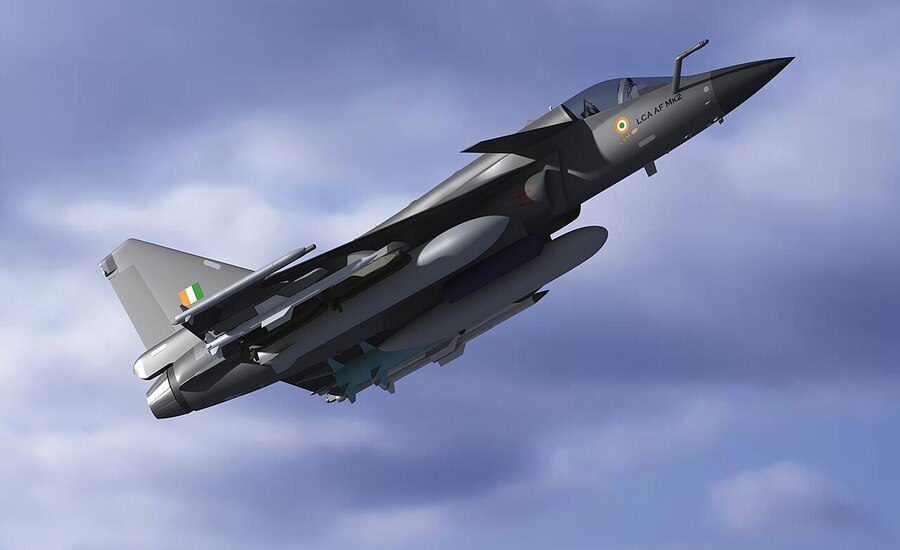
New Delhi: Tejas Mk2 fighter jet indigenous technologies have received a major boost as Hindustan Aeronautics Limited (HAL) develops several critical home-grown systems for India’s next-generation Light Combat Aircraft (LCA) Mk2. According to HAL’s latest annual report and official programme updates, the company has successfully developed indigenous optical fuel sensing technology, an advanced RS422 data acquisition system, and multiple avionics solutions.
These developments are expected to reduce dependence on foreign suppliers, improve operational readiness, and strengthen India’s defence self-reliance goals under the Atmanirbhar Bharat initiative.
HAL Advances Indigenous Technology For Tejas Mk2 Fighter Jet
HAL has developed a range of indigenous onboard technologies for the Tejas Mk2 fighter aircraft. The new systems are designed to improve mission effectiveness, aircraft reliability, maintenance efficiency, and long-term operational readiness.
Read also: Tejas Mk2 Features Explained: How It Surpasses Mk1A in Range, Weapons, and Combat Endurance
The Tejas Mk2 is being jointly developed by HAL and the Aeronautical Development Agency (ADA) under the Defence Research and Development Organisation (DRDO).
Indigenous Optical Fuel Sensing System Enhances Accuracy
One of the most significant achievements is the development of an indigenous optical fuel-level sensing system. The new technology replaces older capacitance-based fuel measurement methods, which could be affected by vibration, temperature changes, and electromagnetic interference during flight. The optical system uses light-based sensors to calculate fuel quantity with greater precision.
This allows pilots and mission computers to receive accurate real-time fuel data, helping improve mission planning, range calculations, and operational decision-making.
Tejas Mk2 Fighter Jet Programme: HAL Gains Greater Strategic Independence
Because HAL has developed the optical sensing system entirely in-house, the company retains full control over design, software updates, maintenance, and future upgrades.
Defence experts believe this reduces dependence on foreign vendors and lowers supply chain risks during critical military operations.
The move also aligns with India’s broader objective of building indigenous defence manufacturing capabilities.
Advanced RS422 Data Acquisition System Developed
HAL has also developed an advanced RS422-based data acquisition system for the Tejas Mk2. The system continuously collects operational data from various aircraft components and transfers it to a central monitoring platform.
RS422 is a widely used aerospace communication standard known for reliable data transfer and resistance to signal interference.
Tejas Mk2 Fighter Jet: Predictive Maintenance Capability Added
The new monitoring system acts as an early-warning mechanism for maintenance teams. It can identify potential component failures before they become serious problems.
This predictive maintenance capability can reduce aircraft downtime, improve fleet availability, and lower maintenance costs throughout the aircraft’s service life.
For the Indian Air Force, higher availability means more aircraft ready for operational deployment at short notice.
New Indigenous Avionics Strengthen Tejas Mk2 Fighter Jet
HAL is also developing several other indigenous avionics and mission systems. These include:
- Integrated environmental control systems
- Indigenous radio altimeter
- Advanced onboard computing architecture
- Flight management and mission computers
- Health monitoring systems
These technologies are expected to improve aircraft performance, pilot situational awareness, and mission effectiveness.
Integration With Indigenous AESA Radar And Electronic Warfare Systems
According to programme updates, the Tejas Mk2 is expected to feature India’s indigenous Uttam Active Electronically Scanned Array (AESA) radar. The aircraft will also be equipped with a Unified Electronic Warfare Suite and advanced infrared search and track capabilities.
Together, these systems will significantly enhance detection, targeting, survivability, and combat performance.
Expert Analysis: Why These Indigenous Systems Matter
Defence analysts view these developments as more important than individual technology upgrades.
The real significance lies in creating a domestic ecosystem capable of designing, producing, upgrading, and supporting advanced combat aircraft systems without external dependence.
Every indigenous subsystem reduces foreign procurement requirements and strengthens India’s technological sovereignty. It also provides greater flexibility for future upgrades and export opportunities.
Tejas Mk2 And India’s Future Air Power
The Tejas Mk2 is expected to bridge the capability gap between the current Tejas Mk1A fleet and the future Advanced Medium Combat Aircraft (AMCA).
The fighter is designed to replace aging aircraft such as the Mirage 2000, Jaguar, and MiG-29 fleets over the coming decades. With increasing indigenous content, the Tejas Mk2 programme is becoming a key pillar of India’s long-term air power strategy.
Read also: Tejas Mk2 Upgrade: New Avionics System to Enable Faster Weapon Integration & AI Combat