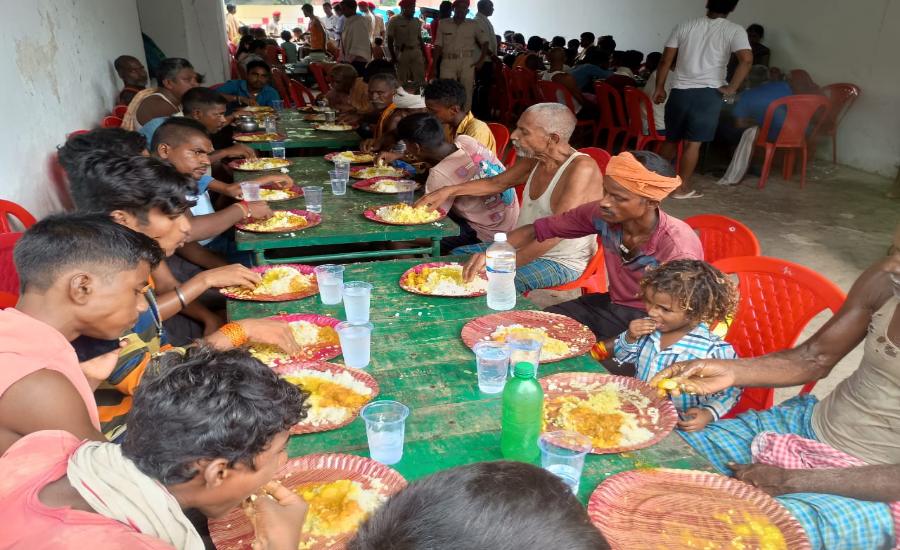
Patna: The Bihar government has significantly scaled up flood relief operations across 12 affected districts, with 190 community kitchens now providing food to around 2.51 lakh people. The Disaster Management Department has also increased the deployment of boats, medical camps and rescue teams as river levels remain above the danger mark at several locations.
22.42 Lakh People Affected Across 12 Districts
According to the Disaster Management Department, around 22.42 lakh people have been affected by floods across 70 blocks and 368 gram panchayats in 12 districts — Patna, Bhojpur, Saran, Vaishali, Bhagalpur, Begusarai, Buxar, Samastipur, Munger, Katihar, Lakhisarai and Arwal.
The government is expanding relief and rescue operations as the flood situation continues to put pressure on several areas. Ensuring food, shelter, healthcare and safe transportation remains the immediate priority.
The scale-up has been particularly rapid in the past 24 hours. The number of community kitchens increased from 80 on September 5 to 190 on September 6.
These kitchens are currently supplying meals to approximately 2.51 lakh flood-affected people, helping ensure that families displaced or cut off by rising water continue to receive food.
Read Also: Bihar to Get High-Tech Indoor Stadium at Patliputra Sports Complex by March 2027
Relief Camps Provide Shelter and Basic Services
Alongside community kitchens, three relief camps are currently operational. These camps are providing accommodation, food, medical care and other essential facilities to 1,631 flood-affected people.
The state has also stepped up the distribution of emergency relief materials.
So far, affected families have received:
- Around 65,700 polythene sheets
- 12,712 dry ration packets
- 1,429 boats for transportation and relief operations
The distribution of polythene sheets increased sharply from 46,000 on September 5 to 65,700 on September 6. Dry ration distribution also rose from 11,700 to 12,712 packets during the same period.
These supplies are aimed at helping families protect themselves from the weather and meet immediate food requirements in flood-hit areas.
Medical Camps Increased to 171
Healthcare has also emerged as a major focus of the Bihar flood response. The number of medical camps providing primary healthcare has been increased from 118 to 171.
The expansion is particularly important in areas where floodwaters can make access to regular health facilities difficult. Medical teams are being deployed to provide basic treatment and support to affected residents.
For people whose movement has been disrupted by floodwaters, 1,429 boats are currently being operated across affected areas. The boats are helping with transportation as well as relief and rescue activities.
37 NDRF and SDRF Teams Deployed
Bihar has also strengthened its emergency response capacity through the deployment of National Disaster Response Force (NDRF) and State Disaster Response Force (SDRF) teams.
A total of 10 NDRF teams and 27 SDRF teams have been deployed in different districts. These teams are carrying out rescue operations and assisting people in areas affected by rising water levels.
The deployment is part of the state’s effort to ensure that rescue operations can be expanded quickly if the situation worsens.
Major Rivers Flow Above Danger Mark
The flood response comes amid elevated water levels in several major rivers.
According to the Central Water Commission, the Gandak, Kosi, Burhi Gandak, Ganga, Punpun, Bagmati and Ghaghra rivers are flowing above the danger mark at various locations.
However, the discharge trend at the Gandak Barrage in Valmikinagar and the Son Barrage in Indrapuri is currently stable, offering some relief amid the continuing flood situation.
The government is keeping a close watch on river levels and water discharge to assess the risk to downstream areas.
More Rain Forecast Over the Next Two Days
The Bihar Meteorological Service Centre has forecast light to moderate rainfall at many places across the state over the next two days, with heavy rainfall possible at some locations.
The additional rainfall could affect water levels in already vulnerable areas, making continued monitoring and quick response important.
The Disaster Management Department is maintaining round-the-clock surveillance of the flood situation. Authorities are monitoring river levels, rainfall, relief requirements and rescue operations so that resources can be moved to areas where they are most urgently needed.
Relief Operations Focus on Reaching Every Affected Family
The rapid increase in community kitchens, medical camps, boats and relief material distribution shows the scale of the state’s response as the flood situation develops.
With more than 22 lakh people affected across 12 districts, the challenge is not limited to rescue alone. Ensuring food, healthcare, shelter and basic supplies reach people in remote and waterlogged areas is equally critical.
The continued deployment of NDRF and SDRF teams, along with round-the-clock monitoring, is aimed at keeping relief operations responsive to changing conditions.
For thousands of families affected by flooding, these measures provide essential support at a time when normal movement and access to services have been disrupted. The government’s immediate focus remains on preventing shortages, strengthening rescue efforts and ensuring that no flood-affected person is left without basic assistance.
Read Also: Bihar Orders Action After 700 Bags of Urea Go Missing from Sealed Warehouse