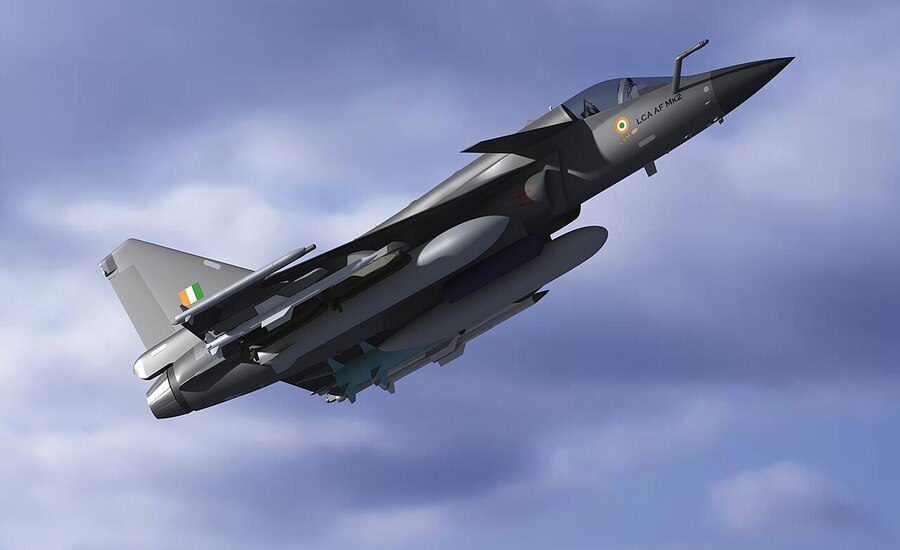
New Delhi: The Tejas Mk2 open architecture avionics system is expected to become one of the biggest technological upgrades in India’s indigenous fighter jet program.
The new avionics design will allow faster integration of next-generation weapons, advanced sensors, and AI-supported combat systems without major software rewrites. The system is being developed to improve flexibility, survivability, and long-term upgrade capability for the Indian Air Force’s future medium-weight fighter platform.
Details of Tejas Mk2 Open Architecture Avionics
The upcoming HAL Tejas Mk2 will use a modern Open Architecture Avionics (OAA) framework.
This architecture is based on a modular approach where hardware and software systems can be upgraded independently. It will help India avoid dependence on foreign “black box” systems and support easier future modernization.
Key improvements include:
- Faster weapon integration
- Easier software upgrades
- Better sensor fusion
- Improved electronic warfare response
- Higher survivability in combat
- Reduced maintenance and certification delays
What is Three-Tiered Computing Hierarchy
The Tejas Mk2 will reportedly use a three-layer computing structure for separating flight operations from combat systems.
1. Digital Flight Control Computer (DFCC)
This system will manage:
- Aircraft stability
- Flight control
- Aerodynamic handling
The DFCC remains isolated from mission software changes. This means adding new weapons or sensors will not require repeated safety certification for flight systems.
2. Mission Management and Display Computer (MMDC)
The MMDC acts as the aircraft’s tactical brain.
It handles:
- Navigation
- Pilot displays
- Targeting systems
- Mission planning
- Weapon deployment
This separation allows rapid updates to mission software without affecting flight-critical functions.
3. Auxiliary Mission Computer (AMC)
The third layer is an advanced backup computer system.
Its role includes:
- Real-time redundancy
- Backup during electronic warfare attacks
- Taking over damaged systems instantly
The AMC improves survivability during contested combat situations.
Tejas Mk2 Open Architecture Avionics: Plug-and-Play Weapon Integration
One of the most important upgrades is the Universal Armament Interface (UAI).
This system allows new weapons to work like “plug-and-play” applications.
Older aircraft often require large software modifications when integrating new missiles. The Tejas Mk2 architecture aims to eliminate that problem.
Weapons expected to benefit include:
- Astra Missile
- Rudram Missile
- Future indigenous smart weapons
- Advanced stand-off munitions
This will significantly reduce testing timelines and operational downtime.
Tejas Mk2 Open Architecture Avionics: High-Speed Data Networks and Sensor Fusion
The Tejas Mk2 is also expected to shift from older MIL-STD-1553B data buses to modern high-speed fibre-optic networks similar to Gigabit Ethernet systems.
This allows:
- Faster data sharing
- Real-time sensor communication
- Better combat awareness
The aircraft will combine data from multiple systems, including:
- Uttam AESA Radar
- Infrared Search and Track (IRST)
- Unified Electronic Warfare Suite (UEWS)
Instead of showing separate information streams, the avionics system will generate a single tactical picture for the pilot.
Graceful Degradation Capability
A major feature of the new avionics design is “graceful degradation.”
If enemy jamming affects one sensor, the system can automatically shift dependence to other sensors without losing combat awareness.
For example:
- If radar gets jammed
- IRST and EW systems continue tracking targets
- Pilot still receives tactical data
This improves survivability in electronic warfare environments.
Important Step for AMCA Development
Experts believe the Tejas Mk2 avionics framework could become a testing platform for India’s future fifth-generation fighter programs.
Technologies validated on the Tejas Mk2 may later support:
- HAL AMCA
- HAL TEDBF
The modular design may reduce future development risk and speed up indigenous fighter aircraft programs.
Tejas Mk2 Development Status
The aircraft remains under prototype development by:
- Aeronautical Development Agency
- Hindustan Aeronautics Limited
Reports suggest prototype rollout activities are progressing, while the aircraft is expected to feature:
- Larger airframe
- Canards
- Increased payload
- More fuel capacity
- Advanced cockpit systems
- GE F414 engine integration
The fighter is intended to replace aging Indian Air Force fleets including Jaguars, Mirage 2000s, and MiG-29 aircraft over time.
What is the Importance of Tejas Mk2 Open Architecture Avionics
The Tejas Mk2’s open architecture design represents a major shift toward software-defined combat aviation.
Benefits include:
- Faster upgrades
- Indigenous control over systems
- Lower lifecycle costs
- Better compatibility with future weapons
- Improved AI-assisted combat operations
If successfully implemented, the aircraft could become one of the most adaptable fighter platforms developed in India.
Read also: From AMCA to 6th Gen Fighters: How India Plans to Dominate Future Air Combat with a Dual Strategy