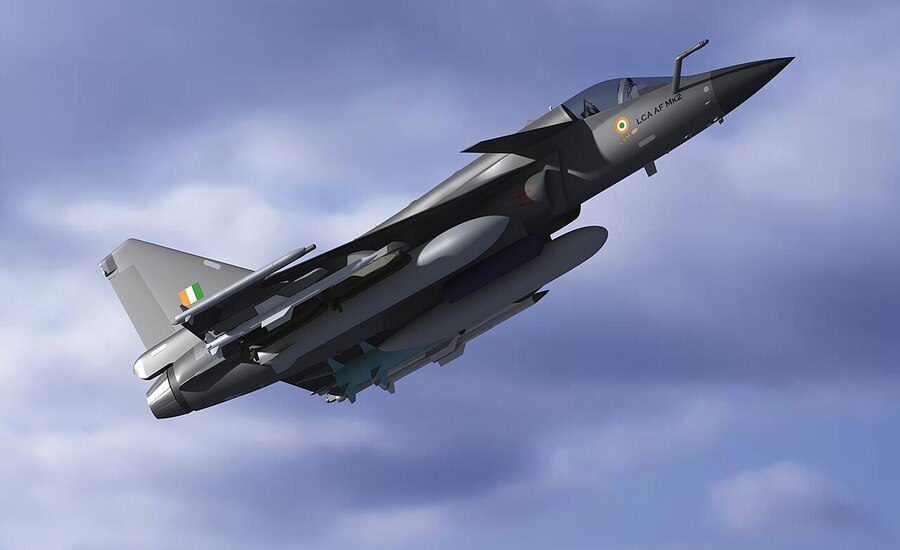
New Delhi: The Tejas Mk2 vs Tejas Mk1A comparison highlights a major leap in India’s air combat capability. The upcoming Tejas Mk2 is being designed as a more powerful, longer-range fighter with higher payload and advanced systems.
With reports of 8 BVR missiles capacity and up to 120-minute combat endurance, the aircraft is expected to significantly enhance the Indian Air Force’s strike power compared to the already advanced Tejas Mk1A.
Official data from HAL and defence reports show that Mk2 is not just an upgrade—it is a completely new medium-weight fighter built for future warfare.
What is Tejas Mk1A?
The HAL Tejas Mk1A is an upgraded version of India’s indigenous light combat aircraft already being inducted into the Indian Air Force.
- Light-weight multirole fighter
- AESA radar and advanced electronic warfare suite
- Around 3.5-ton weapon capacity
- Designed for air defence, strike, and reconnaissance missions
It plays a crucial role in replacing older aircraft and strengthening India’s current fleet.
What is Tejas Mk2?
The HAL Tejas Mk2 is a next-generation medium-weight fighter currently under development.
- More powerful engine (GE F414)
- Larger airframe with canards for better maneuverability
- Advanced avionics and sensor fusion
- Designed to replace Mirage-2000, Jaguar, and MiG-29 fleets
This aircraft is expected to enter service later this decade and form the backbone of future IAF operations.
Key Differences: Tejas Mk2 vs Tejas Mk1A
1. Engine & Power
- Mk1A: GE F404 engine (~84 kN thrust)
- Mk2: GE F414 engine (~98 kN thrust)
Mk2 offers higher speed, better climb rate, and heavier payload capability.
2. Payload & Firepower
- Mk1A: ~3.5 tons payload, 7 hardpoints
- Mk2: ~6.5 tons payload, 11 hardpoints
This allows Mk2 to carry more missiles, bombs, and advanced weapons simultaneously.
3. BVR Missile Capability (Game Changer)
- Mk1A: Limited BVR missile load
- Mk2: Up to 8 Beyond Visual Range (BVR) missiles (expected)
This significantly increases first-strike capability in air combat, allowing engagement from long distances.
4. Combat Range & Endurance
- Mk1A: ~500 km combat radius
- Mk2: ~1000 km combat radius
Mk2 is expected to offer up to 120 minutes combat endurance, nearly doubling mission time.
5. Size & Role
- Mk1A: Light fighter (~13.5 tons MTOW)
- Mk2: Medium-weight fighter (~17.5 tons MTOW)
Mk2 bridges the gap between light fighters and heavy jets like Sukhoi-30MKI.
6. Avionics & Technology
- Mk1A: Advanced AESA radar, modern cockpit
- Mk2:
- Wide-area touchscreen display
- Integrated sensor fusion
- Advanced electronic warfare suite
Mk2 offers network-centric warfare capability and faster decision-making.
How Tejas Mk2 Can Double IAF Firepower
The combination of features makes Mk2 a major force multiplier:
- 2x payload capacity → More weapons per sortie
- Longer endurance → Fewer aircraft needed per mission
- More BVR missiles → Better air dominance
- Higher range → Deeper strike capability
In simple terms: One Tejas Mk2 can perform missions that may require multiple Mk1A sorties, effectively doubling operational firepower.
What is the Importance of Tejas Mk2
- Reduces dependence on foreign fighter jets
- Strengthens “Make in India” defence ecosystem
- Helps maintain air superiority in a two-front scenario
- Supports replacement of ageing aircraft fleets
The IAF is expected to induct over 100 Tejas Mk2 aircraft, making it a key pillar of future air combat strategy.
Read also: The Future of Indian Air Power: How Tejas Mk2 and AMCA Are Transforming India’s Long-Range Air Power