New Delhi: India’s fourth Arihant-class nuclear submarine INS Arisudan is expected to complete its sea trials by the end of 2026, marking another major step in strengthening India’s strategic naval capabilities. The submarine is likely to be commissioned around 2027 after successful completion of all trials and validation processes. Reports indicate that INS Arisudan will complete the first generation of India’s indigenous nuclear-powered ballistic missile submarine (SSBN) fleet.
The development highlights India’s growing focus on strengthening its sea-based nuclear deterrence and maintaining a credible second-strike capability under its nuclear doctrine.
What Is INS Arisudan
INS Arisudan is the fourth and final submarine of the Arihant-class SSBN programme. The submarine was launched at the Ship Building Centre in Visakhapatnam in October 2024 and entered sea trials in late 2025. It is expected to join the Indian Navy in 2027 after completing extensive testing.
Read also: India’s Most Powerful Nuclear Submarine: What Is the K-6 SLBM? Timeline, Speed & Range Explained
The vessel is being developed under India’s Advanced Technology Vessel (ATV) programme, one of the country’s most important indigenous defence projects. The submarine reportedly has an indigenous content level of around 75–80 percent.
INS Arisudan Sea Trials Progressing As Planned
According to defence reports, INS Arisudan has been undergoing advanced sea trials since late 2025. These trials are designed to evaluate propulsion systems, navigation equipment, combat systems, missile launch capabilities, stealth features and overall operational performance. Experts expect the testing process to continue through 2026 before final operational clearance is granted.
Why Sea Trials Are Important
Sea trials are the final and most important stage before a submarine enters active service. During this period, engineers and naval personnel verify whether the submarine can safely perform missions under real operating conditions. Any technical issues are identified and corrected before commissioning.
Bigger And More Powerful Than Earlier Arihant-Class Submarines
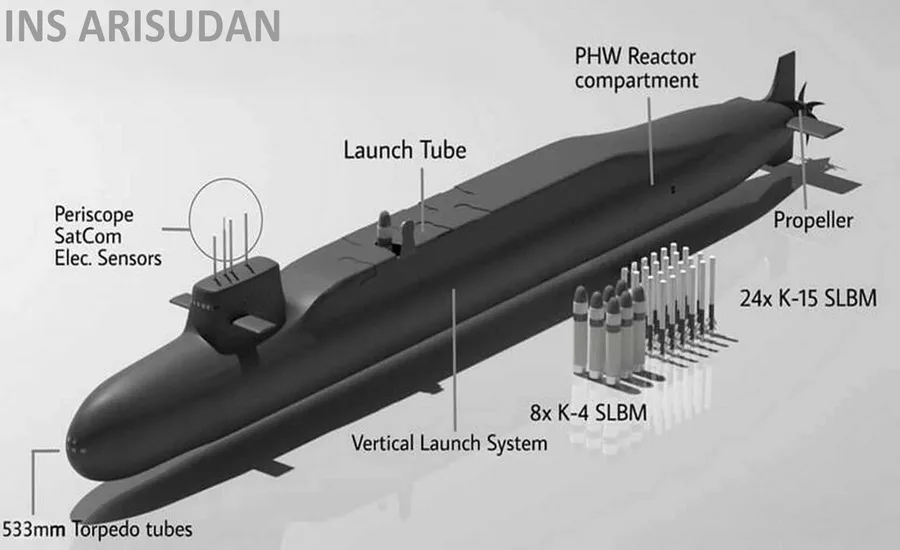
INS Arisudan is considered a stretched version of the Arihant-class design. The submarine reportedly displaces around 7,000 tonnes, making it larger than INS Arihant and INS Arighaat, which displace approximately 6,000 tonnes. The larger size allows the submarine to carry more missiles and remain on patrol for longer durations.
Enhanced Missile Capability
One of the biggest upgrades in INS Arisudan is its expanded vertical launch system. Reports indicate that the submarine could carry up to eight K-4 submarine-launched ballistic missiles with a range of approximately 3,500 kilometres. It may also carry up to 24 K-15 Sagarika missiles depending on mission requirements. This significantly improves India’s sea-based nuclear strike capability.
INS Arisudan: Strengthening India’s Nuclear Triad
India’s nuclear deterrence strategy is based on a nuclear triad consisting of land-based missiles, air-delivered nuclear weapons and submarine-launched nuclear missiles. SSBNs are considered the most survivable element of this triad because they can remain hidden underwater for extended periods.
The induction of INS Arisudan will strengthen India’s ability to maintain a credible second-strike capability.
Completing The First Arihant-Class Fleet
Once commissioned, INS Arisudan will join:
- INS Arihant
- INS Arighaat
- INS Aridhaman
This will complete the first generation of India’s indigenous Arihant-class nuclear-powered ballistic missile submarine fleet. The four submarines together will improve operational flexibility and support rotational deployment of nuclear deterrence patrols.
What is the Importance of INS Arisudan Commissioning
The commissioning of INS Arisudan comes at a time when underwater military capabilities are becoming increasingly important in the Indo-Pacific region. Defence experts believe a stronger SSBN fleet enhances India’s strategic deterrence against potential threats and improves national security preparedness. The submarine programme also showcases India’s progress in indigenous defence manufacturing and advanced naval technology.
What Happens Next?
INS Arisudan is expected to continue sea trials throughout 2026. If testing is completed successfully, the submarine is likely to be commissioned into the Indian Navy in early 2027, completing a significant milestone in India’s nuclear submarine programme.
Read also: Why The Indian Navy Wants A 1,000 Km Range Loitering Munition And Who Could Build
FAQs
Current reports indicate that INS Arisudan is expected to complete sea trials by the end of 2026 before commissioning.
INS Arisudan is India’s fourth Arihant-class nuclear-powered ballistic missile submarine (SSBN) and is expected to join the Indian Navy in 2027 after completing sea trials.
INS Arisudan will strengthen India’s nuclear triad, improve second-strike capability and complete the first generation of India’s indigenous Arihant-class SSBN fleet.