New Delhi: The Indian Navy is reportedly exploring a long-range air-launched torpedo system to strengthen its anti-submarine warfare capabilities in the Indian Ocean Region (IOR). The proposed weapon could be launched from fighter aircraft and unmanned aerial vehicles (UAVs), helping India respond to growing underwater security challenges linked to China’s naval presence.
The concept aims to allow aircraft to attack submarines from a greater distance while staying away from dangerous areas near enemy forces. However, the project has not been officially confirmed as an approved weapon programme.
What Is Indian Navy Long-Range Air-Launched Torpedo System Deal
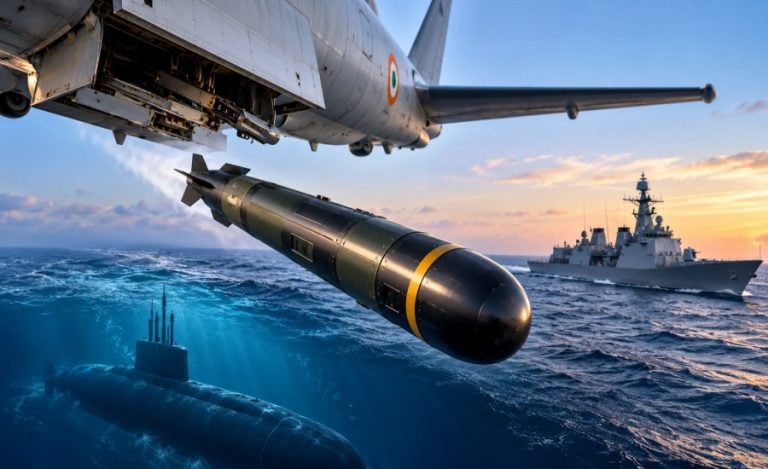
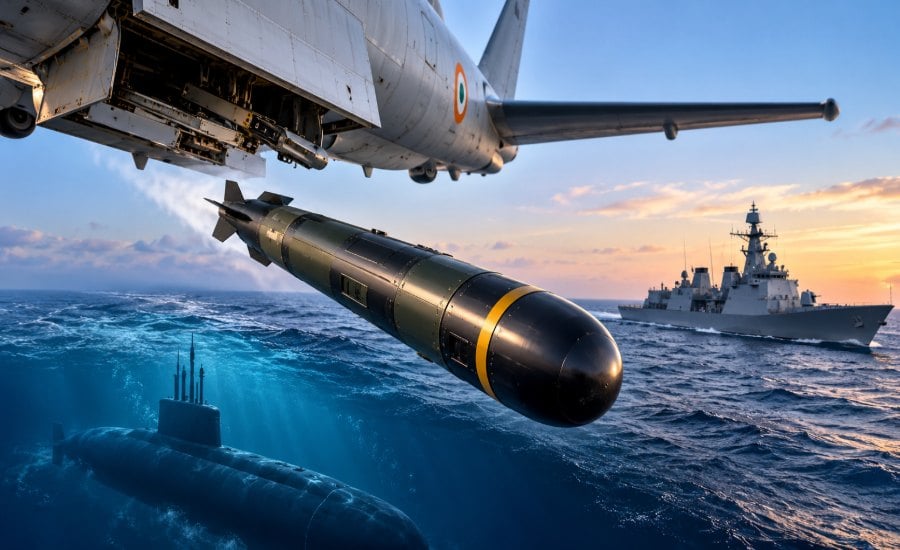
According to the reported concept, the proposed weapon would use a range-extension kit attached to a lightweight torpedo. A propulsion unit would help carry the weapon through the air towards a suspected submarine’s location.
Read also: India Unveils First Submarine-Launched Drones, Heralding A New Era of Naval Warfare
The reported design could have a potential stand-off range of around 150 to 250 kilometres. This range is an estimate from the report, not an officially confirmed performance figure.
After reaching the target area, the flight section would separate, allowing the torpedo to enter the water and search for its target. The system is intended to combine the long reach of an airborne weapon with the underwater attack capability of a torpedo.
Why Does The Indian Navy Need Long-Range Anti-Submarine Weapons
China’s growing naval activity in the Indian Ocean Region has increased the importance of monitoring underwater threats. Submarines can operate without being easily detected and may threaten naval vessels and important sea routes.
The Indian Navy needs effective ways to locate, track and respond to hostile submarines while protecting its own ships and aircraft.
A long-range air-launched torpedo could give commanders another option for responding to underwater threats across a large maritime area.
How Could The New Indian Navy Long-Range Air-Launched Torpedo System Deal Protect Indian Aircraft
Traditional air-dropped torpedoes generally require an aircraft to approach the area where a submarine is suspected to be operating. This can expose the aircraft to enemy air-defence systems, particularly in heavily defended waters.
A stand-off weapon could allow an aircraft to release its torpedo from farther away. This may reduce the aircraft’s exposure to danger and give the Navy greater flexibility during anti-submarine missions.
The proposed system could potentially complement existing maritime patrol aircraft, helicopters and other submarine-hunting platforms. Its actual operational value would depend on its final design and testing.
Could Fighter Jets And UAVs Carry The New Weapon
The reported concept considers the use of both manned aircraft and unmanned aerial vehicles. Fighter aircraft could potentially provide rapid deployment, while suitable UAVs might offer additional surveillance and operational flexibility. However, the aircraft would need to be compatible with the weapon’s size, weight, launch requirements and control systems.
Integration would also require reliable targeting information, communication systems and testing under different operating conditions. No final list of compatible aircraft or UAVs has been officially confirmed for this proposed system.
How Is The Proposed Weapon Different From DRDO’s SMART System
India already has a related anti-submarine weapon programme known as SMART, which stands for Supersonic Missile-Assisted Release of Torpedo.
The Defence Research and Development Organisation (DRDO) developed SMART as a missile-based system designed to deliver a lightweight torpedo over a long distance. It was successfully flight-tested from a ground-based mobile launcher off the Odisha coast on May 1, 2024.
The key difference is the launch method. SMART is a ground-launched, canister-based system, while the newly reported concept would be launched from an aircraft.
Both concepts aim to extend the distance from which a torpedo can be delivered, but they are different systems. There is no official confirmation that the proposed air-launched weapon is a variant of SMART.
Read also: What Is DRDO’s SMART Anti-Submarine Weapon? Final Trials and 2031 Navy Induction Explained
FAQs
The report estimates a potential stand-off range of 150 to 250 kilometres. However, this figure has not been officially confirmed by the Indian Navy.
It is a reported concept for a long-range torpedo that could be launched from aircraft or UAVs. A range-extension system would carry the weapon towards a target area before the torpedo enters the water.
DRDO’s SMART is a ground-launched missile system designed to deliver a lightweight torpedo over a long distance. The newly reported concept would use an aircraft as its launch platform and remains unconfirmed as an approved programme.